
|
Review: Soviet Families' Inner Lives-2

 |
Soviet Families' Inner Lives
Alexander Freund, University of Winnipeg
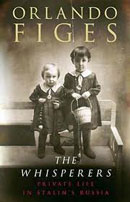
Orlando Figes. The Whisperers. Private Life in Stalin's Russia. [New York:]
Penguin, 2008 [2007]. ISBN 978-0-141-01351-0.
Review: Soviet Families' Inner Lives-1
In order to protect their children, imprisoned parents told their children to renounce them. Liza (last name not known) was imprisoned in 1937. One day, she received a letter from her fifteen-year-old daughter, Zoia, who asked her mother “whether you are guilty or not.” In case she was not guilty, Zoia would not join the Komsomol. “But if you are guilty, then I won’t write to you anymore, because I love our Soviet government and I hate its enemies and I will hate you if you are one of them. Mama, tell me the truth.” Liza ended her four-page letter to her daughter with the words, in capital letters: “ZOIA, YOU ARE RIGHT. I AM GUILTY. JOIN THE KOMSOMOL. THIS IS THE LAST TIME I AM GOING TO WRITE TO YOU. BE HAPPY, YOU AND LIALIA. MOTHER.” According to a report from Olga Adamova-Sliuzberg, Liza’s friend in prison, “Liza showed the correspondence to Olga, and then banged her head on the table. Choking on tears, she said: ‘It is better she hates me. How would she live without the Komsomol - an alien? She would hate the Soviet power. It is better she hates me.’ From that day, recalls Olga, Liza ‘never said a word about her daughters and did not receive any more letters.’” (302–3).
Those who were not imprisoned but saw friends and relatives vanishing believed that they must have been “enemies of the people.” Or they simply looked away. “People dealt with their doubts [about the Party] by suppressing them, or by finding ways to rationalize them so as to preserve the basic structures of their Communist belief. They did not do this consciously and generally only became aware of their behaviour years later” (277). “The Great Terror,” Figes concludes, “undermined the trust that held together families” (300).
Most often, Figes situates individual experiences in larger contexts. He is also not afraid to draw bold conclusions. But sometimes he tends to let the evidence ‘speak for itself,’ and then one wants Figes to step out from the role of the chronicler and into that of the historian. Reading the memoir entries of a young mother imprisoned in a labour camp describing how she witnessed the slow killing of her own infant daughter and that of countless other infants (362-5), I want to know something about the nurses who committed these crimes and the conditions of camp life that made them perpetrate such acts of brutality. Instead, this episode is followed by less brutal and eventually ‘happier’ stories.
The ‘Great Patriotic War’ that killed some 26 million and left many more invalid, homeless and starving, came - and this is somewhat counter-intuitive – as a respite from Stalin’s terror and a resurgence of old values. Exasperated by the chaos and bureaucracy’s incompetence in the early war years, people’s whispers about the state became increasingly louder. Figes shows not only soldiers’ battlefront experiences, but also the experiences of families broken up by the war through relocation, evacuation, and deportation as well as the hardships experienced in Gulags and the “labour army” of forced labourers (many of them ethnic minorities rounded up and put to work under prison-like conditions (423-31)). These experiences of discrimination, Figes argues, should lay to rest the “Soviet myth of wartime national unity” (419). National unity was also not a motivation for soldiers to fight fiercely. Next to coercion, patriotism, and hatred of the enemy, “perhaps the most important element in the soldiers’ determination to fight was the cult of sacrifice. The Soviet people went to war with the psychology of the 1930s. Having lived in a state of constant revolutionary struggle, where they were always being called upon to sacrifice themselves for the greater cause, they were ready for war” (415-16).
Towards the end of the war, the Soviet grip on society relaxed and people felt a sense of freedom they had not felt in a very long time. For the young generation that had never known anything but Stalinism, hearing other people openly criticize the regime without fear of denunciation or imprisonment was eyeopening. Soviet citizens would later remember the war years nostalgically as the best years in their lives. One wonders whether Figes, although remarking on this nostalgia several times, falls prey to it himself when he argues that “the new freedom of expression” (437) resulted in “a new political community” (439) and “a renewed civic spirit and sense of nationhood” at the heart of which lay “a fundamental change of values” (440). Whether the change was as dramatic as he claims or not, a sobering-up and disillusionment took hold soon after the war as families tried, often in vain, to reunite, and as Soviet citizens realized that their hopes for more democracy would not be fulfilled. The postwar poverty led to countless strikes and protests (458). Stalin clamped down immediately and expanded the Gulag system, turning it into an integral part of the economy.
After the war, the communist zeal of the 1920s and 1930s vanished from Soviet society. A new professional middle-class developed that simply played the part. “Through these ordinary Stalinists, the millions of technocrats and petty functionaries who did its bidding, the regime was routinized, its practices bureaucratized” (472). Nevertheless, to make a career in the 1950s people still had to hide their “spoilt biographies.” i.e. the fact that their parents had been kulaks or arrested as “enemies of the people”. By the end of the 1940s, Soviet society had turned to whispering once again. In addition, a large-scale anti-Semitic campaign was launched against tens of thousands of Soviet Jews.
When Stalin died in 1953, Soviet citizens reacted with a mixture of deep sadness, disorientation, and fear of the unknown that lay before them. The Gulag inmates cheered and, when their hopes of being released were dashed, demonstrated in the tens of thousands. Many were released, about one million. Families were reunited and slowly healed the wounds of separation, mistrust, and betrayal. “The family emerged from the years of terror as the one stable institution in a society where virtually all the traditional mainstays of human existence – the neighbourhood community, the village and the church - had been weakened or destroyed. For many people the family represented the only relationships they could trust, the only place they felt a sense of belonging, and they went to extraordinary lengths to reunited with relatives” (541-2). In light of the painful experiences Figes presents, this assertion seems overly optimistic.
Reunifications were often painful. People had become estranged, after years and decades of separation. Those who had survived the camps were broken, both mentally and physically. The camp returnees did not talk about their experiences: silence replaced whispering. There was seldom a happy end to family reunification and if there was, it involved great struggle. Instead, returnees established networks of friends who had been at the same camps. Many returnees had to do this, because they had no family left or the state prevented them from moving to the cities where relatives lived. For most, reintegration was difficult because housing was scarce and employers and other members of society stigmatized and discriminated against former Gulag inmates.
Stalin’s reign ended not with his death but only three years later when Khrushchev denounced Stalin. Only the urban intelligentsia, however, used the “Khrushchev thaw” to openly discuss the regime. “[F]or the mass of the Soviet population,” Figes writes, “who remained confused and ignorant about the forces that had shaped their lives, stoicism and silence were more common ways of dealing with the past” (599). Many children and grandchildren therefore did not find out the truth about their parents’ and grandparents’ imprisonment or deaths until the 1980s and 1990s, when people finally began to talk more openly. Some people found out only when interviewed for this book (604).
The Stalinized whisperer-consciousness was transferred to the next generations and it lives on in today’s Russia. Many Gulag inmates whom Figes interviewed never told their children, but through their silences, gestures, and in other ways transmitted their traumatic memories. Perpetrators, on the other hand, from Party officials to camp guards, expressed no remorse in the interviews. Even two decades after the end of the Soviet Union, Russian society has not found constructive ways of dealing with its Stalinist past - under Putin, this is unlikely to change.
The Whisperers is a massive book with an at times overwhelming amount of detail. This is necessary, because it is a story about hundreds of millions of people during a time span of half a century. The countless psychological wounds Stalinism inflicted on individuals are recounted in testimony after testimony. They add up, by their sheer number, to the failure of a social experiment on a monumental scale. But it is also the individual stories that are at times overwhelming. Figes writes with sympathy for the victims of Stalinism and with empathy for the perpetrators. He accomplishes this mostly by blurring the boundaries between these two categories and, at times, by not employing them at all. He describes what people did, and did to each other, and then lets them explain their own and each others’ motives.
This is a narrative and documentary history, traditional in its approach, an approach that is not interested in viewing sources in any complicated way. This is perfectly legitimate, but the author’s disinterest in the nature of the sources is at times frustrating when the reader is given no clue whether a quote is from a diary, a letter, or an interview. [3] In his last chapter, Figes eventually discusses the nature of his sources. He shows how people’s memories of the Gulag were profoundly shaped by popular published memoirs, how traumatic experiences fragmented memories, and how memory intermingled with myth to create stories people had not lived through but could live with now. Both in his introduction and his concluding thoughts on memory, Figes clearly deems oral history more reliable than Soviet-era diaries, letters, and memoirs, because it allows for crossexamination (xxxv, 636). It would be desirable if this complication of sources could have been integrated into the narrative as a whole rather than added simply at its end, but this would be an unreasonable demand. The story is overwhelmingly complex as it is told, and this would have added yet another layer of meaning.
The Whisperers is a sad story. Below the brutality, idiocy, stupidity, cruelty, opportunism, fanaticism, opportunism, optimism, delusion and even below the deepest depths of despair recounted in the hundreds of individual stories is a sadness, a sadness for a loss so immense that it is hardly comprehensible. There is also a sense of wonder that people could ever persevere and survive to tell their stories. The children’s stories are the saddest of all and yet they also offer the greatest hope, because many of the children - those who were not killed or traumatized - found ways to cope with the unbearable conditions and even to see light in the darkest shadows of Stalin’s empire. But it is the many wounds and scars that are made visible through the testimonies.
This book, then, is not just a book. As a project that includes also a website and several archives, it is a model history. More than that, however, it is - reminiscent both of Alessandro Portelli’s naming of names in The Order Has Been Carried Out and the plates of names of the Vietnam Veterans Memorial in Washington, D.C. - a memorial that puts names, faces, and stories to Stalin’s countless victims. It helps us understand and remember.
3 The very first footnote of the book is “MSP, f. 3, op. 14, d. 2, l. 31; d.3, ll. 18–19.” I have no doubt that if I visited the Archive of the Memorial Society St. Petersburg (MSP), I would find exactly the source this note refers to. But as a reader, I want to know what kind of a source this is - an interview, a diary, a letter? - and who created it when and where. In this case, even a search of the online archives did not get me anywhere.
Source:
Alexander Freund, “Soviet Families’ Inner Lives. Review of The Whisperers. Private Life in Stalin’s Russia by Figes.” Oral History Forum d’histoire orale 29 (2009), pp. 1-8.
|


