Soviet Families' Inner Lives
Alexander Freund, University of Winnipeg
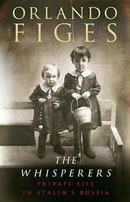
Orlando Figes. The Whisperers. Private Life in Stalin's Russia. [New York:]
Penguin, 2008 [2007]. ISBN 978-0-141-01351-0.
How did Stalin’s terror shape “the inner world of ordinary Soviet citizens” (xxix)? To answer this question, the British historian Orlando Figes organized a team of researchers who interviewed Russians about life since the Revolution. They also collected their personal documents and created several archives and a website (http://www.orlandofiges.com), which serve as extensions of Figes’s book. The “moral sphere of the family” (xxx) is the focus of Figes’s 700-page-narrative. In this sweeping exploration, he masterfully handles a massive number of sources as he constructs a complex history of myriad psychic, emotional, intellectual, social, and cultural changes over the course of nearly a century. The thrust of this compelling and often tragic story of families’ everyday lives in Stalinist Russia derives from hundreds of testimonies that have survived through letters, photographs, diaries, memoirs, oral histories, and many other personal or socalled ego-documents. The result is a history of Soviet society’s mentalité in the longue durée.
Figes’s story moves chronologically from 1917 to 2006 and focuses on the years under Stalin from ca. 1928 to his death in 1953 and the first three years of its aftermath until Khrushchev’s ‘secret speech’ (1956). After the October Revolution, Lenin’s Bolsheviks raised a generation of children, Figes calls them the “Children of 1917,” in a spirit of communism that replaced the family with the party in order to create a “collective personality” (4). They strove to build a society free of family, which was dismissed as a bourgeois institution of oppression. Gradually, the private sphere was dismantled, be it through collective forms of living and a “system of mutual surveillance and denunciation” (35) or through self-discipline. While some people overcame their traditional peasant or bourgeois forms of living and thinking, others lived double lives, outwardly conforming to Party demands while secretly holding on to their old values and beliefs. Although not new to Russian life, whispering entered society as a form of communication - to survive or to betray. A shepchushchii “whispers out of fear of being overheard,” a sheptun “whispers behind people’s backs to the authorities” (xxxii). During Stalin’s reign, “the whole of Soviet society was made up of whisperers of one sort or another” (xxxii) and frequently a whisperer was both a shepchushchii and a sheptun.
The years 1928-1930 saw the massive collectivization of the peasantry. It was “the great break” or “the great turning point in Soviet history [because it] destroyed a way of life that had developed over many centuries” (81). In story after story, Figes documents how envy and greed led village drunks and teenage boys to join the Komsomol (the Communist Party’s youth organization) and denounce the “rich” peasants of the village - whose sole possession might have been a bed - as “kulaks.” Kulaks were then deported to labour camps or fled to other towns or into the cities. Private documents show both kulaks’ experiences and their denouncers’ motivations. This balanced view - analyzing events from the perspectives of all people involved and yet maintaining a clear sympathy for the victims of Soviet Communism - is characteristic of the whole book and one of its many strengths.
Many kulak children, like the children from bourgeois and noble families, concealed their social origins, their “spoilt biography,” and strove to become good Soviet citizens and party members. They often “ended up as ardent Stalinists” (143). In the 1930s, state policies lost much of their communal zeal and instead turned to create a strictly disciplined and hierarchical society in which material deprivation combined with a complete loss of privacy and the emergence of a steady fear of being betrayed, denounced, and arrested. Bleak as this picture of Stalinist society is, Figes nevertheless shows its diverse facets, explaining on the basis of diaries, letters, and oral histories that children nevertheless had happy childhoods and that Party members believed in the Party to such a degree that they saw even their own arrest as a necessary sacrifice for the greater good.
Aleksandr Tvardovsky, for example, denounced his parents and brothers as kulaks, which led to their deportation to labour camps. In several later meetings with his father and one of his brothers, Ivan, he again betrayed them. Ivan explained his brother’s motives. “I felt sorry for my brother. Whether I liked it or not, I had to recognize that he was a sincere member of the Komsomol and had been so since the 1920s. I now think that Aleksandr saw the revolutionary violence that swept away our parents, brothers and sisters, although unjust and mistaken, as a kind of test, to see if he could prove himself as a true member of the Komsomol. […] This was his logic: if you support collectivization, that means you support the liquidation of the kulaks as a class, and you do not have the moral right to ask for an exception for your own father. It is possible that in his heart Aleksandr mourned for his family, but it was just one of many kulak families” (135-6).
Stalinist society left little room for human agency and then only in the most basic form of physical survival, opportunism, deceit, betrayal, denunciation but also courage in taking risks to help and save others. This was a society that was utterly devoid of any privacy. It was a massive social Panopticum.[1] Reading about living space in Soviet cities is like reading George Orwell’s 1984, except that Big Brother’s telescreens and hidden microphones are replaced by dozens of neighbours’ eyes and ears. The paper thin walls between the rooms that families occupied in big apartment blocks (with shared kitchens and bathrooms for dozens of people) allowed for easy eavesdropping, forcing inhabitants to whisper and allowing informers to whisper behind their backs. Much conflict arose from envy, often voiced through whispered accusations. Communal apartment living created “a new type of Soviet personality” that stressed collective values and habits. There is a great tension evident in people’s memories between the invasive surveillance and an appreciation, even enjoyment, of communal living and cooperative values. At times, Figes hesitates to believe such positive memories, discounting them as nostalgia; there is certainly room for further research and analysis both of the experiences and the memories.
Soviet citizens protested such living conditions, but they were a minority. Figes instead turns his attention to the millions who bought into the system, who truly believed in a Communist utopia to such a degree that they were willing to make substantial sacrifices. Figes’s approach here should encourage oral historians to focus more often on finding out why people bought into systems rather than to concentrate all of our energy on discovering the often limited agency people had in protesting such systems. Oral history is particularly well suited for such investigations. Indeed, important projects in the 1970s and 1980s in Germany and Italy focused on exactly these questions: why had the left working-class bought into Nazi and fascist ideology in the 1930s?[2]
The years of “The Great Fear” (1937-8) saw the arrest of at least 1.3 million “for crimes against the state.” The Great Terror, as this period came to be known in Soviet history, was “a calculated policy of mass murder” (234). Rather than persecuting kulaks and other people with a “spoilt biography,” the Bolsheviks turned on themselves. The higher up in the Party hierarchy, the more likely one was to be arrested. Because the arrests appeared to be random (and often were), everyone lived in fear of his or her own arrest. The individual experiences Figes reconstructs for the years 1937-41 are breathtakingly painful. Again, they are not simplistic black-and-white stories of good and evil. Although people now lived in constant fear of being denounced, many continued to believe that in their case it was just a mistake and they would soon be returned to their families. Their spouses and children, however, were filled with doubts. Often, they believed the Party propaganda that their beloved husband, wife, father, or mother was indeed an “enemy of the people.”
A new wave of whispering swept the country; even more topics, places, and partners for conversation became taboo. Families and society as a whole became even more silent. Now, they whispered not only in the presence of the state, as they had learned during the 1920s, or in the presence of neighbours and friends, as they had learned in the early 1930s. Now they whispered in the presence of their closest family. “With the end of genuine communication, mistrust spread throughout society” (255). Everyone suspected everyone of being a spy or “enemy of the people.” Indeed, both voluntary and forced “[i]nformers were everywhere” (258). Many of those put in Gulag camps “continued to believe in the Party as the source of all justice.” They also “continued to believe in the existence of ‘enemies of the people’” and that they were not one of them (272, 275).
1 Michel Foucault, Discipline and Punish: The Birth of the Prison (New York: Vintage, 1995)
2 Luisa Passerini, Fascism in Popular Memory: The Cultural Experience of the Turin Working Class (Cambridge: Cambridge University Press, 1987); ibid., “Italian Working Class Culture between the Wars: Consensus to Fascism and Work Ideology,” International Journal of Oral History 1/1 (1980): 4–27; Lutz Niethammer et al. (eds.), Lebensgeschichte und Sozialkultur im Ruhrgebiet 1930-1960, 3 vols. (Berlin: Dietz, 1983).
Source:
Alexander Freund, “Soviet Families’ Inner Lives. Review of The Whisperers. Private Life in Stalin’s Russia by Figes.” Oral History Forum d’histoire orale 29 (2009), pp. 1-8.