Signage and oral histories are now part of the world's largest collection of outdoor totem poles, City of Duncan staff says.
Completion of the Totem Interpretive Project will be toasted Oct. 23 at 10 a.m. in Charles Hoey Park, beside the train station-museum building.
Signs fronting Totem Town's 37 poles were developed based on oral histories recorded from carvers and their families.
Those stories, collected by Jane Mertz, accessed previously unknown stories about the artists and their kin — and acknowledges the artists' voices in the stories of the poles they made.
Carvers' cultural knowledge is now housed in the Cowichan Valley Museum and Archives for use by visitors and scholars.
Duncan's totem project began in 1985 to help lure tourists and locals to town.
The project also includes an information kiosk in Hoey Park, chronicling a history of the city's pole collection.
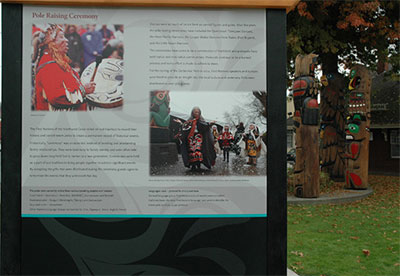
New interpretative signs have been added to Duncan’s totem tour.
Peter W. Rusland
Most are on seen Duncan's Totem Tour, marked by yellow footprints on downtown's sidewalks.
The Totem Interpretive Project was taxpayer-funded with a $60,000 grant to the Duncan Business Improvement Association. That purse was matched by Duncan council, whose contribution funded the city's Centennial pole, raised in Charles Hoey Park.
Three poles not on display include a Doug LaFortune work destroyed during a 1989 car wreck on the Island Highway; one gifted to Duncan's sister city Kaikohe, N.Z. in 1986; plus a Simon Charlie pole gifted to the Cowichan Historical Society, and stored in the Cowichan Valley Museum, city staff said.
Peter Rusland - Cowichan News Leader Pictorial
Source: cowichannewsleader