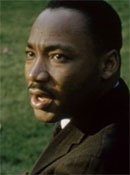
Graham Prindle: 'A hot spring of ideas'
After graduating from high school, Graham Prindle hit the road with a friend. They were hitchhiking to all four corners of the country. It was in the South where Prindle, who is white, said he first really understood racism. The "colored only" signs left him deeply disturbed. He had been involved in a youth movement, the National Student Association -- which he says was "a CIA front" -- but his first serious act to support civil rights was to quit a good-paying job in New York and move to Atlanta to take King's class.
He would only spend a year at Morehouse; eventually he completed an undergraduate degree at Antioch. He went on to work at IBM as a computer programmer and spent many years in San Francisco witnessing the radical changes the youth movement brought. But he says that semester in King's class was one of the most important times in his life.
I guess I didn't ever picture myself in a classroom full of black people in Atlanta until about two weeks before it happened. I was low-profile on purpose in there. I said something to my sister about it recently: Instead of being a fly on the wall there, maybe I should have been thought of as a white moth.
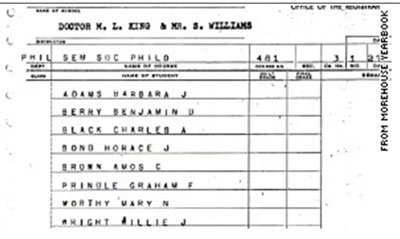
The class roster shows King and Samuel Williams as the teachers and lists the eight students.
When I met Dr. King in this class, I think it hadn't been more than a year since he had come up from Montgomery to be associate pastor of his dad's church, and this was the first time he was living full-time in Atlanta. When they got wind of that, I'm told, the people at Morehouse recruited him to teach this course.
The class itself was a pretty open discussion. Dr. King was not pushing a particular viewpoint so much as exploring the possible viewpoints of social philosophy. The question that kept coming up from the students is, "Is nonviolence just a tactic you deploy when your adversary is susceptible to it? Or is it a piece of ideology you hold to for other reasons?" He never definitively came down on one side or the other but encouraged the discussion of the viewpoints between the rest of us.
Some may have worried that the class was a recruiting tool or something for the movement, but it was less of a recruiting tool than you might think. Most of the people in the class had already been recruited for the movement.
I don't remember any problem of getting into the class when I enrolled at Morehouse. I think you just signed up. Somehow you worked out a roster of classes, and it was no harder than the others to get into. A little footwork was also done on my behalf.
But the class, it was different. There were so many ideas. For most of it he was sitting down at a desk. He did not lecture; he did not speechify at us. That was one of my few reservations about taking the class, that I was going to get preached at for the semester. But no, he absolutely was self-effacing, at least to my retrospective view, and I was keeping a low profile trying to get a sense of what people in the class, the Julian Bond generation, were feeling. He was very light-handed about it and let people talk.
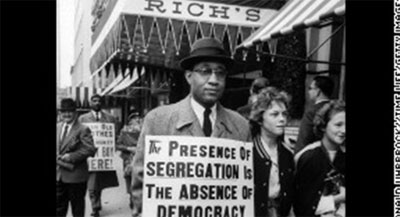
Several of King's students joined protests at Rich's department store in Atlanta.
You know, I didn't see a great deal of him, the real him, in his public persona, except in television later on, of course. My sense is that he had the preacherly tradition on the one hand, and that came through in his voice and his mannerisms in public, and then there was this political or philosophical openness to good ideas.
It certainly struck me as a sane and civilized way of teaching, and I stayed a little bit braced against the preacherly until I saw how he was doing the class, and I was just relaxed then. I tell you I paid less attention to him than I did to the students. I was interested in the variety of viewpoints and stages of thought that people were going through, and he facilitated that in a way that if he had been running the class, I wouldn't have been able to get that sense.
I don't know what the right word is -- this was being the opposite of provincial. The word that comes to mind is "cosmopolitan," but that is an old-fashioned term. The class was more about broadening us, in a way. Ultimately, I think it was pretty unremarkable in that time period, though. There were a lot of people who were being similarly broadened, just by the flavor of the times.
This experience is a different thing from joining a church or joining an ideology. It is like the difference between taking a bath and soaking in the hot spring. The one you do because you have to do it, the other you do because you want to. It is such a pleasure that you keep going back for it. That's what this class was like: a hot spring of ideas.
Mary Worthy: 'He was very much moved by his faith'
It was King's father, "Daddy" King, who bailed Mary Worthy out of jail after she got arrested in one of the many sit-ins she helped organize in Atlanta. But she says you couldn't miss too many classes, because the professors would get angry. The one class she never missed was King's. She was a science major but loved philosophy.
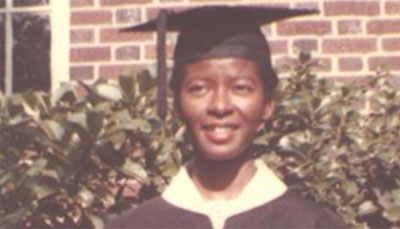
Mary Worthy: "Dr. King was a very good teacher. He was inspirational."
Worthy converted to the Baha'i faith in college. The year she graduated, she married a fellow believer, a white man. The move was risky; at the time, their marriage was legal in only seven states. The couple moved around the country trying to spread the word of their faith. At its core, the message mirrored that of the civil rights movement, abhorring prejudice and teaching about the "oneness of mankind." Worthy raised five children in this same spirit. She now works as an artist in Florida.
As far as Dr. King's class was concerned, I just signed up for a class in social philosophy and he happened to be the teacher. He was known then, but he wasn't the internationally known leader then. He was Dr. King. We knew his family. His dad had a well-known church in the community, and he was prominent in one of the black neighborhoods.
Dr. King was a very good teacher. He was inspirational. A lot of people don't mention it; they mostly think of him as political, but I thought of him as a very religious man. He didn't talk about his religion and he wasn't doing something political with the class. He was just someone who clearly was very much moved by his Christian faith. He really emanated it: that what he was doing was just doing the will of God. That was his attitude.
When you were there, it's not like you are thinking, "This is incredible." It's so regular. It's just there. It's part of school. And he's not saying, "I'm a great guy." He didn't have to; we knew that just being with him. And we saw that he was doing his job and he was inspiring people.
Atlanta was not very violent compared to other places. Even when we were arrested for protesting, it was not a hostile arrest. We were not beaten. It was not like the bus rides, which were quite violent. Whites were close to where I lived; they were right around the corner. Of course certain parts of town were different. We had this great open-air theater and the (civil rights) leaders were talking about staging a protest there to desegregate it. I guess I inadvertently desegregated it because I had already been there to see a show. No one told me I couldn't. Same with the buses.
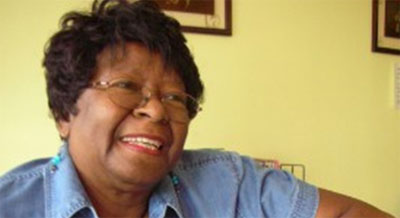
Worthy says King "was very much moved by his Christian faith" and he "was just doing the will of God."
I have always paid attention to politics, but I never felt politically involved. I didn't see myself as a political activist more than teaching what was right to my kids later on. But at school we saw all these other movements at schools and colleges all over the country, so we decided we should get involved.
We had all these organizing meetings and training sessions on how to be nonviolent. We did this for weeks on end. And then came time to do the protests. They were pretty simple. A lot of time we went downtown to march, and we would be on one side and then the KKK was marching on the other. I did take part in some of (the first Atlanta) sit-ins. It wasn't as easy as you might think to do that. We did not get any special treatment. You really had to struggle to keep up your grades, and we'd get lectures from some of the teachers who would say, "You can't rob Peter to pay Paul."
My mother was a little worried. She was a single parent and didn't know what would happen to us. We knew what the consequences were of participating in a sit-in. We knew we would go to jail, but we knew we needed to do it. She didn't say anything against it. And I did get arrested. I spent all day in the jail. It was Dr. King's father who bailed us out of jail.
I don't really talk about taking a class from Dr. King. I've told my grandkids, and when Dr. King day comes up I might mention it to my kids or talk about what it was like during our protests. But when you are there, it's not like you are thinking, "This is an incredible time," or "This is something incredible that we are doing." It's just so regular, and so was he.
The Rev. Willie J. Wright: 'It had to be nonviolent'
Thaddeus T. Wright was only 9 when his father died in 1980. But the Rev. Willie J. Wright made a huge impression on his son. "People say the World War II generation is the greatest generation; I think my parents give them a run for their money," he said. "They organized and fought for equality on their own initiative and under the worst conditions." Wright and King became so close that Thaddeus -- now a naval master chief commissaryman -- thought King was a member of the family.
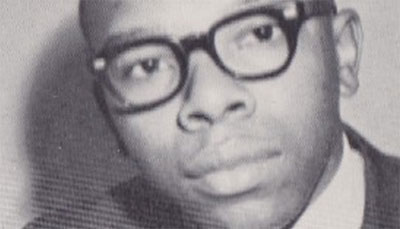
Willie Wright told his wife King used Jesus' words, but "used the teaching of Gandhi to explain how it was going to get done."
Before taking King's class, Wright and his future wife, Hattie Smith, were among the "Greenville 8," a group that staged a sit-in at the whites-only central library in the South Carolina town. When Wright arrived at Morehouse, he was ready to continue his activism. His widow tells about it:
Those were exciting times. But the class, well they didn't really know how famous he would be, and they didn't know what they would become. Charles Black, who was in that class, was one of my husband's favorite friends. He came to our wedding, and he was the best man. He came to help protest in Greenville in '65. My husband always admired his dedication.
When he found out that Dr. King was teaching the class, he seemed excited about it. I was writing letters to (him) at the time, and he told me about the class. He said, "I hope that enrollment is very good and the people who need it can get in there." We always saw Martin as a very obedient son of Morehouse.
The day-to-day teaching, Willie said, was a little different than with the other classes. He said that Martin used to take the words of Jesus to teach, but since it was a philosophy class he used the teaching of Gandhi to explain how it was going to get done. And since Morehouse men were all considered to have the ability to lead, Martin knew he was teaching some of the most talented people who would go on to lead the next generation.
To get to study with someone who becomes your mentor and you become like a disciple is very rare, and that one-on-one kind of time kept him motivated. Here they had someone side-by-side with them, someone who came from their school showing them the degrees, to see how you will get this done -- particularly with all the poison in society. The Civil War didn't work, so it had to be nonviolent.
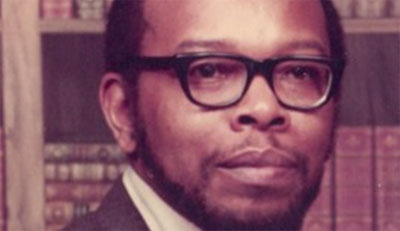
Wright, who died in 1980, continued his work for civil rights and became a pastor after his Morehouse years.
The message he shared with them is, "You are gifted, and because of that you have to take responsibility." It was still a Christ-centered way of life, and the things they learned from Gandhi changed their life forever, because it made change real. And it was with this kind of faith and belief and hope for tomorrow that these things are possible, and it doesn't take a lot of people either. It just takes the right people to sing their passion.
And they talked about how the ills of society had to be addressed in a different way.
That's what was great about the 'House. It's where people are given an opportunity to advance the knowledge they already have, and they can counteract the prevailing sentiment of the time. When you have the Morehouse gift, it is wonderful, but the pressure to lead and succeed is really remarkable.
Jen Christensen
Source: edition.cnn