|
OCEANIA, AUSTRALIA

 |
The National Library of Australia’s ‘Forgotten Australians and Former Child Migrants’ oral history project
Renée Shuttleworth, from the National Library of Australia reports on the recently completed ‘Forgotten Australians and Former Child Migrants’ oral history project, a large scale social history project undertaken by the National Library of Australia which recorded interviews with adults who experienced institutional and out-of- home care as children in Australia.
‘The now completed three year project was supported and funded by the Australian Government through the Department of Families, Housing, Community Services and Indigenous Affairs. It is estimated that 500,000 Forgotten Australians and 6,000 Former Child Migrants from the UK and Malta, spent their childhood in some 800 institutions across Australia throughout the twentieth century.
‘Forty-one interviewers were engaged across Australia to record whole of life interviews with more than 200 men and women who represent the many experiences and lifelong impacts of being separated from family in childhood. Interviewers were specifically trained to understand the particular needs and background of Forgotten Australians and Former Child Migrants. The interviews enabled those who lived the experience to tell their stories in their own words. The project spanned more than sixty years, recording the experiences of out-of-home care from the 1920s to the 1980s. The youngest interviewee was thirty-four at the time of interview and the oldest was ninety-eight. Most interviewees tell of their experiences in homes, institutions, foster care and ‘orphanages’ – although many were not, in fact, orphans. There is also a range of interviews with policymakers, institution administrators and employees, advocates and family members of those who were in care.
‘The project aimed to be as representative as possible of differing experiences. The project used a demographic guide to ensure that care experiences were represented from across the country, across different care types and across eras. Expressions of interest in being interviewed were sought through the Library’s website and via national media. Support and advocacy organizations were consulted to further broaden the scope of applications received. Third party submissions and the growing knowledge of interviewers throughout the project also assisted in addressing gaps in underrepresented groups. The range of experiences captured shows there is no single narrative of the experience of out-of- home care, nor one predictable lifelong impact stemming from those experiences. Memories and experiences differed greatly, and were dependent on such things as length of time in care, age on entering and leaving care and, location and type of care. There are many emotional accounts along with experiences of trauma; as well as recognition that in some cases institutional care, while meeting the physical needs of shelter and food, rarely met a child’s emotional needs.
‘Interviewers note their experiences in conducting the interviews were rewarding, challenging and at times confronting. The formation of social networks among themselves for information sharing and support has assisted some interviewers in dealing with the nature and subject matter of the oral history recordings. Interviewees expressed different reasons for wanting to tell their histories, many noting they have found the experience of being interviewed provided an opportunity for recognition, reflection and for some, closure.
‘Many of the oral history interviews are available online, with interviewee permission, through the National Library of Australia’s catalogue at http://catalogue.nla.gov.au/Record/4707359
‘The Library has produced a booklet introducing the collection titled You Can’t Forget Things Like That. With over 800 hours of recorded histories; the booklet highlights over ninety quotes from the interviews. It is hoped the booklet will encourage people to listen to the interviews, in order to know and understand the life history and experiences of Forgotten Australians and Former Child Migrants. The online version is available at www.nla.gov.au/sites/default/files/forgotten-australiansoralhistory-booklet_0.pdf
• For more information visit the project website http://www.nla.gov.au/oralhistory/forgotten-australians-andformer-child-migrants-oral-historyproject or email fafcm@nla.gov.au
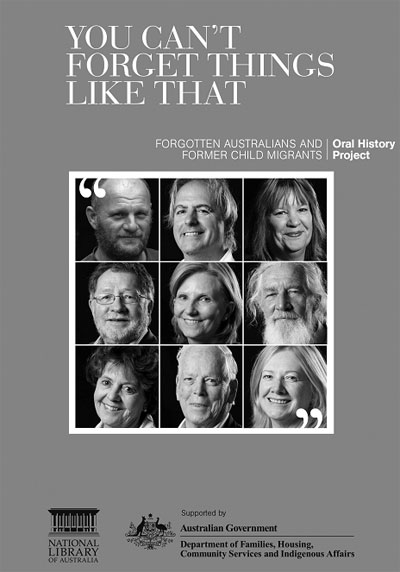
Front cover of the booklet, You Can’t Forget Things Like That.
Source:
ORAL HISTORY, Spring 2013, pages: 30-31
|


