
|
MEMORY AND NATURE IN THE GREAT FLOOD OF 1966

 |
LATIN AMERICA, BRAZIL
Historians Andrea Casa Nova Maia and Lise Sedrez from the Universidade Federal do Rio de Janeiro (UFRJ University) report on a research project which uses oral history to explore the environmental history of the city of Rio de Janeiro, and to study the history of its floods in the 20th century.
‘Rio de Janeiro, one of the best known cities in the world, will host part of the 2014 FIFA World Cup – and will also host the 2016 Olympic Games. Luckily, both events will take place in June, during the Brazilian winter, because another claim to fame of the Wonderful City is its summer rainstorms – the “waters of March” sung by Tom Jobim, which usually flood large parts of the city. Some rainstorms have remained in popular memory as watersheds that defined the relationship between Rio’s residents (cariocas) and the nature of which they are so proud. This is the case, for instance, of the Great Flood of 1966, remembered even by cariocas who were not yet born by that date.
‘The oral history work in Rio is part of a larger project which is called: “Submersed cities: Landscape, history and memory of the floods in Rio de Janeiro and Buenos Aires in the twentieth century (1900-1960)”. Basically, the larger project has three focal points: the floods in the modernization period (until 1930), during the populist era (1930-1960) and in the megacity era (1960-1980). Each of them has a different documental set of sources. For the first phase we are looking at journals, cartoons, pictures; for the second phase, we are emphasizing technical plans and reports; and for the last phase, oral history.
‘By rebuilding the memories of Rio’s Great Flood through oral interviews, the research pinpoints places that have acquired a special meaning for Rio’s residents, for their propensity to flood and for the impact of their flooding on the rest of the city. One of these places is Praça da Bandeira, a major flood-prone area. A former mangrove marsh turned into a nodal point in Rio’s transport system, the Praça da Bandeira has become a “place of environmental memory.” Using the Praça as its focal point, the research combines oral interviews with local residents and analysis of newspapers. It will then create a map of memory and water, underground rivers and social tensions that surfaced in full force when disaster, or flooding, struck the city.
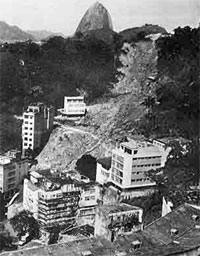
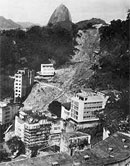
Landslide in the neighbourhood of Laranjeiras, in Rio de Janeiro, January 1967. Both the city’s poor and its middle class residents were victims.
‘One of the interesting research findings is that alongside the devastating damage and casualties brought by the flood, wide “solidarity networks” emerged at that time. However, these networks, far from creating bonds between poor victims and middle-class do-gooders, highlighted how the different social classes experienced life in a highly segregated city, during moments of crisis.
‘The research is in its very first stages, but there has already been one article published on the 1966 flood in Rio: L F Sedrez and Andrea Casa Nova Maia, “Narrativas de um Dilúvio Carioca: memória e natureza na Grande Enchente de 1966”, História Oral (Rio de Janeiro), vol 2, 2011, pp 221 – 254.
Looking forward, the recent floods in Buenos Aires will be investigated alongside an overview of how floods were recorded and documented in the early 20th century.’
• For more information on the research please contact: Lise Sedrez, email lsedrez@gmail.com or Andrea Casa Nova Maia, email andreacn.bh@gmail.com
Source:
ORAL HISTORY, Spring 2013, page: 28
|


