
|
Challenges of Training in Oral History in Iran

 |
Perhaps, talking about the challenges and obstacles would find meaning when the original subject has been accepted. This is different about oral history. Despite the use of this scientific method by many users and history researchers knowingly and unknowingly since more than four decades ago, the establishment of eight professional meetings and the participation of scientific circles including Isfahan University, there are still serious problems over the scientific and documented authenticity of data and oral history documents.
Although hundreds of articles and reliable scientific works about oral history have been written and translated, well-known universities and their professors are alien with the issue of oral history. The reason is that the writers have witnessed the inattention on many occasions. However, it is no wonder that breaking the traditions and cutting the bonds of history and traditional historiography is a daring and great work in the tradition-stricken society and blended in a mass of traditions. They are not ready to accept the method and its modern and updated approach. This is because of getting used to traditional methods on one hand and the resting of main part of historians and history experts in the earlier periods of the history on the other hand. They may not know that the contemporary history will also be forgotten soon, turning into antecedent periods. So it is appropriate to make our utmost efforts in enriching the resources and documents of this period in order to fill the gap of shortages of historic documents and evidence.
If we take a look at the academic researchers in the area of oral history, we will see that the number of them is no more than ten. Meanwhile, some of them belong to other fields except history like economy, communication sciences and sociology due to the nature of oral history. Although it shows that the method is used comprehensively and is superior among other methods, historians are alien with it to a large extent. The situation which can be called qualitative acceptance against quantitative popularity indicates that the historians namely the real inheritors and operators of oral history should pay more attention to it. In view of the extensive approach of university professors and researchers to contemporary history and inter-field subjects like economic history, historic psychology, historic sociology and social and cultural history in recent years, the necessity of using this method has increased day by day even for those who challenge the instinctive nature and efficiency oral history. How long are the Isfahan University and a few professors of other universities going to continue their work in such situation? It is obvious that the seats and chairs of many universities are empty in the conferences and main part of the participants of oral history meetings still consists of open researchers and the authorities of the administrative centers of oral history namely revolutionary institutions. Certainly, the official and scientific acceptance of oral history is subject to the involvement of universities and scientific centers and their professors in this area. Unfortunately, despite a public call, the country’s universities view oral history with arrogance rather than involvement and cooperation.
Thus, when the main subject is treated in this way, how can we expect that the training of this method and approach would face with no challenge and obstacle? It seems that the first condition for achieving the work of training oral history is the attention of universities and scientific center to oral history and its acceptance. In such a situation, the continued efforts of a few university professors in this area will be slow naturally.
Another big and serious challenge is not on the side of the critics and deniers but the users and custodians of oral history. No doubt, in all the previous conferences and meetings of Iranian Oral History Scientific Association, this main and key point has been stressed that oral history is a scientific method for collecting historic data, using active interviews, open questioning package on the basis of subjects or active people who observe and witness the history and the past. Oral history has fundamental differences with memory-telling, memory-writing and memory-finding. Also, oral history is not a tradition and oral culture. Nevertheless, unfortunately it is seen that the centers and institutions active in this method still send their products to the market under the name and title of oral history but with the content of memory-writing. Such products were justifiable before the holding of oral history conferences and numerous meetings of Iranian Oral History Scientific Association but after such numerous meetings that each of them have referred to the issue and stressed frankly, this is not acceptable at all, because these products are a basis and model for researchers and oral experts in other researchers. Therefore, when we present memory- writing as oral history, how can we expect that the oral history regulations are observed in training? It has also been widely stressed in various oral history workshops especially in the field of holy defense, but the area has been mostly damaged from this challenge and misunderstanding regarding oral history.
On the other hand, many oral experts and the instructors of oral history workshops practically train memory-finding and memory-writing instead of oral history because they have gotten used to it and are not able to release themselves from this dilemma. So, it is necessary for the scientific experts and veteran and experienced people in this field to act in this regard. This challenge is directly connected to the restriction of the universities’ involvement in promotion of oral history.
Another challenge is that even if we accept that conducting targeted, open and challenging interviews have been stressed in oral history meetings and workshops, then in the plans ahead, we again witness the recoding of memory not active interview. It is necessary that the defined plans are supervised by scientific observers and oral history experts so that the result of training is seen in the plans. Lack of scientific supervision and stage-to-stage of oral history plans cause the plan to move away. Although this increases the costs, certainly the result has more material and spiritual value.
In conclusion, in a general view on the issue of oral history, it should be said that training is not separate from the oral history itself. The first principle is the acceptance of oral history by the universities and history professors. How can we deal with training without achieving this goal? The inattention and indifference of the universities toward oral history and the continuation of this situation is not only to the detriment of oral history but fails to flourish the area of history especially contemporary history. Oral history authorities and revolutionary institutions and well-known agencies should be obliged to observe oral history regulations, conduct active interviews, train it in oral history workshops and observe the rules in producing oral history. In this line, with necessary coordination, all oral history workshops with different issues can be led and run with the knowledge of the Iranian Oral History Scientific Association and through providing efficient and competent instructors. This contributes to the correct and scientific training of oral history.
By Dr. Mehdi Abolhassan Taraqi
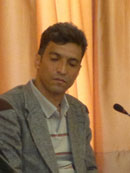
Researcher and lecturer in Shahid Bahonar College of Isfahan University
Translated By: Mohammad Bagher Khoshnevisan
|


