
|
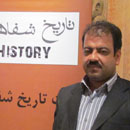
Abolfazl Hassanabadi (PhD), Director of Documentation and Press Affairs of Astan-e Qods Razavi

 |
Note: Since we were approaching the 100th issue of Oral History weekly, we conducted an interview with Dr. Abolfazl Hassanabadi, Director of Documentation and Press Affairs of Astan-e Qods Razavi who has been cooperating with us since the start of the website and then the Oral History weekly. He is the author of Oral History in Iran and editor of The 5th National Conference of Iranian Oral History.
He said, “If we look from this viewpoint that the weekly in general is the first electronic journal in the area of history with oral history approach which are sent to the interested people largely, and in view of the fact that the collection of subjects in this specialized area is very difficult within one week, we should congratulate those who are in charge of the weekly on their perseverance. Working non-stop and without interval for two years is of great importance.”
He said, “I have not seen your goal in the weekly’s first page and because of the dependence of the website and weekly to each other, you may have sufficed to the site. But I believe that we must highlight the goal in the weekly too, because I think 90 percent of we lazy historians do not pay attention to it, and we may have not visited the section “About us” in your website so far.”
Regarding the level of the website’s relation with other oral historians and institutions and centers, Dr. Hassanabadi said, “Your goal in establishing connection with independent centers and oral historians should be clear. You must make clear the goal in the field of content so that the level of the subjects put in the website should be proportional to these policies. You have not been successful in establishing connection with the community of oral historians outside Tehran, and have not been able to do so with the public.”
He added, “A flaw I hear from friends is that they say that you have become the voice of the Arts Center (Hozeh-ye Honari), covering mostly the events that have happened in the center while I know well that you have no other way due to some backings and costs and it is natural although it is not favorable. Another point is that over 80 percent of your subjects and articles are about the war and revolution. You should explain why it is so. However, I mention again that since I am involved, I know that this is natural in view of the location of the center. Also, another point that should not be forgotten is that oral history in Iran is based on two factors of revolution and war, overshadowing other activities unconsciously. However, these reasons should not be an excuse for ignoring other areas and be a weakness in this field. You can give this answer to the rest.”
In response to the question which part you like more, he said, “I am satisfied with the news, I also like training. I could also use the translation of some of foreign articles about transcription, theory in oral history, the oral history of US military and so on. You’d better use the special edition more. The section of memoirs should not become so highlighted. To me, it has gone obsolete and repetitive.”
Dr. Hassanabadi proposed, “You should find the shortcomings for the next decade. Is the job of oral history done somewhere else or has it been remained in the surroundings of war and revolution and …? Investigate about the reasons for the truth and present to the audience. One of the jobs the weekly can carry out better is to bring up new subjects and to open new working areas for oral historians who have just been involved in so that they are not trapped in the discourse circle of the first generation of oral history.”
His other proposal is to highlight and separate the items in the weekly’s first page because in a scientific weekly, the sorting should be on the basis of information even at the expense of remaining an item unfilled in an issue, but instead, it makes the image of the journal more scientific.
About the designing of the weekly, the Head of Documentation and Press Affairs and Oral History Expert of Astan-e Qods Razavi proposed, “The designing should become more colorful, because oral history is not very old. It is the history of yesterday. Some believe that the color of the site is more historic rather than oral history. The designing is not scientific and it looks that it is just a website.”
In conclusion, he recalled, “Despite the above mentioned shortcomings, the existence of such journal for expression of thoughts and views is a good opportunity. In view of the fact that the history groups have less relation with each other, the relation of oral historians is of great importance especially when using of each other’s experiences influences the progress of oral history. Of course, the community of its audiences is limited, the situation of our oral history is this and it cannot be expected more.”
Interviewer: Maliheh Kamaledin
Translated by: Mohammad Bagher Khoshnevisan
|


