
|
Seyyed Abolfazl Razavi (PhD), Associate Professor of Khawrazmi University

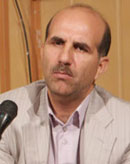 |
Note: Seyyed Abolfazl Razavi is one of history instructors at universities who are known to oral historian in Iran. He has published many papers in theoretical fields of history and oral history in particular. Critical Philosophy of History has been published by him lately. He shared his ideas about our website and weekly as follow:
Oral History Share in Historical Studies
On the Occasion of the 100th Issue of Oral History Weekly
Historians are the intellectual representatives of every society and the collective identity of social activists of every period finds a proper image in the light of the historians' view. In a conventional and of course, delicate interpretation, if we differentiate between a historian as a person who is contemporaneous with occurrence of (past) historical events and reports his or her interpretation of a series of historical events, with the history researcher as a person who lives in the next discourse ages and instead of connecting with a series of historical events related to his or her considered subject ( in the past), connects with the historians of the same period that the events have happened in order to present a new interpretation, the history researcher has both burdensome mission and responsibility and this burdensome responsibility is the consequence of a dual role whom he or she plays both as a historian – in line with interpreting and reporting about his or her contemporary events – and the history researcher. The historian and history researcher thinks continually about the present period and the past one who studies, thus has no other way but to understand history from the viewpoint of combing discourse horizons. But when he or she studies the considered past, since the past discourse atmosphere has come to an end and has found an almost constant nature, he or she will face with delimiting of history in terms of perception, and his or her study and research is easier than the time when seeks to establish connection with the present events and to present systematic view about them. This comes as the multilateral and systematic study of contemporary history becomes more difficult in view of being fluid of the present discourse atmosphere and lack of documents accessible to historians. When the history specialist wants to research about the contemporary events, he or she from the very beginning knows very well that has not the ability to present a scientific achievement – in a way that brings the consensus of history experts about the studied subject- and his or her work remains less in the minds of people. The question posed here which gives an exit from the viewpoint of the significance and status of oral history is what a historian expert should do in such conditions and what is the right path to advance his or her work? In the opinion of the writer, the study of history with the approach of oral history - despite all the deficiencies it has in its perception – can contribute to historical studies to a large extent since it has more fluid and updated nature as compared to more classic approaches of history study, making more practical the study of contemporary history, or at least the providing of reports and presenting of historical interpretations about the contemporary period.
Applying the methods the oral historians use in studying history does not have a long record and particularly it seems a more newly-arrived method in our society in a way that they try to take steps toward the historiography of oral history through collecting historical data by focusing on oral history. Such strategy plays a supplementary role in historical studies and even we can make it move toward the direction where it can take the responsibility of studying contemporary history. In an interpretation, oral history is in charge of filling the vacuum and blind spots of contemporary history but with a more comprehensive look, on condition that we define a more efficient methodology and policy for it, it can be said that the strategy is in charge of studying contemporary history.
Thus, it can be concluded that the activity of oral history experts especially those who take steps with more attention and obsession in this path, plays an important role and can be an attempt in line with promoting the sociological and perceptional dignity of history.
Undoubtedly, oral historians like any other activity are able to do their mission better and further within the framework of a source or special sources that are able to present plan, viewpoints, criticism and interaction of their thought and function.
The significance of sources like oral history website especially a weekly which has started its activity in recent years with the attempt of friends and those who are interested in this research area, and it’s really fair to say that it has been efficient in general, is very important from this view. Now that the oral history weekly has published its issue 100, I seize the opportunity to first wish for the success of active colleagues in this area, and then call on the researchers and experts of history to provide the grounds for increasing such research references as this website especially the weekly by paying more attention to more essential issues in the area of history studies particularly what has contributed to restriction and institutionalization of oral history especially its historiography. Undoubtedly, focusing on cases like paying more attention to theoretical discussions and trying to explain about the relation of oral history with historical researches in terms of recognition and methodology as well as the conception of oral history as a fundamental issue in line with clarifying the latter and taking steps toward the historiography of oral history as an area of study or completing contemporary history studies, can play a decisive role in this path.
Translated by: Mohammad Bagher Khoshnevisan
|


