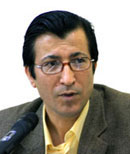
Note: What follows is the summary of an interview with Mr. Morteza Rasoulipour, a known oral history expert and director of Oral History Department at Iranian Contemporary History Studies Institute, on his estimation about the online Oral History weekly. Editor of “Memoirs and Biography of Seyyed Ebrahim Chehrazi” and “A look inside, Political Memoirs of Dr. Javad Sadr” and writer of several articles in History and Geography Monthly Book and Iranian Contemporary History Quarterly shares his ideas with us.
"Undoubtedly, publication of articles about oral history online has its benefits, and the need for such a website on the subject has been felt since a long time ago. I know the website's organizers and I can tell that they intend to inform the society about oral history activities and developments through the weekly. I have a remote idea about the website and its published content, and would like to offer my views briefly and in general terms.
First, the nice layout of the website has much to commend it, but what matters is its organizers' approach toward oral history activities. Is the website meant to serve as a news outlet or should it produce an effect on its audience?
Interview is arguably the core of oral history. We agree that the correct interpretation of every subject can be achieved through the proper exchange of ideas, discussion and dialogue; then one would ask how much the website has considered interviews as the most pivotal aspect of oral history. In other words, how successfully has the website orchestrated a close bond and discourse between various national and international foundations and organizations which are in some way or another related to oral history activities? Every organization is naturally based on its own principles and pursues a predetermined objective. Identifying these foundations and their scholars, besides highlighting the principles they apply in their interviews as well as the activities and goals they pursue involves an all-out effort and considerable amount of time, energy and expenses on the part of the website organizers. The principal question here is to know how much the website has managed to contact and introduce these centers. So far, our understanding of these centers was limited merely to a few Iranian centers and the releases of foreign universities like Harvard and Colombia; this is while we are blissfully ignorant of what is going on in various other places in the world like Islamic and Arab countries, the Middle East, India and our neighboring countries. Can one really suppose that nothing is taking place in Islamic and Arabic countries at the moment regarding oral history?
As its overriding concern, the weekly should develop a detailed strategy to batch oral history activities and coordinate the sporadic steps taken by some oral history activists with reliance on government budgets, which are scientifically worthless in most instances. Unfortunately, in years, some of these activists have become totally irresponsive to changes of any kind and deem them impossible. Lack of such a handy strategy has enfeebled the weekly by publication of disconnected content indicating a mental anomaly among those involved with oral history. This has led to the inconsistency of the published materials. One should not infer that I oppose freedom of writing and speech, but the esteemed chief editor of the website is supposed to be more wary of inconsistency of the released articles.
Provided that the outlook of oral history activities and their objectives are properly addressed in the weekly, publication of controversial issues and their juxtaposition would lead us to better results. Such an approach has been overlooked in the weekly since its establishment and interviews are ignored to some extent, leading to publication of monotonous content. One useful way to step out of this monotony and exerting more effect on readers is developing questionnaires and placing them online for the public to respond and asking scholars for their opinions about key topics of the field. In view of the fact that some may accuse me of nitpicking and raising only negative issues, and in order for my discussion to be regarded as a compassionate argument, I present you with two fundamental issues in the form of questions:
-What is the role of oral history in historical studies? And which approach (philosophical or historical) can provide us with the proper answer for this query?
-Do you believe that oral history activities should be solely focused on preservation and maintenance? Or besides archives, publication of oral history interviews should be included among the priorities? Several other questions can be raised in this regard.
Another area where authorities of the weekly should keep their attention on is assessment and introduction of releases on oral history theories, principles and views given the fact that most of the activists in Iran lack enough knowledge about such topics. If there is an inclination towards highlighting educational topics on oral history, a separate column can be added to each issue of the weekly on the latest educational development of the readers based on international standards. This spurs interested readers with scant knowledge about oral history principles to read more about the subject and learn about foreigners' views about their desired topic. Since the beginning years of the 90s, so many valuable books have been written in Europe and the US about oral history, but none have yet been rendered into Persian. This negligence of Iranian academic and scientific centers for oral history activities and works might be due to the fact that some scholars question the validity of oral statements, leading to alienation of most translators from converting the works into Persian. However regrettable, this reality has poised the website for an opportunity to identify and introduce these works and promote translation of the works. It may be that some scholars hold a varying view about this argument on the grounds that we should still be more concerned with the definition of oral history and focus our activities on offering more intelligible, clearer definitions of the issue.
The next thing I would like to mention here is the space available at the website for assessment and criticism of oral history sessions and gatherings. Thus far, 7 specialized oral history sessions have been held at Isfahan University, the National Library and Archives Organization of the Islamic Republic of Iran, the Arts Bureau of the Islamic Propagation Organization, Astan Qods Razavi, and the Islamic Assembly library. What is more, several other gatherings have been arranged in educational and research centers in Tehran and other cities of Iran underscoring oral history-related topics; however, the website has just informed about them in the form of news pieces or reports. A review of the discussions and the raised topics in the sessions can insure a rich throughput for the weekly's content. As an example, the last session arranged at the library of the Islamic assembly held last February in Tehran was themed at compilation of oral literature; however, with the exception of one or two speakers, the rest had nothing new to say and the core of most of the presented articles were threadbare indicating the remoteness of oral history centers from the idea of compilation. Reviewing an article, a lecture or a meeting properly and stating its shortcomings thoughtfully helps sort our problems and defects in the works and prevents them from being repeated while valuable rhetoric becomes paramount in the society.
The other point that the weekly officials should notice is that oral history activities are beyond revolution or war. Albeit, we always appreciate martyrs, warriors, combatants, POWs and those injured in the war and put their works on top of our activities; but, it should be noted that the weekly, which is supported by the Arts Bureau, should not limit its span on these issues only, at least as long as it is the only website in Iran considering oral history activities in the country and there are no other journals or publications on the subject. Therefore, it should refrain from subject limitations of any sort and function in a more nationwide level to be applicable for all Persian speaking audience.
Finally, the weekly should shun strict historical judgments on oral literature to respect all readers. Even on topics where it seems to possess a scholarly view, articles should be placed online in a way that the audience would feel the weekly is completely impartial in presentation of the reports and articles.
I wish success for all involved in release of the weekly.
Interviewer: Maliheh Kamaledin
Translated by: Abbas Hajihashemi