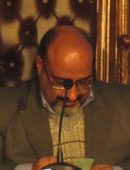
Note: Dr. Dehghan Nejad is among scholars who believe oral history is a way of retrieving people's history by themselves rather than hearing it from elites and power masters. The history scholar is very hard to contact as many other luminaries we tried hard to contact. After numerous efforts, we took his precious time and had him answer our questions about the performance of our website. What follows is an online interview with Dr. Dehghan Nejad about Oral History Weekly's operation in its past 100 issues.
-What is your estimation of the weekly's performance in spreading Iran's oral history developments and updates in cyberspace?
To begin with, let me express my most sincere gratitude as a member of the academia toward organizers of this magnificent cause, in view of the fact that oral history gives all Iranians space for expression of their emotions, concerns and memories nowhere else they would be able to do so. The Oral History website and weekly give oral history activists freedom to act and transmit their findings to their interested audience without destroying forests(without using paper). Although oral history practices have been in action since a relatively longer time in the modern world, the movement is still in its incipient stages in Iran. The weekly is one of the forerunners of the cause and is expected to stick to its duty with innovative ideas in the future.
-How do you view the weekly's performance as a resource for oral history research studies in and outside of Iran?
The validity of every study is entirely dependent on the extent to which researchers are able to convey their findings. Interpretation of every incident is much more valuable when it is made by someone who was directly involved in a course of events; rather than being provided afterwards by someone else who may happen to utter a varying interpretation of the incident in a way that was never meant by the narrator. Live interviews may bear tears and smiles with them imparting sweet or bitter realities of life never conveyed in official documents or written accounts. Even sometimes the empathy discharged by youthful, energetic interviewers makes interviewees want to say more and more of things they might have never mentioned otherwise. I wish the weekly could be sent to all schools and high schools for teachers to instruct students to put down their parents' memories instead of having them write about threadbare essay topics like “which one's better, knowledge or wealth?”, and had their writings published in a space provided by the weekly. Generally, speaking is better than thinking; while speaking, humans are able to promote their thinking. So, everyone should be given the right to have a say and feel they exist. [I think] oral history's motto should be this: "I speak, therefore I exist"; which means I exist because I can speak of my concerns. Oral history gives the society's mute the chance to articulate their say.
-Are the oral history website and weekly general or merely exclusive to a certain audience?
Oral history should be studied through different levels, inclusive of children to the elderly to men and women. There was a time when newspapers merely addressed grownups, but later they began to realize that children are as needy of learning as adults are. Therefore children's magazines began to hit bookshelves with fresh and joyous designs and managed to spark a lot of interest in families. Today, I think, special pages can be designed to address youngsters, adults, and women in the website. Under the Safavid dynasty, Nourollah Tabakh wrote two treatises on cooking and confectionary ; why not asking women in various parts of Iran about their cookery customs or asking their children about their favorite dishes, and publishing articles about them on the weekly. By and large, oral history is so broad its dimensions cannot be specified, but it sure can include some pages on different topics.
-What form of language should be adopted for the website? The standard, interactive, publically understood, academic, etc. languages? In other words, which language style should be used in the site and the weekly?
Some accents are so cute which are a form of oral history by themselves. What if they made this part in your website to place audio and video files of narrators (which is an issue considered long ago in numerous oral history websites in the world like the National Library of the US Congress which has an audio archive and voices of prominent figures are being stored there). This is not a difficult task given today's technological advances. This is why at least half of all interviews should be video-recorded.
-Do the published articles in the website meet academic and international standards and guidelines? What is the website and weekly's obligation in this regard?
Oral history in Iran is in fact a response to an oral history project at Harvard University and other centers on stories of emigrants. Here, in Iran, they tried to garner memories of revolutionary figures only. However, the fact is that oral history covers a much wider areas than these topics. Who will trace the oral history of Zayandeh Roud (a large river in the city of Isfahan)? Who will ever tell what came to the poor river? We are yet to realize the essence of oral history. A very small step (the website) has been taken with government support, while the issue is much more overwhelming. A lot of issues are covered in the journal, but it has not managed to find its place in the society and academic arenas yet.
-In what areas are historians, researchers and oral historians failing in their attempts to record oral history? How can the website underscore these weak points in your estimation?
I reckon that stereotypes are the greatest problem for all areas. We have not yet been able to prepare the society ruminate anti-memories. Most stories have a good beginning and ending. But how many times have we considered memories of addicts or convicts sentenced to death, or even runaway girls in a bid to figure out what brought them to such misery? Are the memories of such people not worthy of listening to? Today, AIDS is creeping beneath the surface of our society, and we are blissfully unruffled, why? (I tell you why). Because officials are afraid of learning. Respectively, people pretend not to see or hear. This is while delinquency has a lot of history to tell with many stories to teach. A research work herein can be greatly appreciated and its coverage by the website will indeed be welcome and appealing to the audience. Knowing about such issues and social challenges in the form of memories by those who have been directly entrapped by them can teach audiences lessons.
-How effective has the website acted in terms of spreading news and information about oral history in cyberspace?
Well, online publication is very inexpensive, but given the fact that tens of emails are sent to everyone's inbox every day, a mere website address beside a myriad of other stuff cannot spark a lot of attention for viewers. Therefore, I believe that the printed publication the website's select articles with intriguing topics can bring about good results.
-Oral historians need to learn about each other's activities; how much has the website been able to function as a liaison for these activists?
Obviously, when they learn about each other's activities, they will not waste time running parallel studies. In the beginning, the website was established to make a bond between these activists, but it seems that group works are doomed to fail in Iran. Today, new technological advances have emerged in the world and all oral historians need to be in contact to learn from each other and modify their old practices. Principally speaking, repetition does not ensure a promising future.
-What are the most striking issues in compilation of oral history and how can the website address them?
Today's most urgent need of oral history is making it possible for historiography to alight from its ivory tower and penetrate into people's lives. To this end, the website should make space for people's say. Life is not war and politics only. Indeed, life is love, affection and good stories. The memories of a sixty-year-old man who has spent his life with his wife can be enthralling to here for a generation that cannot tolerate each other four more than four years. We should not forget that people desire to hear about things they have been deprived of. Many lifestyles and stories have turned into rare animals only found in museums and national parks.
-Should the website be confined to topics like the Islamic Revolution and the Sacred Defense, or should it tackle other social, cultural and economic areas, as well?
Of course the Revolution was a salient point in the history of our country, which is why the TV, radio and universities repeatedly focus on it. But as I mentioned earlier, life is not just war. Economic struggle is a war of its own. The champions of this war have nothing less than war comrades. Doesn't it matter to know about an individual who has managed to create jobs with the least possible at hand? Is it not really interesting to hear about a woman who lives with a half-crippled body? Shouldn't we hear about an artist who makes art works despite thousands of mental and physical difficulties? Can the stories of our parents who worked and studied with all kinds of difficulties be sweet to hear for a generation who is hardened to easy life? Obviously yes, but it appears that our half deaf ears cannot hear anything less thunderous than the deafening yell of wounded soldiers and tanks. The cry of broken bones under the economic strain is as well audible
-How do you observe the effect of translated articles published by the website in introduction of oral history developments in the world?
Of course it’s effective. The problem is that our cultural needs are so enormous that cannot be addressed easily. Outcomes of cultural works never show up overnight; as notes a Chinese proverb, “Educate people now if you have plans for the next one hundred years.” Cultural works can help this education. A little promotional activity should be sprinkled on cultural activities for added effectiveness like contacting schools, spreading news, sending CDs of the weekly to various institutions, and, above all, respecting people’s concerns. People should be asked for their impressions. Let a part of the weekly be filled with free writings. Today, social networks are successful because they have managed to step into people’s lives. The same is true for us. By “people” I mean all the people.
Translated by: Abbas Hajihashemi