by Linda Holmes
October 16, 2012 4:23 PM
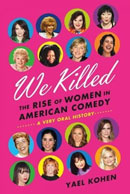
We Killed: The Rise Of Women In American Comedy is a sprawling oral history that grew out of a Marie Claire piece. It has the loose structure of most similar books (of which there are more and more), though the introduction unfortunately ties it to the tired women arent funny assertions that apparently were not through talking about yet. I must admit, Im a bit biased against this approach, since for me, women trying to respond with seriousness to women arent funny is a little like astronauts trying to respond with seriousness to the sun goes around the Earth. In both cases, its certainly unfortunate if anyone whos in charge of anything believes it, but its not a belief likely to be vulnerable to dissuasion through logical argument if its still held at all.
Yael Kohen, who put the book together, bounces around various parts of American comedy, from stand-up to sitcom to late-night, and some sections are substantially more interesting than others. The Saturday Night Live story has been told so many times that devoting two long sections to it here, influential though the show may be in the formation of a comics career, makes the book a bit of a retread for people who like either pop culture history or comedy history.
The stand-up sections, though, are substantially stronger. Phyllis Diller and Joan Rivers are identified as early pioneers, and while they both talked about being married a lot, they did it quite differently. It was, Kohens interview subjects posit, Elayne Boosler who first found significant success as a single, sexually active woman doing stand-up about her own life.
But perhaps the woman who looms largest in these sections is Mitzi Shore, who ran The Comedy Store in Los Angeles beginning in the 1970s and remained enormously influential in building stand-ups boom years of the 1980s. (Shes also Pauly Shores mother, though it is not suggested that this is one of her more important contributions.) And then theres Merrill Markoe, who talks about sacrificing career opportunities for herself in order to support the career of her boyfriend, the up-and-coming comic David Letterman.
Where We Killed is best is where it isnt just people talking about who was good and who was bad, but where it explores specific issues: Shores creation of the Belly Room, a special room at the Comedy Store for women comics to work, was seen by some as a great opportunity to have the space you needed and by others — no matter its upstairs location — as a subpar, substandard subbasement where they were kept off the main stage. And Johnny Carsons Tonight Show, spoken of so reverently by comics who launched their careers there, is not uniformly remembered with fondness, since some women recall feeling like only certain kinds of women were welcome, and where, reports Kohen, Boosler once told The New York Times they made her throw away her regular confident-person material and wanted her to open with a joke about being ugly.
Some of whats here is well covered territory; Ellen DeGeneres doesnt say much about her coming-out experience thats different from what shes said before, and the treatments of Mary Tyler Moore and other comic actresses are too brief to be satisfying. But it does touch on a wide variety of challenges that really are specific to funny women — how vulgar to be, how cute to be, how sexy to be, how self-deprecating to be (the term comes up over and over), and, crucially, to separate the challenges in your career that have everything to do with being a woman from the ones that have nothing or only something to do with it.
What makes a story like this a little poignant, of course, is that to the degree theres a history of it being hard for women to break into comedy, the ones that would be most interesting to know about arent the ones who made it anyway, whose names you know. Theyre the ones who didnt make it, who couldnt figure out how to navigate around the obstacles. And if theyre out there, its hard to say how youd find them.
Source: npr.org