By: Kristen Green | Richmond Times-Dispatch
RICHMOND, Va. --
Students at Virginia Commonwealth University are "interacting with history" as they record the stories of former schoolchildren denied an education by school closures during Massive Resistance.
Thirteen video interviews have been transcribed for the Massive Resistance Oral History Project and will be posted on the VCU Libraries' website this fall, said organizer Shawn O. Utsey, chairman of the Department of African American Studies at VCU. Utsey hopes the project will ultimately capture hundreds of oral histories.
The project is a collaboration between VCU and the state's Dr. Martin Luther King Jr. Memorial Commission.
This spring, the university offered a course that taught VCU students how to record the oral histories in a sensitive, supportive way, Utsey said. He said he hopes that the project can help former students, many of whom are now in their 60s, find closure.
"We want this process to continue to provide people with opportunities to tell their story, to illuminate Virginia history, to connect young people — VCU students — with living history," Utsey said.
The course will be offered again in the spring, but Utsey said the project needs additional funding to continue. The first phase of the project was funded with a $48,000 grant from VCU.
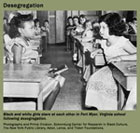
Sen. Harry F. Byrd Sr., D-Va., proposed Massive Resistance policies in the late 1950s, urging localities not to integrate their schools in response to the 1954 Brown v. Board decision by the U.S. Supreme Court. Public schools were closed in Arlington, Prince Edward and Warren counties, and in the cities of Charlottesville and Norfolk.
In Prince Edward, where public schools were closed from 1959 to 1964, many African-American children saw their educations end. While some black children moved to live with family members out of state so they could attend school, more than 1,500 were shut out of an education.
The Rev. James Kilby, of Front Royal, who was one of 23 students to integrate Warren County High School in 1959, said he was pleased to share his experiences because he wants young people to know the story of Massive Resistance and learn from it.
"A lot of young people don't appreciate what the older generation has done to pave the way to make education easier for them to obtain," Kilby said.
The Rev. J. Samuel Williams, an organizer of the 1951 walkout at Prince Edward County's black high school, said he enjoyed sharing his story with the student interviewer. He recently wrote a book about the impact of black churches in Prince Edward County on the civil rights movement.
Phyllistine Mosely, of Lynchburg, said she also remembered the positive things that came out of the experience. She was a junior living in Prince Edward when the schools closed, and she was sent to Ohio to live with a family and attend school there.
"I was ready to learn and understand how other people lived," she said. But her younger sister, with whom she was interviewed, had an entirely different experience and more difficult time because she stayed home, Mosely said.
Debra Marshall-Gwathmey, a VCU student who lived in Prince Edward when the schools were closed but was too young to attend, conducted interviews and worked on transcriptions. Marshall-Gwathmey, who is attending college on a Brown v. Board of Education Scholarship offered to Virginians denied the opportunity to attend school because of Massive Resistance, said the process gave her a deeper understanding of how being blocked from school affected students.
"The legacy of Massive Resistance continues to go on," she said, noting that inequities in the state's public schools are part of that legacy.
Utsey said he saw a connection between Massive Resistance and the South African policy of apartheid, and, in December, he took a delegation from VCU and the commission to South Africa's Sinomlando Centre for Oral History and Memory Work at University of KwaZulu-Natal.
The centre, which has worked since 1994 to create an indigenous oral history, trained the Virginia representatives to conduct the oral-history interviews, and they trained the VCU students on their return.
State Sen. Henry L. Marsh III, D-Richmond, chairman of the King commission and a former civil rights attorney who represented schoolchildren in the integration of Norfolk's public schools, said he's "a believer in this project."
"There are two or three generations of black and white children that don't understand what happened," he said, "and we have an obligation to tell them."
Source: newsadvance