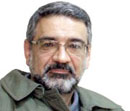
Golshan: You have for long been researching the Islamic Revolution. Were you to describe the status of documentary publication in the coming year, what would you propose? How should more documents be published? Will researching the Revolution acquire new depth, be armed with different perspectives, and be further enriched?
Behbūdi: I do not wish for more sources to be published; I wish for these sources to be processed.
Golshan: I have a feeling that the publication of documents shall continue.
Behbūdi: Yes, it shall. But imagine that the current deposit is enriched ten times more, yet it will be of no use if it sees no processing and leads to no more works.
Golshan: The Revolution spread into many regions in the country, regions which participated exuberantly in the Revolution. They had so felt the wave of the Revolution, with their locals taking an active role in the Revolution, rising up against the Pahlavi Regime. I have noticed that these events have been underplayed in the books so far published on the subject of the Revolution. There are cities about which a book is yet to be published. Do you consider these as voids? Do you believe that these are shortcomings?
Behbūdi: Well, you pointed out something important. I think that local historiographies on the subject of the Revolution have direct connection with the national identity of Iranians. This is all because of these reasons: the first is that the Revolution had a wide domain, spreading across the country as wide as the geography of Iran. We witness an event in major cities which would immediately repeat itself in a village. An event that occurred in a memorial service in a village in Māzandaran reoccurred in Mināb, in Hormozgān. We witness a similar event in a city in Kordestān and in Sistān Balūchestān. So the first reason is that the Revolution spread as wise as the geography of Iran. The second significance of local historiographies is indicative of the way our cities rely upon sources in order take proud in their past. You may have noticed that in any city, intellectuals feel proud of the history of their cities and attempt to base their works on the facts of their birthplaces and the regions they come from. This tendency towards the Revolution naturally exists in different cities and is strengthened with local historiographies. Local pride is only a form of national pride in miniature; national pride may further be enhanced and re-emphasized by national pride. What I wish to demonstrate here is that when put together, these issues depth and content; we see that the Islamic Revolution featured the national identity of Iranians. You well know that there live many tribes and clans in Iran and their management throughout the centuries was an art accomplished by sovereigns. Much has been invested to stir disunity among Iranian ethnicities and tribes. It was at last national unity that kept them loyal to their homeland and their religion, in particular. The Islamic Revolution, as we saw, was an embodiment of this.
Golshan: And even after that, during the War.
Behbūdi: The War was the apex of this. You well know that there was a time that there was much effort to endorse kings and sultans as a pillar of identity. Our history abounds with examples of this. The recent decades saw an attempt to replace this with race and then in a period language, the Persian language. However, the Revolution proved that thought, which in Iran manifests itself in Islam and Shiism, resembles a container that holds together race and language as well as different tribes and has a capacity to reshape them. From this perspective, local historiographies may well reveal our national identity in a country wherein all wishes and events are embodied by one color and voice in a region called the geography of Iran which is now extending into the Iranian Plateau. I wished to explain the significance of local historiography from this perspective.
Golshan: Has this subject been attended to as you would deem necessary (and I fully agree with you on that)?
Behbūdi: We spoke of a wish.
Golshan: Will it be attended to?
Behbūdi: Insha`Allah (God willing).
Golshan: Why do you think it has been postponed so far? Is it not interesting enough?
Behbūdi: The centre sucks in all energy; there would be a time before it would be fixed.
Golshan: So you say that Tehran is so special because it represented the centre in the Revolution?
Behbūdi: Not the centre, but the drum of the Capital city once struck, would produce a far louder sound in comparison to other cities.
Golshan: In retrospect, have there been enough sources produced for us to write local historiographies on the subject of the Islamic Revolution?
Behbūdi: You see, some major cities like Esfahān have done this. Tabriz is doing this, and as far as I know it has been carried out in Shiraz. Occasionally this task is carried out far more quickly and more exuberantly in smaller cities.
Golshan: In all the works published so far, has there been an attempt to publish the documents and write the oral history of smaller cities as well?
Behbūdi: No, they are dependent on larger cities. What I meant was that intellectuals in districts, smaller cities, and counties should pay attention to this matter, for their work is in fact the crème de la crème of the historiography of the Islamic Revolution.
Golshan: We are apparently in short of time. Do you think that regarding the history of the Revolution, there can be any points or concerns proposed which you find interesting?
Behbūdi: I have heard from some precursors that the historiography of the Islamic Revolution is yet to be adequately considered. But, considering all we said tonight and my first-hand observations during these past 20-25 years, I believe that we may not worry about the production of sources. We should be more concerned regarding other things such as imparting the knowledge of these facts into the next generation in the form of history; that is a task that the Ministry of Education has failed to accomplish and a task not taken seriously in our universities. Those who have a first-hand experience of the Revolution feel a particular form of affinity towards it. Those who have heard of the Revolution or have watched it on TV feel another form of affinity. These two are not the same. In essence, they are completely different, and there exists a wide gap between the two. I believe that we should worry about this gap and worry that the originality and clarity of this Event is not transmitted into the next generation. You see, being a Muslim differs from having a historical knowledge. We should not congratulate ourselves only because the next generation is going to be Muslim; we should worry whether it will share in the same historical memory of the first generation or not. Will it inherit the identity forged by the first generation? I worry about this and not producing sources.
Golshan: Could you explain our current status in producing analytic works?
Behbūdi: As I earlier in our discussion mentioned, it has so begun. You may well consider what Mr. Rasūl Ja`fariān did with the religious and political parties and movements of the years 1320 AP (1942) to 1357 AP (1979); it was a quintessential work. We have other similar examples.
Golshan: Another question just occurred to me. I believe that others might share in my concern. For some researchers researching the eight-year War holds more fascination than the Islamic Revolution. To tell the truth, the heroic deeds during the eight-year Sacred Defense, those memories, events, and valorous deeds are imbued with much ardor rarely felt in researching the Islamic Revolution. What is your view?
Behbūdi: Not only is it the case with research, but it also holds true in case of other fields such as literature, culture, and cinema wherein the Revolution is overshadowed by the War. Those who work in the field of the Revolution may only bemoan their jealousy and not speak of it as a bad event. Anyway, the Revolution is being overshadowed in all fields. Are there as many filmmakers in the field of the Revolution as there are on the subject of the War?
Golshan: No.
Behbūdi: Are there as many poets writing about the Revolution as there are poets portraying the War? I am not saying that this is a nuisance; I am saying that it should be fixed. If there was ever a war, it was all because there took place a revolution in the first place. So even if we are to consider one as the offshoot of the other, we should assign the central role to the Revolution. But, as you mentioned, the events of the War had such depth and at the same time appealed so much to the public opinion that it won the hearts of many viewers.
Golshan: Thank you very much, Mr. Behbūdi, and thank you our dear audience. There is yet much to discuss tonight. And if we had more time, there was yet much to discuss and ask; and I wish that this was the case. Yet, I feel we got to discuss the topic of the historiography of the Islamic Revolution adequately to the best of our abilities, and we got to analyze its different dimensions with Mr. Behbūdi. I hope that we continue with this discussion on the historiography and history writing of the Islamic Revolution further at another ample time in our future programs on history in the next year.
*The full version of this interview is available at the website of the Iranian Oral History.
Translated by: Katayoun Davallou