
|
What Is Oral History?(3)

 |
Why Are They Talking?
The purposes of an interview, expressed and implied, conscious and unconscious, also influence and shape the narrative itself. For a generation, social historians worked to shift the focus of historical inquiry away from party politics and public life towards an understanding of the everyday lives of ordinary people. As a result, their interviews are often rich with detail about work and family, neighborhood and church, but include little about the workings of local power. Interviews are also often exercises in historical resuscitation, efforts to revive popular memory about a subject precisely at that moment when it is about to slip away-hence the enormous number of interviews done in the 1960s and 1970s with pre-World War I immigrants. Hence too the more recent spate of interviewing projects on World War II, the holocaust, and the civil rights movement. These interviews often have a valorizing quality—the passion to remember and the pleasure of remembering serving as a filter to what is actually remembered, even as narrators also confront loss, disappointment, and unmet goals. Community-based oral history projects, often seeking to enhance feelings of local identity and pride, tend to side step more difficult and controversial aspects of a community’s history, as interviewer and narrator collude to present the community’s best face. More practically, narrators whose interviews are intended for web publication, with a potential audience of millions, are perhaps more likely to exercise a greater degree of self-censorship than those whose interviews will be placed in an archive, accessible only to scholarly researchers. Personal motives too can color an interview. An interviewer who admires the interviewee may well fail to ask challenging questions out of deference and respect; a narrator seeking to enhance a public reputation may well deflect an area of inquiry that threatens to tarnish it.
What Are the Circumstances of the Interview?
The circumstances of an interview can also affect what is recalled. In general, interviews for which both interviewer and interviewee have prepared are likely to be fuller and more detailed accounts than more spontaneous exchanges. Similarly, physical comfort and adequate time help create the expansive mood and unhurried pace that enhances recall. I remember carving out two hours from an otherwise busy day in which to conduct an interview with a local civil rights activist. The narrator turned out to have an exceptionally well-developed historical sense, answering questions with not only great specificity but also considerable reflectiveness on the larger significance of his actions. After two hours of talk, I was becoming increasingly anxious about all the other things I had to do that day. I was also becoming very hungry, as we had talked through the lunch hour. As a result, the last part of the interview is rather perfunctory. It would have been better if I had stopped the interview after an hour and a half and scheduled a second session on another day.
Other external conditions can also affect an interview. Some oral historians have suggested that the location of the interview subtly influences what a narrator talks about and how they talk about it. Interviews in a person’s office, for example, tend to be more formal, less intimate, with the narrator emphasizing public rather than private life. Likewise, an interview with more than one person simultaneously or the presence of a third person in the room where an interview is taking place can constrain a narrator, turning a private exchange into something more akin to a public performance. I often think that interviews with two or more family members at the same time document family relationships more than the actual topics under discussion.
Summary of Questions to Ask
To evaluate an oral history interview, consider the following:
1. Who is the narrator?
What is the narrator’s relationship to the events under discussion?
What stake might the narrator have in presenting a particular version of events?
What effect might the narrator’s social identity and position have on the interview?
How does the narrator present himself or herself in the interview?
What sort of character does the narrator become in the interview?
What influences—personal, cultural, social—might shape the way the narrator expresses himself or herself?
Consider especially how the events under discussion are generally regarded and how popular culture might shape the narrator’s account.
2. Who is the interviewer?
What background and interests does the interviewer bring to the topic of the interview?
How might this affect the interview?
How do the interviewer’s questions shape the story told?
Has the interviewer prepared for the interview?
How adept is the interviewer in getting the narrator to tell his or her story in his own way?
What effect might the interviewer’s social identity and position have on the interviewee, and hence the interview?
How might the dynamic between narrator and interviewer affect what is said in the interview?
Does the interviewer have a prior relationship with the interviewee?
How might this affect the interview?
3. What has been said in the interview?
How has the narrator structured the interview?
What’s the plot of the story?
What does this tell us about the way the narrator thinks about his or her experience?
What motifs, images, anecdotes does the narrator use to encapsulate experience?
What can this tell us about how the narrator thinks about his or her experience?
What does the narrator avoid or sidestep?
What topics does the narrator especially warm to, or speak about with interest, enthusiasm, or conviction?
What might this tell us?
Are there times when the narrator doesn’t seem to answer the question posed?
What might be the reason for this?
Are there significant factual errors in the narrative?
Is it internally consistent?
How might you account for errors and inconsistencies?
How does the narrator’s account jibe with other sources, other interviews?
How can you explain any discrepancies?
4. For what purpose has this interview been conducted?
How might the purpose have shaped the content, perspective, and tone of the interview?
5. What are the circumstances of the interview?
What effect might the location of the interview has had on what was said in the interview?
If anyone other than the interviewer and interviewee were present, what effect might the presence of this other person have had on the interview?
Do you know the mental and physical health of the narrator and interviewer?
What effect might these have had on the interview?
Model Interpretation
First, the interview.
In the mid 1990s, health educator Patricia Fabiano interviewed Dolores Bordas Kosko of McKees Rocks, Pennsylvania, as part of her study of the First Thursday Girls’ Club. This group of working-class women has been meeting socially on the first Thursday of the month for more than forty years. The Kosko interview is one of several Fabiano conducted with the club’s seven members to investigate the relationship between informal support systems and health, understood as a sense of coherence and well being. In this interview, Ms. Kosko speaks about her experiences working at Dravo Corporation, an industrial manufacturing plant located near McKees Rocks. As she tells it:
I went to work for Dravo [in June 1972], I didn’t want to progress, all I wanted to do was go back and help supplement [my husband’s] income, because we were struggling. It was just too hard on one salary. We had zip. We lived from one pay to the other. There were no extras. And we never went on vacation, we couldn’t afford it. . . . By that time Valerie was twelve, Diane was nine, and then I went to work part-time, which was fine. But then, you know, you work three days, and then the next thing you know, they want you to work four days, and then before you know it you're working five days, with no benefits, no nothing. No paid vacation. Then they offered me the full-time job, and I thought, “Well, I’m working five days anyways, and it seems to be working.” I was living right there . . . so it was very convenient, so I did go as a full-time employee.
Over the years, her work life continued to change:
And I did that for maybe about three years and then I was offered . . . a job as a supervisor. What did I know about being a supervisor? I took it, and I think to myself, “How did I ever do it?” Without any formal training. I did not have a college degree, they gave me the job of supervisor of stenographic services. I had ten girls reporting to me. Responsible for a co-op program of students going to business school and working at Dravo. Setting that program up. Interviewing. I never had any formal instruction on how to interview people. I was interviewing people. I had to do performance reviews. Writing procedure manuals. Maybe part of it is my sense of organization. Do you develop a sense of organization or is that ingrained in you, a part of your personality?
And then after that, as I look back now, it seems like every four years I made a change. I was transferred over to Automation Systems responsible for office automation, testing software, making recommendations. I still very much wanted to go to college, to get a college degree. I didn’t think I was going to be able to go for the four years, but I definitely wanted to have an associate’s degree. And Dravo had the tuition refund program. You have to pay for it first, and then they reimbursed you for it. And I started with classes. It took me twelve years. But I have my associate’s degree in Business Administration. I’m not bragging, but I just feel very proud of myself that I was able to do it, working full time, raising a family, working overtime also when projects needed it or demanded it. . . .
Then, in 1988 Kosko lost her job, a crisis that disrupted her life and challenged her to reassess certain assumptions and choices:
After sixteen years at Dravo my job was eliminated because they were downsizing. Always in the back of your mind you think, “Oh, I wish I could get laid off and I'll sit at home.” And no one really knows what happens to them when there really is a layoff. But my job was eliminated, I was laid off. And I had two weeks, they gave me a two-week notice. And a lot of people reacted with anger when they were laid off. They just picked up their stuff and they left their office. I got laid off, I came out of the office, and I went back to my office, and I went back to work. And people were walking past my office because they put two and two together, so they figured I got laid off, but they couldn’t figure out why I was still working. But I never thought I should do it any other way. I had a job, I had a project to finish. And I finished it in the two weeks, and then when the two weeks were over, then I packed up my stuff and I left. Why? Dravo was good to me. I got my education. They paid me. That was the contract with them. My contract was to finish that project. And I did. And I wouldn’t do it any other way.
But the day I had to walk out of there, it was the most horrible feeling. I felt as though I was in limbo. Like I wasn’t anywhere, and I thought to myself, “I should be enjoying this time off.” But I had out-placement services, and I went to work at that. But I didn’t start at eight o'clock. I started at eight thirty, because I really didn’t want to bump into the people in the elevators. So I went in a little bit later, and I left like four o’clock because my job was to get a job. I felt like I was in limbo. Like I didn’t have an identity. I didn’t have an identity. I wasn’t. I was Dolores Kosko, but yet, I wasn’t Steve's wife, I wasn’t Valerie’s mother, or Diane’s mother, or Julia Bordas’s daughter. I felt in limbo, that I had no identity. That’s the only way that I can describe it. I was collecting unemployment. Steve was working. And I had severance pay ‘till the end of the year. What drove me [to find another job]? I don’t know. [My friend] Joanne would say to me, “You’re crazy. Stay home!” But I don’t know. I still don’t know what it was.
“Should I go to do something different?” And I looked at that, but I’m not good at sales, because I can’t sell a product I don’t believe in. I can’t lie to anyone. So I knew sales weren’t for me. The position I really liked the best at Dravo was where I was responsible for office automation, and then I was responsible for the voice mail and I did training sessions. And then, I realized then, that I missed my calling. I should have gone to school to be a teacher. That’s my one regret, that I didn’t go to college. But, at the time, I don’t think I was mature enough, or I didn’t know what I wanted to do. My parents wanted to send me to college, but I felt that I didn’t want to burden my parents because my parents really couldn’t afford it. So I just went to Robert Morris School of Business for a six month course, but after my layoff, that's when I realized that I missed my calling. But I didn’t know that when I was eighteen. [Patricia Maria Fabiano, “The First Thursday Girls Club: A Narrative Study of Health and Social Support in a Working-Class Community,” (Ph.D. diss., The Graduate School of the Union Institute, 1999), 211-215.]
Now, the analysis.
Recall that Kosko recounted her family and work history to Patricia Fabiano for her study of a group of women who have met informally every month for more than four decades. Fabiano is a good interviewer. She is prepared and has prepared Kosko for the interview by explaining the purpose of her study. Long acquainted with Kosko and knowledgeable but not part of her world, she is deeply respectful and appreciative of the club—she assumes its value and wants to understand how it works to enhance health. She also wants to situate the story of the club in broad biographical and social, that is to say, historical, context. These preconditions to the interview create enormous rapport and set the stage for creative inquiry. Much of the richness of Kosko’s account comes from her effort to address Fabiano’s questions (regrettably not included in the edited transcript) thoughtfully and honestly.
The questions Fabiano brings to the study also open a way for Kosko to draw upon an interesting repertoire of both personal and social explanations as she puts her life into words. Like most people speaking within the individualizing framework of an interview, Kosko presents herself as the hero of her own story, a sturdy survivor and ethical person who will finish a job even when laid off and who cannot lie in a way that she feels would be necessary for a career in sales. The assumptions of the study work to create a self-consciously progressive narrative, shaped around the theme of growing confidence and autonomy. Not incidentally, this theme resonates with contemporary feminism, which has validated women’s aspirations and married women’s right to work. Though Kosko would not likely identify herself as a feminist, the assumptions and language of feminism are reflected in her account. And when Kosko’s very identity is challenged by the loss of her job, she explains the limited options and missed opportunities in her life in terms of both personal limits (“I wasn’t mature enough [to go to college at eighteen]”) and the constraints imposed by her family’s class position (“My parents really couldn’t afford it.”) Although conducted one-on-one in Kosko’s home, this interview is also quite similar in content, tone, and perspective to the interviews Fabiano conducted with the other six group members for her study. In part, this is so because the women’s lives have been similar. But it also suggests that their individual accounts have been influenced by the conversation they have been having among themselves for more than forty years about the shape and meaning of their lives. Fabiano’s interviews simply made that understanding more conscious and explicit.
To assess the interview in this way does not reduce it to an exercise in good feeling or in telling the interviewer what she wants to hear. Nor does it suggest that it is in any way untruthful or that all interviews are equal—some are richer, more thoughtful, more insightful that others, offering up more for historical analysis. Rather, it helps us understand the deeply situated, contingent, and subjective nature of oral history interviews.
To be continued…
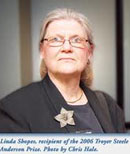
Linda Shopes
|


