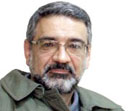
Not long ago, in one of the special episodes on history in the TV show Hezār-o Yek Shab aired during the days commemorating the victory of the Islamic Revolution, Hedāyatollah Behbūdi and Ja`far Golshan, as experts, discussed the historiography of the Islamic Revolution. Their discussion might more or less be regarded as a report on the status quo of the historiography of the Revolution. From the perspective of oral history, reading the said discussion had its merits; therefore, the website of the Iranian Oral History took it upon itself to transcribe the discussion. It should here be noted that once transcribed, the result was modified by Mr. Behbūdi before it was published on the website.
Golshan: we are to discuss a topic long abandoned with our dear guest on the eve of the anniversary of the victory of the Islamic Revolution. The historiography of the Revolution is one of the major theoretical themes in the field of research, and if it is attended to properly, we could reap the many benefits and results. It could serve as a milestone in the way of future historical researches. We are discussing this tonight with Mr. Hedāyatollah Behbūdi, who has been the head of the Bureau for the Islamic Revolution Literature at the Iranian Arts Center (Hoze Honari) for more than two decades. There have so far been many works published, whether biographies, researches, or even chronologies by the said bureau under his supervision. He has furthermore carried out many historical researches, especially with the topic of the Islamic Revolution. In a word, he has been researching the Revolution for quite some time now and is thus a prominent researcher in the field. Mr. Behbūdi, we are so pleased to have you here in our programme.
Behbūdi: In the Name of Allah. I would like to say hello to the audience.
Golshan: Before I get into any discussion with Mr. Behbūdi, I would like to clear out two concepts: historiography and history writing. There does exist a subtle difference between the two in the field of history, and the field of history owes its dynamism to this meticulousness. I now ask Mr. Behbūdi whether it is possible for us to consider any special historiography for the Islamic Revolution. And if so, what are the major trends of such a historiography?
Behbūdi: What you are proposing has a background, and that is historicism. I believe that no historical period or generation is above historicism, and it is precisely this belief which leads them all to write and research about history, albeit for one in a simplified manner and for another in the form of a science. I have elsewhere underlined this as well, and I believe it is useful to know that the historiography of the Islamic revolution may from a perspective be divided into three periods, with the first period being the 60s and starting sometime after the victory of the revolution. There are many translated sources and other writings by ambassadors and journalists who represented their news media and witnessed the events and those politicians who in their own homelands got first-hand news of the events. These people wrote the first writings on the Revolution, and their writings were later translated and considered in Iran.
Golshan: So you say that our first writings on the Revolution were imported from other countries?
Behbūdi: Yes. We were in fact but the consumers of sources authored by others. Yes, there existed some domestic sources, but those were few. One might say that Hāj Mehdi`s unsaid words was an exception in the field of oral history, and this was also the case for the first volume of the book by Seyyed Hamid Rohāni. There were furthermore few local historiographies on Esfahān and other cities. Then we have the 70s which was the decade right after the Imposed War when we were beginning to realize that not much had been done regarding a major event such as the Revolution. This decade witnessed the emergence of a new historical genre: oral history. The said genre began to extensively collect and publish the memories of witnesses and the individuals who were around during the Revolution. The advent of this available and fast-growing genre led to equilibrium in the production of translated works in the 60s and the production of domestic sources in the 70s. The final years of the 70s witnessed the opening of documentary archives. Archival organizations, abiding by their own rules, provided the researchers directly or indirectly with the necessary sources. For instance, with the release of the documents of the Center for the Historical Documents Survey, the Islamic Revolution Document Center, the Institute for Political Researches and Studies, the Ministry of Foreign Affairs, the Presidential Office`s Center for Documentation, the Islamic Consultative Assembly, and other organizations such as the Iranian Institute for Contemporary History and the National Archives Organization; the field of historiography found itself bouncing forward. In the 80s, the production of domestic sources was scaled up to be higher than the production of translated works. We may now consider a fourth period: the period during which we are tapping into historiography and researching history. This period opens up new horizons which shall later be discussed.
Golshan: I understand that you mean there are three sources: imported or translated works, oral history, and then archival books. After three decades of gathering sources on the Revolution, we can now review these historiographies and take into account the historiography of the Revolution. But, is there such an ambience among the researchers for them to consider the historiography of the Revolution?
Behbūdi: well, you see we are pushing through a process of trial and error. From the perspective of historiography, rather than relying on the predecessors and those forces who dabbed in historiography even before the Revolution, we tend to rely far more on those that began their work after the revolution. That was why I believe that the process of trial and error is coming to an end, marking the beginning of a professional era in the field of historiography.
Golshan: And that would be criticizing, analyzing, and examining our writings.
Behbūdi: Yes, that`s right.
Golshan: What you mentioned earlier made me wonder. In the first decade, we have those works which were translated from non-Persian sources into Persian. This may lead to the impression that we had no domestic way of analyzing the Islamic Revolution, and there was mostly an approach imported from other countries. Did this not influence our understanding and analysis of the Revolution?
Behbūdi: Well what you propose is one of the long-lasting shortcomings of historiography. In order to uncover the basics of the Revolution, we have for years dealt with theories complied in other countries and then imported into Iran through translation. Some have tried to identify the causes of the Revolution by applying these theories when amazingly enough western academics are after these many years revising these theories and have concluded that what has so far been proposed falls short of explaining that great event which took place in Iran. You may well know that for long we applied theories such as Nikki Keddie`s multi-urbanism in Iran's Revolution or Theda Skocpol`s views regarding the Islamic Revolution or other theories such as uneven development. We have never been able to develop a domestic theory which would originate in our own country and would in line with our national beliefs take into consideration our national traditions. There have been many general views proposed. We may well assume that this was a divine revolution; no loyalist to the Revolution would ever oppose such a view, yet this true view should be made scientific and presented in the form of a tangible theory that could well be proposed. We cannot ratify theorization about the Revolution with these general views. There now exists a foreign theory which is based on uninterpretability. One of the western academics believes that the Revolution is not interpretable; i.e. it rejects all written about it so far. Yes, we still suffer from such a shortcoming; therefore, advocates, theorists, and scholars of the Revolution had better change this by proceeding to develop a theory of the Revolution based upon its domestic origins.
Golshan: Then you say that the westerners, those who do not write in Persian, increasingly approach the Revolution with a new perspective or from a new angle and try to better fathom the Revolution and all its aspects. In other words, they now feel that it is a significant phenomenon, so there exists a need to review what has been observed before. Now if you wish to continue with this discussion, the topic of oral history as you proposed, let us presume that these reviewer perspectives by which we can analyze a new aspect every day, have a re-analysis, and approach the subject from a new scientific angle are political sociology, economic sociology or other fields such as history or psychology. Does there exist such a mentality among researchers to approach the Islamic Revolution from these perspectives?
Behbūdi: I believe that we are yet to be there. We have so far successfully pushed past the stage of developing the preliminary sources.
Golshan: Meaning that the data necessary for researching the Revolution has been published.
Behbūdi: It so appears, and anyone who wishes to employ these elements may have them well at his/her disposal. Now it is time for the specialists of the aforementioned fields to gather around and employ these elements and apply different perspectives. I believe that we are yet to be there.
To be continued…
Translated by: Katayoun Davallou