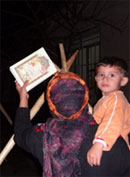
The last Wednesday of the year is reminder of a sense of nostalgia which a great part of it is related to an ancient heritage, preserved by our ancestors and great men through oral narrations. This heritage now comprises a part of cultural believes of ethnic groups. Reviewing the past memories, the last Wednesday of the year has always been considered as a pure and sacred day in my mind. Expression of rituals and cultural believes, as symbol of insights of different groups and nations, certainly can help a lot in recording and reviving its different aspects.
What is left in my mind as the last Wednesday of the year is different from Chaharshanbeh-Suri [feast of last Wednesday of the year] or fireworks, crackers etc, which is seen today in a vast and dangerous manner. This day was the symbol of pureness, earnestness, seeking God’s remission and resorting to Koran and had a special place in cultural believes of the inhabitants of Hezar-Masjed [in north east of Iran].
They started their fireworks a little sooner than other parts and celebrated the end of Cheleh-Kuchik [the first forty days of the winter] by making fire and jumping over that, as a sign of ending cold days of winter. Sweet and sad memories of those days are in front of my eyes like a book, although they are being faded and many of its terms are being forgotten after all these years.
Cultural symbols are different between various ethnic groups and every part of Iran gets ready for the New Year (Nowruz) in a different ways. In Elefe days, last Sunday, Monday and Tuesday of the year, people go to the graves of those passed away, in the last Tuesday of the year and read Koran for them.
The last Tuesday of the year was one of the most crowded days of the public baths. Because everybody wanted to be clean when he passes beneath Koran. After sunset people put Korans on tripods so that a tunnel would be shaped. Then they passed beneath them, kissing the Korans and prayed the following year to be full of goodness and blessings for them. They did this three times. In this way, they discarded uncleanness from themselves and started the New Year resorting to Koran, may God bestow them freshness and pureness in the New Year. The bitter memories of baths and bitter taste of deprivation of the people in villages in those days are undeniable parts of my memories.
Preparing for Nowruz
Nowruz [New Year] rituals is a national feast rooted in history and culture of the Iranian people. It is remained from King Jamshid and is considered as the origin of development and resurrection of the nature. It has a special place and importance between all ethnic groups. After entrance of Islam to Iran this feast took a religious color too.
The Kormanj people start their Nowruz rituals a month before Nowruz. The Kormanj of Khorasan province prepare for grandiose rituals of Nowruz with their own special ceremonies. Some of the ceremonies and rituals performed in the past are as bellow:
1- 17 Mal
Every member of a family chose a small piece of stone and put it on a specific point on the ground, 17 days before Nowruz. After the New Year if there were some grass grown under that stone it would be a sign of a rainy and bountiful year. If the ground under the stone was dry with no grass that meant it would be a hard and droughty year.
2- Growing Sabzeh
Usually two weeks before New Year every family grows some seeds. They put some wheat or barley seeds in a dish and keep it wet so that it would germinate. After a few days the green leaves grow tall. This is called Sabzeh of Nowruz.
Sabzeh is also used to cook Samanu [a sweet pudding made from germinated wheat], which is one of the seven parts of Nowruz table in Kormanj starting with S.
3- House Cleaning
House cleaning ceremony is usually performed a week before Nowruz. The Kormanj believe cleaning the house, carpets and other furniture will bring pureness and freshness to their home. The women put hand in hand to take the furniture out in sunlight so that their oldness to be removed.
4- Cooking Dano
Almost two weeks to Nowruz the Kormanj people cook a special food called Dano. They use pea, lentil and spice to cook it. After cooking Dano they drop a blue bead in the food pot. Then the mother of the family picks food for each one of the family member by a big spoon from the pot, starting from the youngest member. If the blue bead drops in anybody’s dish, the following year would be after his name, if he/she is a good mannered one, that year would be bounteous.
5- Nowruz Table
A special flamboyant and delicacies cloth is woven by Kormanj women for Nowruz table. They put Koran, water, garlic, Samanu, apple, coin, Sabzeh [all starting with S in Persian], confection etc on it. The table is usually set in the drawing room by young girls. Family members sit around the table and start the New Year with happiness.
6- The Day of Nowruz
Nowruz is one of the happiest days of the year. Kids put on their new clothes. Families go to meet each other and the kids are given gifts and money. They wish a good year for each other. People also go to meet families who have lost a member of theirs to condolence them. Families whose sons have married take some gifts for their brides and …
Although these unrepeatable memories are now forgotten, but Nowruz with all its passion and enthusiasm is reminder of resurrection, kindness and benevolence.
Translator: Asghar Aboutorabi
Persian Source:
http://oral-history.ir/show.php?page=article&id=667