
|
The 6th Oral History Workshop Held in Hamadan

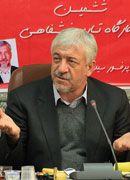 |
The 6th oral history workshop was hold in 20.Azar.1393 (11.Dec.2014) in Hamadan Bonyad Shahid gathering hall (gathering hall of Hamadan Sacrificing and Martyrs’ affairs Foundation) by presentation of Morteza Nurayee, PhD and Professor in the field of history in Isfahan University, in continuation with the last oral-history workshops.
It should be mentioned that the workshops have been hold since the early of 1393 (March 2014) by the Head of Hamadan National Library and Archives of IR beside other well-known organizations and institutions, such as Hozeh Honari (Art Center) along with Sacrificing and Martyrs’ Affairs Foundation in Hamadan province, to train young and amateur researchers together with professional ones.
Mr. Nurayee had begun his speech through illustrating in relation to the writing a research subject.
“Contrary to the most persons’ believes; the writing should be done in the beginning of the research plan not after the ending of that. Although, the main and significance step toward writing is at the time of executing and extracting the plan” he said.
“There is divided in two titles, first is the person-driven and second is the subject-driven. In person-driven plans, biography and performance of a person is important while in the subject-driven, the narrator is important. There should be mentioned that the research will never be ended especially in oral history” he continued.
As Nurayee’s experience, he referred to the following viewpoints:
1- Gathering the uneducated or low-educated persons in a same place to interview simultaneously because of decreasing the incorrect statements and completing the subject; moreover, increasing the variables and the reliability by uttering each person in cooperation,
2- Presenting of two persons during the interview, one for making the interview and another for analyzing and writing the action and interaction of interviewee through a precise observation,
3- Making the interview more than one time because sometimes, it needs to complete the statements over again.
“For the reason of the importance of the history especially oral history, it should be mentioned that documentary depends on oral history because history is consist of a group’s conscious experience, in addition oral history is under category of qualitative research,” he cited.
“Generally, the hypothesis defines the research method, also it facilities the method. Therefore, it should be mentioned that there is not the hypothesis in the qualitative research; however, it is proved that if researcher follows the oral history by the hypothesis, s/he cannot achieve anything. There should have been a research problem not research questions as well as have been a question but not an observable method completely because if there were an observable method in the beginning of research, we would reach to what we want not what we should get to it,” he said.
“Research questions are consisting of two types in oral history ‘structured or closed questionnaire and unstructured or open questionnaire. For instance, the questionnaires are not applied researches at all; therefore, it is better to apply the unstructured or open questionnaires. It means that all questionnaires have been setting before the interview and designing the questions”, he cited.
“In the research concerning with oral history, there are important following steps: first is the sequencing; second is the successive hearsay; and third is the analyzing. The sequencing is the historical and chronological laying out as well as the place and its accuracy. Successive hearsay is about the documents and the narrators. They are complementing each other. Analyzing helps readers to realize the subject-mater better. In historical research all above dimensions should be investigated but in case and field study research, there is only one subject that it should be investigated,” he added.
By: Abolfath Momen
Translated by: Farah Jafarkhan (Adipen)
|


