
|
Anyone who can write the history will leave us soon

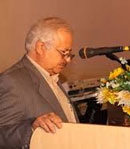 |
“Besides recording the events and the realities in oral history, it helps us to procreating the global peace” said Alireza Ghahhari.
The one hundred and forty second discourse in art and architecture meeting was concerning with oral history.
In the begging of the meeting, there was played a film about Tehran and explained about the situation of Sâhebgharâneh palace, then Seyed Alireza Ghahhari, Director Member of Board of Trustees in Iran's Architecture Prideworthies Fundation, began to make a speech.
“The reason of holding these meetings has been referring to 10 years ago when the first outlook in relation to collecting the art and architecture resources of oral history was set up. However, up to now, there has been no any activity more regarding with. Naturally, oral history in Europe and USA is a new subject too” he added.
“It refers to the days of the invention of the tape recorder after the end of WW2 (Second World War) that refugees who had immigrated to USA, recorded the words by which said and heard through the war themselves”, he stated.
“In this case, it was lead to propound the oral history viewpoint because there was no any historian on that period of time who wrote true historical documents about the war events and its issues. In addition, the architecture documents about Ghajareh era were collected through oral hearsay” he continued.
“Today, we are out of reach to who can write the history. This oral attitude is a special significance. We can talk with one who designed Azadi tore or conductors who built it now, but they will be far-reaching in 50 years later” he stated.
After Islamic Revolution, Harvard University started to collect the current political history of Iran such as the Europe Second World War and talked with civil official persons or people who had been refugees even with children.
“Afterward in the 1360s (1980s), the war oral history of Iran and Iraq was collected, however, now there is nobody who says and writes about the crafts of those days”, he mentioned.
“One, who played the role to make the outline of the art and architecture space, is not alive today and anybody has no listened to his/her talking before”, he said.
“Now, if we spend a lot of money, there will be no any advantage to get because we have lost such people as Jahanara” he pointed out.
“Oral history is following two facts. The first is the recording of the era of the history and the second is the helping of procreating the global peace. One who has participated in an event or served, if s/he gives information as a false or wrong quotation, then nobody cannot change it to different one”, he cited.
By: Alireza Ghahhari
Translated by : Farah Jafarkhan (Adipen)
Source: honaronline
|


