Cliff Bellamy
HSNWS 11-13 daoud haroon photo
DURHAM —
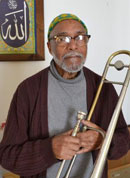
“I m working out of a big bag – maybe too big,” says Daoud Haroon in his Mangum Street apartment.
He is talking about how he plans to use the award money he will receive as one of 34 people that United States Artists has chosen as fellows for 2014. All 34 fellows receive a $50,000 award to use however they wish in the development of their art.
Haroon plans to use the grant to create musical vignettes for works of African and African-American literature. A trombonist and percussionist, when he speaks of this project, he brings in his experience and the perspectives of many disciplines besides music – visual art, oral history and spiritual teachings.
Collaboration among artists is crucial to Haroon, and this project will involve collaboration. He wants to film a griot, an African term for an oral historian and chronicler. He holds up a copy of South African poet Don Mattera’s collection titled “Azanian Love Song.” He mentions the possibility of enlisting vocalist Aura Msimang to sing or read some of the poems. “This is the formulation of what I call a source book that could be used by any artist, not just musicians,” he said. “It could be material for dancers because it would have the video.” It will incorporate ancient unpublished music and “contemporary work with a contemporary interpretation, coming from my own creativity because I’ve got some music I want to work on. … That in itself is a monster project, but that’s one of many.”
He heard about the award about a month ago. He is one of three musicians to get the fellowship. The others are bass player and songwriter Meshell Ndegeocello and banjo player Alison Brown. Haroon and other fellows will be in Chicago in March, and he said he is looking forward to talking to Brown because of his interest in the African origins of the banjo.
Haroon, 81, was born John Mancebo Lewis in Boston’s Roxbury section, where in the 1950s he learned firsthand from the musicians who were part of that city’s fervent music scene. “Today everybody thinks you have to go to school to learn how to play jazz, but then you learned how to play jazz en passant. … It had nothing to do with academia, it had nothing to do with professors and degrees. All of that came for me later, much later,” he said.
A public school dropout, Haroon eventually earned a bachelor of music from Wesleyan University in Connecticut, where he was a student-instructor. He has a master’s degree in history from Texas Southern University in Houston, where his specialties include oral history and colonial American history. He has traveled and studied music and spirituality in Iran, Pakistan, Morocco and other countries.
Well before he heard about the United States Artists award, he began preparing his talk on Duke Ellington, to be delivered in December as part of the Durham County Library’s Humanities series.
His personal journey in music has many Ellington connections. He heard Ellington’s music from the time he was a baby, because his mom would take him to a club in Boston where she worked, and where musicians performed. Haroon originally played congas but later switched to the trombone, and the connection many of Ellington’s musicians had to Boston led to his taking lessons from Charles “Chuck” Connors, trombonist in Ellington’s orchestra.
Connors came out of the Navy symphony orchestra and came to Boston to go to school, Haroon said. “He was a student at the Boston Conservatory, so a lot of the guys in Boston that I knew actually either found their way to the Boston Conservatory or New England Conservatory, those guys who were interested in perfecting their writing skills, their composing skills, their conducting skills,” he said. Connors “graduated in the same class as [saxophonist] Ken McIntyre [with whom Haroon recorded], [reed player] Roland Alexander, a bunch of really great Boston musicians.”
During the 1950s, Haroon also was learning the music in Boston’s venues. “There was a strip in Roxbury where I grew up where all the nightclubs were and where all the eating establishments were, sort of like the Harlem of Boston,” Haroon said. “In the ’50s, they still had segregated musicians unions. So they had the black musicians’ union right in the middle of all of this. … Most of the composers at the time would invite all the musicians to come either into those nightclubs in the afternoons or the mornings or into the musicians’ union and rehearse their music.”
Connors went with Dizzy Gillespie’s band on several State Department world tours. When he came back to Boston, Ellington needed another trombonist and chose Connors. Haroon later recorded with McIntyre, and in the 1960s when he went to New York, Connors was still with Ellington. “Charlie was trying to convince me that I should come into the band,” he said. “So I followed that band around for awhile … waiting in the wings for the opportunity,” he said.
One of the points he plans to make in his talk is that Ellington also was a great collaborator. Visual artist Romare Bearden was a contemporary of Ellington’s, “so Ellington’s music didn’t develop in a vacuum. There are social implications to all these arts. They overlap.” Ellington also was trained as a painter and “had that painter’s sensitivity. He would see and he could translate. Music became the medium, but he was very visual,” Haroon said.
“A lot of musicians are not lucky enough to know the dancers, and the musicians and the poets and the painters,” he said. “I came up in an era when all these different artists were of one fraternity.”
Go and Do
WHAT: Duke Ellington: Man, Myth, Music and the Eternal Sacred
WHEN: Dec. 9, 7 p.m.
WHERE: Stanford L. Warren Library, 1201 Fayetteville St., Durham
ADMISSION: Free
Source: heraldsun