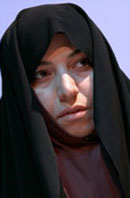
Author of Da, Iran's bestselling title in history after the holy Quran and Mafatih al-Janan, believes that the book's English translator has undermined the work's scientific and literary value by not mentioning the author's title in the book. Da has undergone over 100 reprints in Iran and its English version is about to be unveiled in Iran. Mazda publications has released the English version of the work in the US.
What follows is an interview with Azam Husseini about the translation of her work into English by Paul Sprachman.
Q: Ms. Hosseini! Please, tell us how you view translations of Sacred Defense works? Specially, do you regard Da's English rendition a success?
A: Books are written to be read and their contents transferred to the readers. It is a great success for a writer to have their book translated into foreign languages so they are accessed by readers overseas. Not every book has the chance of being presented abroad. When translated, a work is to represent the culture and belief systems of where it was created, which is the good part of the story. There are, however, some sideline issues which inflict damages to the beauty of this cultural scenario that make its sweet taste banal. I hope these issues are resolved for good.
Q: What makes you think this way? Does it include what Da has undergone in its translation?
A: This interview is not the proper place for putting certain issues on the table; however, I shall focus on a number of issues to be able to answer your question logically and exactly.
Why has the English version's publisher made every effort to eliminate the book's author?
Has the publisher been entitled to have the book translated at all?
Why is the book's author not invited to the decision-making sessions for translation of the book, and is not even informed of the meetings?
Why no meetings were arranged between the book's creator and translator, Mr. Paul Sprachman, so they could discuss their concerns about the work's English translation?
These are not issues I would like to discuss in this interview. But, I shall focus on one single issue. Da's English rendition is about to be released after about five years. I heard the news in the media and saw pictures of the translated work online. I am at this moment unable to speak of the translated content given the fact that I have not received any copies of the translation and have no idea which parts were eliminated by the translator.
The problem begins with the translation's cover picture. Then it goes to the titles and book's creators that are not printed on the cover. Instead the name of the translator appears on the title which looks like Mr. Sprachman has created the book. What does it imply when the title of the book's creator is not mentioned on its cover? And, who should be responsible for violation of the rights in this regard? Over the years since the release of the original version of the book, the name of Azam Husseini, the book's author, has been omitted in various print-runs and Zahra Husseini has been mentioned as the book's creator and narrator instead, which is not right. Now in the English translation neither Zahra Husseini nor Azam Husseini have been mentioned at all. What does this mean? Isn’t this a case of plagiarism? When the name Sprachman is printed on the cover, then doesn’t this mean that he has created the work? Furthermore, no mention of Zahra nor Azam Husseini has been made in the introduction of the book which is penned by Mr. Sprachman and is uploaded on the website of Mazda Publications (Da's publisher in California).
Q: Do you think Mr. Sprachman knew what he was doing or he had simply become the subject of this violation by others?
A: Well, he had access to every line of the book right from the beginning and must have read about the role Zahra and Azam Husseini jointly played to create the book. Then, why is it that he did not even mention their names on the cover of the translation. If Mr. Sprachman respected Ms. Zahra Husseini as the book's author why is it only written on the cover that the book is based on the memories of Zahra Husseini? And if he regards her as the narrator, why has she been referred to as the book's author in the Persian preface?
Should Mr. Jabari, manager of Mazda publications in the US, be accountable for publication of Da's translation without mentioning the author's name? I don’t know, maybe this is OK in a country that is ahead of us in terms of technology and science, and patents are no longer observed when it comes to publication of books. Should I render the scientific and literary damages caused by this oversight to myself, given the fact that I saw signs of this piracy over the years and did not manage to counter them?
I can attribute this problem to everyone involved in publication of the English version of the book including the translator, the publisher and the author.
Mr. Sprachman did not feel any need to care about the book's author when he never met her in the decision-making sessions with publishers for translation of the book.
It is a known fact that Mazda publications had Mr. Sprachman translate the book independent of the Persian publisher of the book in Iran, and therefore Mr. Sprachman as the sole individual who pursued the English publication of the book could not be expected to care about the author's rights in this regard. He did not even bother to recognize who the real writer of the book was.
When it comes to me, as the author of the book, I have spared no effort to fight for my rights as the creator of this bestselling book since its release about five years ago.
Q: Did the officials in the Arts Bureau who published the original Persian version of the book and are about to unveil it English version contact you or coordinate with the during the translation process?
A: Not at all. I have not received any copies of the translation yet, even though it is about to be unveiled, and I wonder who will be responsible for resolving the possible issues with the translation? Who will be accountable for preserving the rights of the author? Has the translator been completely briefed about the technical points that need special consideration throughout the work and has he been made eligible of all the patent rights that may include his work? Or maybe he has been ignorantly given carte blanche in his decisions to translate the book however he deemed proper? Why did the publishers not mind the sensitivities of the work? All these issues are due to the fact that the publisher of the Persian version of the book, Soureh Mehr, has not assumed any rights for the book's author which has ensued her rights being violated by the translator who has put his name on the cover of the book, looking like he was one who authored and created the work. Mazda publications and Soureh Mehr have not considered any rights to the author of the book in its English version.
Translated by: Abbas Hajihashemi