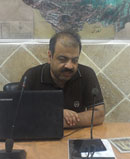
Head of the Documentation Center of Astan Quds Razavi in Sari said:
The greatest activity occurred in the field of oral history in Iran is pertaining to Martyrs Congresses, which has had a good function, but has no scientific basis.
Doctor AbolFadl Hasan Abadi comes from Mashhad and teaches oral and local history. He is the author of two books; Sadat Razavi in Mashhad and oral history in Iran. Also, he has written 80 research articles, which 30 of them are in the oral history field.
At the Tuesday afternoon, Doctor Hasan Abadi attended in the scientific meeting which was held in the center of Sarishenasi, and a group of history instructors of schools and universities, and few researchers, who are working in the field of Mazandaran, were presented there.
Initially, Doctor Hasan Abadi spoke about oral history and its status in the Iran and then audience raised their comments and questions.
* Oral history as a tool
At this meeting, Mashhad University professor said that Oral history is a method in which information was collected by means of audio and video interviews through two factors of interviewer and interviewee. Oral history is not a specific method of research, but it is a special tool which gathers information at the needs basis.
* History is taught hard
The history of Oral History in the world goes back to post World War II. There were two period in Oral History. The first was between 1948 and 1960 and most of elites, dignitaries and political influential persons were interviewed in this period. Second period was initiated from 1960 and continued to 1975.
This researcher from Mashhad stated that, Oral History archives were created from 1960s to 1970s in universities and public and private centers. Also, Oral history became quickly comprehensive and common practice from 1980s. Computers completed archival sources’ dissemination of information too. And all these lead to the currency of oral history in the community.
He also argued about the problem of apathy among students majoring in history. He said this subject is a general discussion and some people poses that inapplicability of history causes this problem. Certainly the instructors of this course also teach lessons in the form of hard and low attraction.
Hasan Abadi explained that war and Iran's Islamic Revolution are fields to create an oral history in Iran and its functional areas in Iran began from 1370s (A.H.S) afterwards.
He emphasized that we don’t have any statistics for determining how much interview exists and in what areas of oral history. It is estimated that 100 to 150 thousand hours of interviews exist in the country that certainly some of them are only the cost and not oral history.
* We don’t have good condition in oral history
Columbia University is the only university in the world that graduates oral history degree. And in Iran, just a few course of oral history are taught in the University of Isfahan and still higher academic degrees aren’t graduated in the oral history field.
Our situation is not favorable in terms of oral history and most activities center on the characters and personalities and not other areas. In Iran, Oral history standards have been developed in the recent years.
Despite this situation, certainly we don’t have bad situation in Asia and we are among 2-3 top countries in Asia in the field of oral history.
* Historians who write history or historians who make history?
Doctor Hasan Abadi then pointed out that we also have non-academic historians in the society who go to different places and explore very hard, rather than teaching and exchange of knowledge.
Hasan Abadi named Iraj Afshar and Manouchehr Sotoudeh and added that these are historians and researchers who have traveled through country and explored. Now, which group has more shares?
By introducing a researcher from Mashhad who alone has interviewed 20 thousand hours about war, he stated that such researchers shouldn’t be compared with individuals who just teach history and use other’s data.
* Standard oral history
One of the problems that exist in the field of oral history is its border overlaps with oral traditions and folklore. There is a difference between folklore and oral history.
The concern is that, narration measurement, validation, and error rate of persons who interested in culture and record interviews is not clear.
But with all these uncertainties and difficulties, oral history can be cited, because we're not looking for judgment and merely collect historical information.
By referring to other weaknesses of oral history, like positive thinking and self-censorship, he declared that we are looking more positive aspect in oral history. and about matters that are dark and negative, research does not take place.
* Both knowledge and budget
Oral history in the world and in Iran is the new trend. And with all the weaknesses, it cannot be ignored. Oral history is a two-way interaction and dialogue and because we have more oral tradition in Iran than written, you can start important efforts and making history by compliance with standards in this field.
Reaching to the summit requires knowledge, planning and reliability, and of course the latter, i.e. money, has more prominent role.
Hasan Abadi said that in Astan Quds Razavi about 20 official and unofficial forces are working in the field of oral history by his supervision.
At the end, he added there is not any organization and scientific center in the charge of this important affair in our province. And local researchers’ interest is the basis of the amount of works which is done in the field of oral history.
Source: Mazandnoomeh
Translated by: Zahra Hosseinian