| |

|
The Challenges of Oral History Weekly

The number 100 is sacred for some people and has a special meaning for many people of the world. But most people believe that the number implies plentitude and excess. That is why this number is used at the time of joyfulness among Iranians. The children also count number 100 many times and every time they want to create in others minds the plentitude of something, they will use it.
I wrote the above few sentences to show my intention of writing this article. I think probably the significance and the meaning which is hidden in the number 100, has made those who are involved in Oral history weekly to open a special account on the weeklys issue 100.

| |

|
|
When a prison, is not prison
A short while after the 1953 Iranian coup détat (known in Iran as the 28 Mordad coup), they set most theaters on fire, closed them down and captured the artists. Under Bakhtiars military command in Tehran, they incarcerated the local populace under the pretext of the Article V of Law and imprisoned every artist. I was, too, arrested in the street. At first, they kept me in a detention center in Tehran where I met Mohammad Ali Jafari and many other artists and radio staff; then, a few days later they took me and Mr. Jafari to Qasr Prison due to lack of room for the detainees in the detention center. The word had gone out that those taken to Qasr would never return home.
| |
|
|
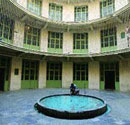
Book to be unveiled on Qezel-Qale (Red Castle)
A book will be unveiled and published on Qezel-Qale (Red Castle) at Iran’s Ebrat Museum next Sunday.
IBNA: The unveiling ceremony of Yaghub Lotfi’s latest publication was scheduled to be held today (Sunday) but was postponed to next Sunday due to certain unforeseen events.
The prison’s geographical status, the prisoners, campaigners and memories of the prisoners are the themes of the book’s chapters.
| |
|
|
Every province to hold oral history workshops
Talking about the importance of writing oral history as books, an official of the Art Bureau said: “Considering the work’s significance in registering the revolution and Sacred Defense’s incidents, every province will hold 36 hours of workshops.”
IBNA: The resistance literature and studies office of Art Bureau’s province’s affairs held the 10th edition of its educational workshops, themed on oral history, in Isfahan.
The workshops are held in order to promote provincial researchers and writer’s activities for writing better oral history books.
| |
|
|
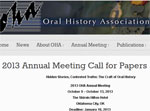
2013 Annual Meeting Call for Papers
The 2013 annual meeting of the Oral History Association will offer an opportunity to showcase the ways in which oral history has been used to unearth hidden stories and contest accepted truths. Through work to address silences, oral history provides a method by which unknown experiences and fresh perspectives can come to light and provide scholars and communities a more robust understanding of the past. It holds the power to defy stereotypes and challenge simple generalizations. Conference organizers invite proposals for panels or individual papers exploring the ways in which oral history has recorded and presented critical counter narratives, bringing needed diversity and enhanced complexity to the study of events, ideas, or issues. Our hope is that oral historians from a wide range of settings and disciplines will contribute to this discussion of how their work has uncovered new stories or defied popular notions.
| |
|
|
Conference: Faculty of Asian and African Studies Saint Petersburg State University
THE XXVII INTERNATIONAL CONFERENCE ON HISTORIOGRAPHY AND SOURCE STUDIES OF ASIA AND AFRICA
The Faculty of Asian and African Studies of the Saint Petersburg State University is organizing the XXVII International Conference on Historiography and Source Studies of Asia and Africa «Local Heritage and Global Perspective»
| |
|
|
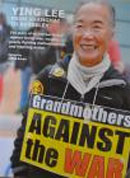
Book recounts activists journey From Shanghai to Berkeley
Ying Lee isnt slowing down. The former city councilwoman is 80 now, but she has a limited amount of time to talk because shes heading downtown to a protest at the historic Berkeley Post Office building.
Shes worried about the impending closure of branches across the country, both because of the service and the jobs that will be lost.
"I really think of the post office as being one of the fundamental institutions of the United States," Lee says. "Not only in terms of providing basic services but also in terms of work opportunities. Job opportunities for African-Americans."
| |
|
|
Oral History Weekly Magazine Aims and Regulations
Oral History Weekly Magazine wishes to create a suitable place for thoughts and idea development; Its main field would be “Oral History” and subjects as telling & writing memoirs, writing diaries, travelogues, chronologies, and all other subfields of history which are presented in the form of news, articles, reports, notes, interviews and memoirs can be included. There is no limitation on the length of would-be-sent materials.
Mentioning the name, academic background and email is necessary. Articles with complete references and bibliography are more credited and an abstract would quite helpful.
Weekly is not about to publish any material consisting insults and libels about other people or anything that brings anxiety to public opinion. Weekly can edit and translate the received materials.
The published articles and materials are only the writer’s ideas and Oral History Weekly Magazine has no responsibility about their content.
|
|
|

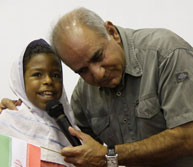
A ceremony was held to honour the incorporation of a lesson in the sixth-grade book about the legend who Martyr Darya-Qoli Surani.

Ahmad Ahmad Memoirs (11)
Edited by Mohsen Kazemi
Soureh Mehr Publishing Company
(Original Text in Persian, 2000)
Translated by Mohammad Karimi
Female Pioneers of Fight
When the families of Coalition members or the free ones became aware of the prisoner members situation, their first priority was to free their comrades or at least make a better condition for them in the prison.
A month after the martyrdom of the ones who killed Masour (Bukharai, Amani, Saffar Harandi& Niknezhad) while the worries of prisoners families were growing the other members of Coalition began thinking on a strategy to put pressure on the regime to create a better condition for the prisoners.
After long and clear consultations, the wives and family members of prisoners were advised to take the flag of fight in their own hand. They had always been sympathetically supporting their men in the past, but now they became forerunners in the fight to create a bigger epic in the history of the country.
The coalition chose Haj Mahmood Shafiq (Haj Mahdis brother) & me to provide and coordinate the womens gatherings. Of course, this matter was announced officially because of the stifling conditions.
It was decided that the meeting should be held in front of Prime Ministers office. We contacted the families and informed them about the time and place of the gathering.
It was in hot summer day of 1965 that about 150 veiled women gathered in front of Prime Ministers office to make a calm peaceful rally. We told them to go in front and we, the men, would follow them with a short distance and would watch and care the condition around.(1)
The women reached in front of Prime Ministers office. Some of began to speak including the sister of Martyr Sadegh Amani(2) who was a brave lady. She talked enthusiastically and it aroused the sensitivity of the guards. The guards took position but did not make any attack. Mrs. Amani declared whatever the prisoners families wanted. One of the guards started to speak to impede conflict and promised the announced demands of prisoners families would be considered. |


|
|