| |

|
A Librarians Ponderings on Oral History

In my belief, oral history is a method for exploring the mental world of an individual in order to access his personal views, memories and experiences through specialized interviews so that they are used in historical, political, social, anthropological, psychological and literary studies as accurate, well-documented and credible information. Awareness of interview techniques constitutes the basis of any project on oral history; therefore, experts with different specialties can act as interviewers. Moreover, if the collected information is preserved in sound archives, it will turn into an oral source in the form of “interview” and have the capability to be tapped for forming different written genres.

| |

|
|
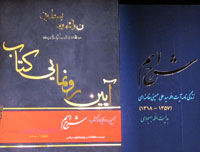
Supreme Leader’s biography unveiled
The life story of the Supreme Leader of the Islamic Revolution Ayatollah Seyyed Ali Khamenei was unveiled during a ceremony at the Art Bureau in Tehran on Saturday.
IBNA: The ceremony was attended by Islamic Guidance and Culture Minister Seyyed Mohammad Husseini who expressed his gratitude to the book’s author and publisher saying: “Several works have been written about the contemporary history but they aren’t enough. Not many books have been written and compiled about the previous centuries particularly the last century, from the constitution so far.
| |
|
|
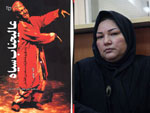
His Majesty Black: biography of Saadi Afshar released
His Majesty Black: The biography and memories of Saadi Afshar is written by Laleh Alem and published by Pouyandeh Publications.
IBNA: There was a god reception of Laleh Alem's last book, 'Meet the Faces' at the time of publication. Saadi Afshar was one of the figures introduced in this book; and then many readers have asked Alem to write a complete book on him.
Alem added: "The book contains the biography and memories of Saadi Afshar in his own words. I have tried to give a fictional structure to it based on the realities, and so all the names and characters mentioned in the book are real."
| |
|
|
Barnidge: Preserving Bay Area history one word at a time
When UC Berkeley's Regional Oral History Office announced last week that it was beginning research on a Bay Bridge project, a question leapt to mind: UC Berkeley has a Regional Oral History Office?
Yep, it's been around since 1954 -- as a division of the Bancroft Library -- dedicated to preserving the history of the Bay Area and the western United States by "conducting carefully researched, tape-recorded and transcribed interviews" of those who were witness to the past.
| |
|
|
Q&A with Art Howard
City of residence: Warner Robins
Occupation: Co-founder of Warner Robins Heritage Society; program manager for Stover and Associates
QUESTION: What is the Warner Robins Heritage Society?
ANSWER: Our motto is “Anchor the future by honoring our past,” and that says what we want to do. We want to document our past so it doesn’t just slip away.
QUESTION: How are you doing that?
ANSWER: Our focus now is collecting oral histories, video histories, from long-time Warner Robins residents. We’re also collecting materials for an archive.
| |
|
|
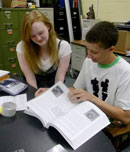
D.C. Everest Oral History Club publishes "Witnesses and Survivors: The Story of the Holocaust"
A group of D.C. Everest-area students aims to keep memories and personal accounts of the Holocaust alive through a book students spent three years researching.
"Witnesses and Survivors: The Story of the Holocaust," was published in July. About 50 students in the D.C. Everest Oral History Club contributed to the project, which includes hundreds of photographs and interviews with 72 Jewish Holocaust survivors from across the country. At 800 pages, the book is the largest of the 22 books published by the group to date.
| |
|
|
Oral history project on Massive Resistance organized
Students at Virginia Commonwealth University are "interacting with history" as they record the stories of former schoolchildren denied an education by school closures during Massive Resistance.
Thirteen video interviews have been transcribed for the Massive Resistance Oral History Project and will be posted on the VCU Libraries' website this fall, said organizer Shawn O. Utsey, chairman of the Department of African American Studies at VCU. Utsey hopes the project will ultimately capture hundreds of oral histories.
The project is a collaboration between VCU and the state's Dr. Martin Luther King Jr. Memorial Commission.
| |
|
|
US ARMY GUIDE TO ORAL HISTORY (1)
The U.S. Army Center of Military History (CMH) first developed a concept for an oral history handbook in the mid-1980s. Its objective was to provide Department of the Army (DA) oral history guidance for the growing number of historians tasked with conducting interviews. Since that time, Army historians, military and civilian, have conducted thousands of oral history interviews. Because of the increased importance of oral history in documenting the history of the U.S. Army-as exemplified by the efforts to capture the Army’s response to the terrorist attacks of 11 September 2001 and the ongoing operations in the Global War on Terrorism-the Center of Military History deemed the time was right to revise its guide to practicing oral history in order to disseminate lessons learned from this wealth of experience.
| |
|
|
Oral History Weekly Magazine Aims and Regulations
Oral History Weekly Magazine wishes to create a suitable place for thoughts and idea development; Its main field would be “Oral History” and subjects as telling & writing memoirs, writing diaries, travelogues, chronologies, and all other subfields of history which are presented in the form of news, articles, reports, notes, interviews and memoirs can be included. There is no limitation on the length of would-be-sent materials.
Mentioning the name, academic background and email is necessary. Articles with complete references and bibliography are more credited and an abstract would quite helpful.
Weekly is not about to publish any material consisting insults and libels about other people or anything that brings anxiety to public opinion. Weekly can edit and translate the received materials.
The published articles and materials are only the writer’s ideas and Oral History Weekly Magazine has no responsibility about their content.
|
|
|

Seyyed Mahmūd Qāderi Golābdare`i, the author of the book Revolutionary Moments, passed away. Born in 1939, in Golābdare, in Shemirān, the author passed away on the 5th of August, 2012.
The Director of the Bureau for the Islamic Revolution Literature believes, “Revolutionary Moments is a valuable work, depicting the different moments of events of the Revolution. It might even be the first book to ever depict the Revolution so vividly.”

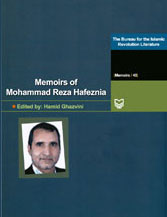
Memoirs of Hafeznia (17)
I came next to the road. I saw a closet of a well near there. I decided to enter it and wait until morning. I might have been arrested due to the martial law. At the same time, the closet was warm. When I reached the closet, I found out that it was locked. I had no choice but to sit by the wall of the closet. I was very tired and it was cold. I had been moving since 10 PM and now it was near dawn. So I inevitably tried to keep myself warm by doing exercises.
Arrival in Mashhad
While I was waiting for the weather to become clear, every few minutes, I was hearing the sound of some vehicles which made me worried. The weather was clearing little by little. I prayed and prepared to move. When the sun rose, I came by the road and raised my hand for the cars passing by there. A Paykan whose only passenger was its driver was approaching and stopped by my request. The driver asked, "Where are you going?" I said, "I want to go to the holy shrine of Imam Reza (PBUH)." He said, "I won't go there but if you like, I can reach you until Ferdowsi Square." I accepted and got in.
I didn't know where Ferdowsi Square was located exactly. After a few minutes, the driver put me down in the square. I could find a vehicle there. First, I went to the holy shrine of Imam Reza (PBUH) to take a pilgrimage. Then, I decided to go to the house of Mr. Alireza Chaychi.
When I reached there, I saw that they were having breakfast. After greeting, I told my story and asked them to hide me as soon as possible.
I knew that it would be announced the same morning that somebody had escaped and the guards would start looking after me. If it kept secret today, it would be revealed one or two days later. I was important for them. They would certainly come to find me, and the first place was the house of Mr. Chaychi. He said serenely, "Now have breakfast. No problem, we think of it later." I started having breakfast, but he left there to review ways for escaping.
He took a look at the backyard, saw the roof and found a ladder. On the whole, he was looking for ways to help me escape if something happened. So he was looking for a way for my escape. After a few minutes, he came and had breakfast.
I told Mr. Chaych, "I have to leave your house anyhow, since it is not safe. If they don't understand today, they will understand that I have escaped tomorrow."
He asked, "what should we do?' I said, "To me, I'd better go to the house of one of other relatives."
We thought I went to the house of my cousin "Mrs. Assieh" in Mohammad Abad area located in the suburbs of Mashhad.
Nobody knew that one of my relatives was living there. So, we got in the car and moved. As soon as my cousin and her husband saw me, they got happy and welcomed me warmly. Although they knew that I had escaped from the prison, they gave me shelter and I stayed there. Mr. Chaychi came to visit me every now and then. After a while, I told Mr. Chaychi, "I feel that it is not safe here anymore. So, notify friends and revolutionary forces that the continuation of this situation is not proper." After a few moments, he said, "I'll go the house of Ayatollah Mar'ashi and tell them that you are here."
He left there and came back after a while and said, "Come on, I could manage to do something for you." He took me to the house of ayatollah Mar'ashi immediately. Most of the people who attended there and were young welcomed me warmly. Of course I was worried that there might have been a few spies among them. But Mr. Chaychi assured me that everybody was insider here and not to be worried. He stressed that the regime's agents did not dare to come here.
After a few moments, I and Mr. Chaychi were guided to a room. As we entered the room, we sat by the side of Ayatollah Mar'ashi. After some two hours, one of the young men came and said, "I am Mohammad Beikzadeh, come with me Mr. Hafeznia!" He was an active man. I asked him, "Where?" He said, "Let's go for the present."
I again asked, "Where should we go?" He said, "Let's go to my house." And then he took me to his house secretly.
M. Beikzadeh was living with his mother in a rented house in Mashhad's Khawjeh Rabi Street. Their house owner was from Azerbaijan and looked a good man.
Finally, I hid in their house. His mother was also an informed and combatant woman. At the same time, they gave me a gun in order to defend myself if something wrong happened. Later I found out that the house had already been searched for one time by the police and security forces and no suspicious object had been found. It was interesting that two big guns had existed in the house that the daughter of the house owner had hidden under her chador and stood in the yard. The police had inspected the house and found nothing.
Translated by: Mohammad Baqer Khoshnevisan |


|
|