| |
|
100 Narratives from Hassan Bāqeri`s Life

The book 100 Narratives from Hassan Bāqeri`s Life, penned by Sa`eed Alāmiān and published in 690 pages, is at first blush indicative of a new approach to the life of this influential commander of the War. The Institute of Martyred Hassan Bāqeri has been active for a decade, having published a five-volume book named A Daily Account of War last year. The first volume is by far the eighth book published about Hassan Bāqeri.

| |

|
|
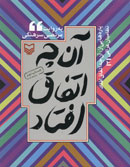
Fragments of What Happened, Vol.3
In older issues of Oral History Weekly, the first two volumes of the three-volume book Fragments of What Happened were introduced. Recounting Iraqi soldiers and servicemen`s memoirs chosen, compiled, and elaborated upon by Mortezā Sarhangi and with illustrations by Kūrosh Pārsānezhād, this book was first published last year, reprinted in medium octavo and with a new book cover this year, and published in 72 pages and 2500 copies by Mehr publications recently.
The third volume is the five hundred and ninety third book published by the Bureau for the Literature and Art of Resistance at Hozeh-ye Honari (Art Center).
| |
|
|
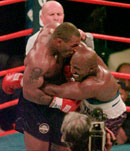
The Bonus: An oral history of the infamous 1997 Tyson-Holyfield bite fight
On June 28, 1997, Mike Tyson and Evander Holyfield fought in Las Vegas in one of the most anticipated rematches in durable boxing history. Holyfield was the defending planet champion after he had shocked Tyson seven months before in an 11th-round knockout. The two had wildly different personalities and categorically different battalion. Holyfield was a warrior and a strategist; Tyson was a fearful brawler. The events that followed wait some of the most inexplicable, out of the ordinary, and disturbing moments in a sport water supply-accustomed to pandemonium.
| |
|
|
Trap’s Army: an oral history of how Ireland’s fans stole European hearts
DUBLIN, NOVEMBER 2011: As Status Quo’s classic ‘Rocking all over the World’ blared over the PA, the Republic of Ireland squad soaked up a lap of honour in front of a delighted Aviva Stadium.
At the end of a gruelling Euro 2012 qualifying campaign, a 5-1 aggregate win over Estonia meant that, for the first time since the drama of Saipan and Suwon at World Cup 2002, the Boys in Green were heading to a major tournament. Without delay, fans started planning the trip of a lifetime to Poland.
| |
|
|
Naticks Oral History Project Could Receive $30,000 From State
Massachusetts potential 2013 budget, as voted upon by the state legislature, includes $30,000 for Naticks Oral History project, which contains spoken accounts of military service from World War I to present.
“I am thrilled that the funding has been restored to $30,000 for the Veterans’ Oral History Project after being reduced in several previous budgets,” State Rep. David Linsky said in a press release.
| |
|
|
Oral History Awards reflect extraordinary diversity
New Zealand Oral History Awards reflect extraordinary diversity
Almost $110,000 has this year been awarded to 14 oral history projects that will span a huge range of subjects including workers on the Manapouri Hydro Dam, women living in the Chatham Islands and Auckland’s West Coasters Club – a group of Auckland residents with connections to the South Island’s West Coast.
| |
|
|
A Dialogical Relationship. An Approach to Oral History(2)
From the point of view of traditional, more methodologically conservative historians, the most important objection to oral sources concerned their reliability: one cannot rely on oral narratives because memory and subjectivity tend to “distort” the facts.
In the first place, this is not always the case – also, how can we be sure that equally serious distortions are not to be found also in more established documentary sources? Thus, as with all other sources, the task of the historian lies in cross-checking the information, checking each narrative against other narratives and other kinds of sources.
| |
|
|
Oral history: Veteran still ‘amazed’ at the bravery of Marines in Iraq
Michael Schoenfeld spent the first days of the United States-led invasion of Iraq in the back of a seven-ton truck that offered little protection aside from a canvas cover and sandbags that quickly turned hard as concrete.
He joked to fellow servicemen that if rocket-propelled grenades were fired at them, the rounds would sail through the canvas and explode somewhere else. But the bullets they encountered on the way to, and in, Baghdad were no joke, Schoenfeld said, nor were the tactics of Saddam loyalists who hid behind civilians.
| |
|
|
Oral History Weekly Magazine Aims and Regulations
Oral History Weekly Magazine wishes to create a suitable place for thoughts and idea development; Its main field would be “Oral History” and subjects as telling & writing memoirs, writing diaries, travelogues, chronologies, and all other subfields of history which are presented in the form of news, articles, reports, notes, interviews and memoirs can be included. There is no limitation on the length of would-be-sent materials.
Mentioning the name, academic background and email is necessary. Articles with complete references and bibliography are more credited and an abstract would quite helpful.
Weekly is not about to publish any material consisting insults and libels about other people or anything that brings anxiety to public opinion. Weekly can edit and translate the received materials.
The published articles and materials are only the writer’s ideas and Oral History Weekly Magazine has no responsibility about their content.
|
|
|

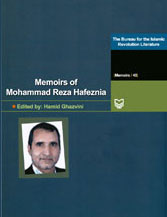
Memoirs of Hafeznia (13)
I was really uniformed. I didn't know what would happen. Finally, they made me to enter the large hall of the prison. They opened a small door and asked me to go in. It looked very dark and tight in the first look. I said, "oh, God where is here? Where is this cellar?" I went forward. The space became bigger. A number of people were there. First, we entered a small room. It seemed that the head of that section of the prison was stationed there. He was a black sergeant major, and very tough and angry. I came to him. He registered my name, showing me a bed and said, "This is your bed." I looked around myself and saw that the space was very dirty and polluted. Later, I found out that the prison was the same fifth ward of Vakilabad prison in Mashahd where those who had been sentenced to death and life in prison were kept. It was a very strange ward. All those who had no hope of this world either the ones who had been sentenced to death or life in prison had been kept in this ward. When you looked at the faces of these prisoners you could find every kind of criminals ranging from the Soviet Union spy to smuggler, murderer, addict and so on. I did not match this complex at all. Their faces were horrible. So, I referred to the head of the ward, and said, "Isn't it possible to change my place? How long should I stay here? He disappointed me with an angry tone.
I said to myself oh God what story this was. Why have they brought me here? I should not be here. As soon as I reached there, some of the prisoners surrounded me, demanding money. I thought this might be a new phase for annoying me. The first night was a very long one for me. I remembered the solitary confinement and wished to come back there. That night and the next night spent so badly and I was under pressure mentally so much so that for the first time I decided to commit suicide. I had the necessary tool for doing this.
I saw that they sharpened some of the spoons. They used the tools even against each other. But I said to myself, "We are Muslims and suicide is considered as a sin". I didn't know what to do. I was in my world and very grief-stricken. I neither ate food nor had an appetite to do so and prayed I was sent back again to the same solitary confinement. The environment was so annoying for me that I preferred the solitary confinement. I think one or two days had been passed and I was walking in the prison compound. Suddenly, I saw that some verses from the holy Qur'an and narrations had been written behind a column. Recommendations about patience and resistance were seen there. These phrases were new for me, and in this place?! These men did not understand such things. So, what had happened? I found out that probably other political prisoners had been or would be brought here and after enduring different kinds of pressures and troubles, they sought refuge to such religious teachings in order to boost their resistance in this environment. I understood that I was not the only one who was under mental pressure. There were other persons with the same situation. Later, I asked Mr. Javad Mansouri about the ward. He said, "I was just kept in the same ward just for one day and transferred to another ward". They kept me in the ward for a few days. I saw that it was not tolerable. The head of the ward was both tough and impolite. I again asked him, "How long should I stay here?" he replied, "It is not clear. You may be here until the end of your life." This was very shocking for me and I was completely disappointed.
He went on, "some stay here for seven months and then are tried in the court until the verdict is issued." I said to myself, "Oh God, I like to be tried as soon as possible in order to rescue this bad place." One week passed and I endured the situation in any way. Then, a young man came to the ward. He was a student from Torbat-e Jam. His name was Majid Rezaiyan.
He had been arrested on charge of distributing communiqués or publicity papers in Mashhad. I got very happy, because I had found someone like myself. I was not alone anymore and started talking to him. I had no news of the outside. He had good information about what had happened in the outside. I thought that this might be the first and last opportunity that I could get enough information. On the other hand it was a good opportunity for me to share what had happened to me from the very beginning privately since I had not told anybody about it so far. Nobody still knew about the original operation. Of course, I had told some cases during the interrogation but I still had other things in my heart. I said this was the best opportunity because I might be executed soon. I saw that he was a good lively boy. Of course he was there for a few days and then released. I told him a lot of issues. He even sympathized with me and invited me to be patient. Anyway, I knew that I was at the end of the way and said these things so that at least someone knew what I did. I gradually got out of the exhaustion in the fifth ward. One day the head of the prison who was a captain came to visit there. I quickly came to him and said, "Sir, I am neither a murderer, nor a smuggler, nor a spy, nor an addict and nor sentenced to life in prison. Please, if possible release me from here. Here is not my place." The captain looked very humble and good-tempered and unlike the head of the ward who was very tough, he got my dossier, looking at it patiently and then said OK, I would review and then left there. The same day, I was called from the office. I was told that they wanted to transfer you to another ward. It was a happy news for me. I prepared to leave the fifth ward. I was taken to the second ward. It was a large ward. As if I had released from the prison. I found out that the prisoners of this ward had political tendencies. Also, those who had been arrested in Mashhad were brought here. There were also a large number of public and normal prisoners in this ward. The first ward (or the political ward) was for those prisoners who had been tried and were located beside the first ward. I saw what they were doing to some extent. Sometimes, I went to the library. The prisoners of the first ward came also there and I visited them. I was freer here and felt that I had rescued from that bad situation. At the same time, as I was waiting for my situation and future, I was told that someone had come to visit you.
Translated by: Mohammad Baqer Khoshnevisan |


|
|