| |

|
An Introduction to Point of Departure in Oral History Interviews

The point of departure constitutes a key component of narration as the motif of oral history biographies, diaries and interviews. It addresses the questions as to from which point of time the narration of life events should start and whether the interviewer should restrict the interview to a section of interviewee's life or also ask about the backgrounds and contexts. This paper is an attempt to underline the significance of developing a regular framework of the interviewee's life to overcome the disorder plaguing the recorded interviews. Answering these questions requires a consideration of the type of memory (political, social, cultural and economic) and its function; however, a single model for the point of departure could be prescribed with some degree of flexibility.

| |

|
|
Volume 12 of "Islamic Revolution Chronology" on the Eve of Release
Volume 12 of "Islamic Revolution Chronology" that reviews the events of January 17, 1979 till January 20, 1979 will be published in a few months by Sooreye Mehr Publications.
The wide variety of political developments in late January of 1979 was to the extent that one volume of "Islamic Revolution Chronology" (volume 12) encompassed to the period of January 17, 1979 till January 20, 1979.
| |
|
|
Society of Martyrdom Writers to be founded
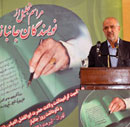
The Foundation of Martyrs and Veterans’ Affairs held a ceremony to praise Sacred Defense veteran writers. It was announced in the ceremony that the society of writers and researchers of martyrdom and sacrifice will be established. The ceremony was held on July 1, 2012 at the conference hall of Enghelab Hotel in the presence of the Minister of Culture and Islamic Guidance, Mohammad Husseini, Masoud Zarbafan, head of the Foundation of Martyrs and Veterans’ Affairs, ...
| |
|
|
Husseini:"Noted Sacred Defense works to be translated"
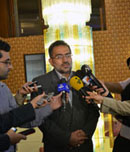
On the sidelines of praising injured war veteran authors, Minister of Islamic Guidance and Culture Seyyed Mohammad Husseini said:" We have decided to translate some of the books which are written by injured war veteran authors."
The ceremony was held this noon, July 1, in Enqelab Hotel. Talking about the injured war veteran authors Husseini said:" ...
| |
|
|
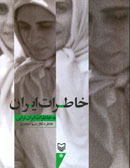
Memoirs of Irān: Memoirs of a Sumayyah during the War
“The Resistance Literature and Art Bureau” has published many works on the role of women and first aiders during the Imposed War. Among these works are Dā: Memoirs of Seyyedeh Zahrā Hosseini, The Last Sunday: Memoirs of Ma`sūmeh Rāmhormozi, The Autumn of 1359 (1980): Memoirs of Zahrā Sotūdeh, Maryam`s Boots: Memoirs of Maryam Amjadi, From Chandeh-lā to the War: Memoirs of Shamsi Sobhāni, The Wayward Shoes: Memoirs of Soheilā Farjāmfar, This is my Home: Memoirs of Afsāneh Qāzizadeh, and Girls of O.P.D.: Memoirs of Minā Komāyi.
| |
|
|
Oral history: Iraq veteran ‘wouldn’t have missed’ it for $10 million
In the early-morning hours, a voice blared over a loudspeaker warning of incoming projectiles, possibly mortars or maybe rockets. Sleeping almost naked in the 110-degree heat, John Reed jolted awake, sat up and froze, his forgotten body armor and helmet lying just a few feet away in a little trailer.
This was his welcome to Baghdad, a place the liberal professor in his mid-50s never thought he would be.
| |
|
|
A Dialogical Relationship. An Approach to Oral History(1)
The phrase oral history is a common abbreviation for what we might describe, more articulately, as the use of oral sources in history or the social sciences.(1) In its most elementary form, the oral narratives and testimony which constitute oral history are but an additional tool in the historian’s panoply of sources, and are therefore subject to the same critical scrutiny as all other sources, in order to ascertain their reliability and their usefulness.
| |
|
|
Oral History Weekly Magazine Aims and Regulations
Oral History Weekly Magazine wishes to create a suitable place for thoughts and idea development; Its main field would be “Oral History” and subjects as telling & writing memoirs, writing diaries, travelogues, chronologies, and all other subfields of history which are presented in the form of news, articles, reports, notes, interviews and memoirs can be included. There is no limitation on the length of would-be-sent materials.
Mentioning the name, academic background and email is necessary. Articles with complete references and bibliography are more credited and an abstract would quite helpful.
Weekly is not about to publish any material consisting insults and libels about other people or anything that brings anxiety to public opinion. Weekly can edit and translate the received materials.
The published articles and materials are only the writer’s ideas and Oral History Weekly Magazine has no responsibility about their content.
|
|
|

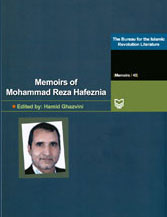
Memoirs of Hafeznia (12)
Of course, I also asked them to give me books. First they didn't accept but after my insistence, I was given two books one of which was The Roots ( It was about the sad story of the African blacks and slaves' being sent to America the studying of which annoyed me more), and the other The Dragon Generation. They did not give me any other religious book except the holy Qur'an. I was heavily guarded in the prison. When I wanted to go to WC, they opened the door very cautiously. A few people stood along the way, waiting for me to go and come back. Even, I was not allowed to take a shower. There was a pond in the middle of the prison yard that I was just able to wash myself inside it. However, they later took me to the division's bath.
On the whole, they treated on me toughly. Sometimes, the soldiers or persons who were imprisoned tried to get in touch with me and say something. For example, one of them came behind the window and said, "You had a great combat with these disbelievers." I did not reply since I didn't know whether this was a plan for testing me or not. I was in the solitary confinement for two months, and during the period, I tried not to talk to anybody. Only one day, a sergeant who was my guard told me quietly, "Don't you have any work or order?" I felt that he was right but didn't trust him. I just asked him to inform my mother that I was alive, because after my detention, she had no news of my fate and did not know where I was. Also, my friends and relatives had no news of me, because I was in the solitary confinement and had no connection with the outside world. The sergeant said nothing but later I found out that he had delivered my message.
Some two months had passed since I had imprisoned in a solitary cell in the division's prison and was almost knew nothing of the outside. Only sometimes, the soldiers came secretly at the door of my cell and gave information about the outside situation through gestures. During this period, I regularly read the holy Qur'an and in general I had no hope of living because I knew that I would be tried and sentenced to death.
At the same time, sometimes doubts came to my mind that the procedure of my case might change. For example, they might sentence me to prison instead of execution, or the interrogation conditions might be changed and they wanted to interrogate me again from the beginning or the developments in the society and the expansion of popular movement could change the situation.
During my detention, I found out that martial law had been established for the first time in Isfahan. Later I was also informed that Imam Khomeini had left Iraq for France and he was not in Iraq anymore.
One day, I was told that you should go to the court for investigation. I had a few clothes. I prepared very soon and left. The interrogator was a colonel who raised questions with anger. He asked me to write the answers. Since the solitary confinement had made me tired, I thought if I was tried sooner and the execution verdict was performed, I would be rescued of the situation. Thus, I said to myself to ask the interrogator about my situation. I did so.
He thought that I had lost my morale and had become tired. He answered very fast, “What do you want to happen? It is very clear. At least, you’ll be sentenced to death.”
I thanked God in my heart because I liked the same thing happened.
Then, I became sprightly, as if I had come to life. I knew what would happen to me finally. The interrogation came to an end. I came out and was returned to the cell amid tight security measures. But I felt that I had become a little freer. Some of the soldiers came and talked to me for a few moments and left there very soon. Connection with me was not as hard as the first days. One of them who had apparently left leanings and was imprisoned there, came at the window and said, “What happened to you during the interrogation?” I happily took my hand like a knife under my throat and told him, “Execution!” he was surprised and said suddenly, “Don’t you scare?” I said, “The Muslims scare nothing.” When he heard the reply, he was drowned in thought. I again stressed that a Muslim does not scare anything. I was very happy that they want to try and execute me. I also remember that there were two religious men who were also imprisoned in the garrison. Sometimes, they came to me and asked about my health secretly. One of them was a soldier. He was from the city of Saveh and expressed sympathy with me deeply. Since he saw that I had no clothes and nothing else, he gave me something secretly. For example, he gave me a towel or some food stuffs. Of course, he did this very secretly and with panic, because he should have been accountable.
Transfer to Vakilabad Prison
One day they asked me to prepare for being transferred to another prison. I don’t remember exactly but it was almost in September 1978. I prepared. They made me get in a car and I was transferred to the city’s public prison, that is Vakilabad Prison. I had not seen the prison since then and did not know where it had been located. They made me get off and the normal convention of every prison was carried out in the first phase of arrival. They seized my clothes and cut my hair. They gave me another clothes and I was fingerprinted. I did all of these things. They did not say where I was being taken and what would happen to me.
Translated by: Mohammad Baqer Khoshnevisan |


|
|