| |

|
28 June 1981: The Day A Nation was Martyred

The summer of 1981 was the bloodiest season witnessed by the Islamic Republic of Iran who lost many of its high-ranking officials due to consecutive acts of assassination.
In two separate bombings conducted on 28 June and 29 August by the People's Mujahedin of Iran (PMOI), Iranian President (Muhammad Ali Raja'i), Prime Minister (Muhammad Javad Bahonar), Head of National Supreme Court (Ayatollah Seyyed Muhammad Beheshti), four ministers and counselors and 27 members of parliament were martyred.

| |

|
|
Steps to Conduct an Imposed War Oral History Project
It is difficult to talk in details about steps in writing memoirs and conducting oral history projects on the imposed war in a short article like this. What I say then, will focus on general tips concerning the issue. But before delving into the issue of doing oral history, it will be useful to mention a neglected fact. Writing memoirs and doing oral history is a specialized field that similar to other disciplines, requires education and training. So any individual with any knowledge and level of literacy is not capable of doing oral history.
| |
|
|
Johns Hopkins to do ‘oral history’ of cancer study
A research team from Johns Hopkins Bloomberg School of Public Health is conducting a case study about the 2010 Fort Detrick cancer cluster investigation and has invited community members to participate.
The goal is to gather a public health oral history, said Beth Resnick, principal investigator and director of the Johns Hopkins Office of Public Health Practices.
“This is a way to profile people’s stories about cancer cluster investigations and how that impacts the community,” Resnick said.
| |
|
|
Oral history project planned in Hanover
Hanover — In a project that will begin later this year, senior citizens will be recorded on local community television having discussions and sharing their stories with senior high school students.
“We’ll have the seniors share their experiences,” said Robyn Mitton, the director of the Hanover COA. “There is such history here in Hanover.”
| |
|
|
Award Recognizes Oral History Project
The East Mountain Historical Society has received the Oral History Project of 2012 award for its "Great People, Great Stories" interviews conducted in recent months among East Mountains residents.
The award was presented to Kris Thacher, oral history project coordinator, and Denise Tessier, society president, by noted oral historian Rose Diaz of Origins and Legacies Historical Services. The honor came during a three-hour celebration June 3 honoring the 15 East Mountains-area residents who had shared their life stories through the "Great People, Great Stories" oral history pilot project. The event was held at the historic church in Tijeras and adjacent Luis Garcia Park.
| |
|
|
Saving veterans’ ‘nuanced stories’ of Iraq and Afghanistan
A young Marine lies on his belly, sobbing after he and his comrades shot up an Iraqi family whose white Chevy Citation sped into the middle of a firefight. Another Marine, bone-weary on a march into Baghdad, falls asleep while replacing his sock.
A third is whisked away from war with a torn-up face and survivor’s guilt because his buddy, a husband and father of two, died in the same foxhole.
These are some of the poignant stories told by Iraq and Afghanistan veterans to historians at the University of Utah’s American West Center.
experiences are raw, in contrast to the belated nationwide effort to gather oral histories of World War II vets.
| |
|
|
Recording today’s history for the future
Stow — The West School Museum Summer Series will kick off with a Sunday-evening Oral History project on Sunday, June 24. The program, interviewing three long-time Stow stalwarts on facets of recent town history, will begin at 7 p.m.
All West School programs, jointly sponsored by the Stow Historical Society and the Stow Historical Commission, are free and open to the public. The Oral History session will focus on:
Fittingly for the West School setting, he’ll also talk about Mark Twain’s education in the 1830s and 1840s. The production is geared for ages 10 to 100, but Budd has found that younger children do seem to enjoy the show even if they do not understand it all.
| |
|
|
Oral History Weekly Magazine Aims and Regulations
Oral History Weekly Magazine wishes to create a suitable place for thoughts and idea development; Its main field would be “Oral History” and subjects as telling & writing memoirs, writing diaries, travelogues, chronologies, and all other subfields of history which are presented in the form of news, articles, reports, notes, interviews and memoirs can be included. There is no limitation on the length of would-be-sent materials.
Mentioning the name, academic background and email is necessary. Articles with complete references and bibliography are more credited and an abstract would quite helpful.
Weekly is not about to publish any material consisting insults and libels about other people or anything that brings anxiety to public opinion. Weekly can edit and translate the received materials.
The published articles and materials are only the writer’s ideas and Oral History Weekly Magazine has no responsibility about their content.
|
|
|

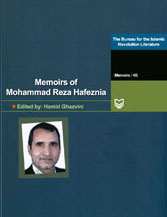
Memoirs of Hafeznia (11)
Then the interrogators brought the pamphlet of "The Land of Islam" which I had written in Teacher Training University upon the request of some students, asking questions about it.
Some issues had been brought up in the pamphlet which were new at that time. I had brought up a series of solutions in the pamphlet about which the interrogator asked several questions: "Have you written these works by yourself?" – "Yes" –"It doesn't seem that you are capable of writing such things."
I said, "Anyhow, this is just like the operation that doesn't seem to be carried out by me." We talked a little about it, and apparently after one week of mental and sometimes physical harassment and threats, they convinced to some extent that the operation had been carried out by me and no one else had been involved in it.
Finally, they started treating warmly with me a little and after several days, I was allowed to sleep a little. During interrogation, they pointed to a number of issues according to which I found out to some extent what was happening in the country. For example, they said, "you have mentioned a person as Imam while we have no more than twelve Imams in the religion of Shia. Why do you say Imam Khomeini! Who is Imam Khomeini? He is not Imam! What the hell is this that you have made?"
The second issue was about Rex Cinema in the southern city of Abadan. It was there that I found out what had happened in the cinema. They said, “Religious people like you do not have mercy on the people and burnt several hundred people.”
I did not know at all what the case of Abadan’s Rex Cinema was. But I understood from their words that something wrong had happened and they wanted to attribute it to religious people and revolutionaries. (On August 19, 1978, the Cinema Rex in Abadan, Iran, was set ablaze by the SAVAK agents, killing some 400 individuals.)
Eventually, after detailed interrogations, they apparently convinced that nobody had been involved in the operation, so they let me sleep for a few hours. It was interesting that at the end of the day, they used the weapon of pity, saying constantly, “Take pity on your family, brother or at least take pity on yourself.”
I think they also pointed to the issue that Brigadier General Shahir Motlaq had survived and pardoned you. They might have other aim but on the whole, they treated me rather softly at the final stages of their work.
Pressures diminished
After several days of interrogation, they transferred me to another part of the same complex. Since I was blindfolded, I didn’t know where I was being transferred. I had no information of the interrogation place.
They transferred me to a solitary confinement the space of which looked more like the room of the officer on duty. So I guessed that I had been taken to the room of the officer on duty. The environment looked normal and they had opened my eyes. There was nothing inside the confinement except a canvas-made rug. After a few hours, I was brought some food. Since, it was the holy month of Ramadhan, I said I’d like to fast.
Of course, I couldn’t recognize day and night previously and was in a closed area, but this became possible in the new place. Therefore, I informed them of my decision and determined to do it. I was given sahahri the same night and ate it.
When I was there, an officer came at the door of the cell, shouting at me, “What was your aim from doing this?” I felt that he did not say it from the bottom of his heart. For example, he first intimidated me, then said very quietly, “Don’t you want some water or tea?” It seemed that he liked me somehow. He was a commissioned officer on duty. He was good to me and watched me somewhat.
I didn’t know how many days I was there that suddenly I was told to leave.
Return to Mashahd garrison
They returned me back again to Mehrabad Airport and sent to Mashahd with the same airplane. When we reached Mashhad, they took me to Khorasan’s 77 Division and imprisoned me again. I was uniformed and didn’t know what would happen to me. Also I couldn’t ask any question.
I was in the solitary confinement for some two months. It was a very small place that I think the space of which was not more than one in two meters. The cell had been located in the prison of the officer on duty in other words prison in prison! The entrance door of the prison had always been locked and a soldier was guarding. I guessed that the story was still continuing and it was not as easy as I thought. It had just been started. So, I tried to find out what their plan was.
Sometimes, a few people came in and talked about something and apparently expected me to show reaction but I did say nothing. One time, I asked them to give me a holy book of Qur’an and they did so. So, the most important thing I did for one month is to read the holy Qur’an.
It was rumor among the soldiers that this prisoner always read the holy Qur’an. During this time, I read it completely and memorized two parts of it.
Translated by: Mohammad Baqer Khoshnevisan |


|
|