| |
|
A new collection of Sacred Defenses oral history

An official of Sacred Defense Museum Garden said that a new collection of Sacred Defense's oral history will be compiled. The collection will be released as a document for the period's incidents.
IBNA: Qasem Qasem-khani said:" So far we hold 400 hour interviews with the Army of the Guardians commanders."
He added:" A group of 60 will transcribe, edit and compile the interviews in the Sacred Defense Museum Garden."

| |

|
|
"Sacrifice made Sacred Defense memories nice"
The Iranian President Mahmoud Ahmadinejad stated this morning (Monday, April 09, 2012) that sacrifice is the key to human perfection and permanence of divine values.
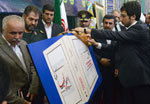
IBNA: Ahmadinejad made his comments in a ceremony held this morning to honor memory of army's chief commander Ali Sayyad Shirazi and 110 prominent Sacred Defense commanders.
| |
|
|
Iran s Ground Force to publish 50 new titles
The Ground Force of the Islamic Republic of Iran will publish as many as 50 new titles in the resent year in Iranian calendar. The titles will cover issues about the role of ground forces in the Sacred Defense.
IBNA: The main theme of the books will be introducing top comrades in the war who served in the ground forces of Iran's army. The organization of Army's Ground Force Devotees will published some 50 titles about the history of the Sacred Defense, and memories of veterans, casualties and devotees of the army.
| |
|
|
List of Irans manuscripts compiled
A 40- volume collection has been compiled holding complete information of Irans manuscripts. Entitled List of Irans manuscripts, the first 5 volumes will be presented at the 25th Tehran International Book Fair.
IBNA: The collections editor Mojtaba Derayati said: We are busy compiling the collection, since some 15 years ago.
He added: The summary of the collected data was released last year in 12 volumes by Majlis Publications.
The 40- volume collection will be released in 40 volumes which will be released by the National Library. The first 5 volumes will most probably be presented at the Tehran International Book Fair. The complete collection will be presented within two years, he said.
| |
|
|
Heeding Sacred Defense, Revolutions literature will fortify TIBF
Deputy Minister of Islamic Guidance and Culture said: The 25th Tehran International Book Fair (TIBF), as a cultural event, will fortify considering the literature of Sacred Defense and the Islamic Revolution and accordingly we can witness the thoughts real place in international fields.
IBNA: During the closing ceremony of the 1st edition of Resistance Book of the Year (Martyr Avini literary award), Deputy Minister of Islamic Guidance and Culture in the cultural affairs Bahman Dorri said: During the past two year Sacred Defense and Resistance Book Fairs were held which indeed were the bliss of the martyrs blood and the Martyr Avini literary award is not an exception.
He added; A Resistance Book Fair will be held in the 25th TIBF and its details will be announced to the media.
| |
|
|
Latino Voices Echo in the Southwest to Save the Colorado River
Latinos gathered in four states to call for practical measures to help build water levels in the Colorado River. With the release of Nuestro Rio's new corrido, which is song that traditionally passes on oral history in the Latino community, they marked the 85th anniversary of Cesar Chavez’s birthday and held coordinated actions in four Southwestern states – Arizona, Colorado, Nevada and New Mexico.
| |
|
|
Making history more personal
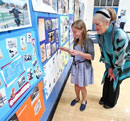
Sixth-graders at Thurston Middle School present their Oral History projects, where they interviewed people at least 50 years old.
Pulitzer Prize winners, foreign athletes, successful business people and veterans were just some of the fascinating people who crowded the Thurston Middle School auditorium this week.
The sixth-grade Oral History project asks students to interview someone at least 50 years older and present their findings to their classmates.
The school held its annual luncheon Monday, Tuesday and Wednesday, when students gave a 30-second presentation about their person, asking their interviewee to stand to applause and usually ending with "thank you for sharing your life with me
| |
|
|
Social historian Stephen Brier lectures about digital storytelling
Stephen Brier, professor of urban education and senior academic technology officer at The City University of New York, spoke at Lehigh on Thursday, April 5, about his personal experience with digital storytelling by connecting it to his work with oral history.
Briers lecture was the first installment of the Digital Storytelling Cluster Development Lecture Series that Lehigh is hosting.
Brier described himself as a premature digital storyteller, mainly because most of his work has dealt with the usage of oral history.
Ive spent more than 35 years of my professional life committed to making the history of ordinary people accessible, he said.
Professor Brier is an internationally known social historian who has brought digital storytelling methods to history, said journalism professor Jack Lule, who is heading cluster development for digital storytelling at Lehigh.
| |
|
|
Oral History Weekly Magazine Aims and Regulations
Oral History Weekly Magazine wishes to create a suitable place for thoughts and idea development; Its main field would be “Oral History” and subjects as telling & writing memoirs, writing diaries, travelogues, chronologies, and all other subfields of history which are presented in the form of news, articles, reports, notes, interviews and memoirs can be included. There is no limitation on the length of would-be-sent materials.
Mentioning the name, academic background and email is necessary. Articles with complete references and bibliography are more credited and an abstract would quite helpful.
Weekly is not about to publish any material consisting insults and libels about other people or anything that brings anxiety to public opinion. Weekly can edit and translate the received materials.
The published articles and materials are only the writer’s ideas and Oral History Weekly Magazine has no responsibility about their content.
|
|
|

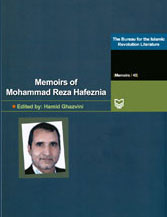
The Memoirs of Mohammad Reza Hafeznia
The Memoirs of Mohammad Reza Hafeznia is the story of an attempt by an enlisted officer (Mohammad Reza Hafeznia) in 77 Khorasan Division for assassinating the Division's commander whom he regarded as the cause of the people's suppression. The event had a wide reflection in summer of 1978.
The book explains about how the narrator's personality was grown up since his childhood and how his though and campaign motives were formed. It also says about the process of the operation's planning and its implementation, how he was arrested, his interrogation, the period of detention, and escape from the prison as well as the life of the narrator until the victory of the Islamic revolution and his first attempts in the first months of the establishment of the Islamic Republic government.
The Memoirs of Mohammad Reza Hafeznia collected by the Oral History Department of the Islamic Revolution Literature Bureau has been compiled by Hamid Qazvini and published recently in 173 pages by Sooreh Mehr Publishing Co. We are going to review parts of English translation of the book from this week.
Leaving for Mashhad
I could no longer stand to continue the situation. I wanted to carry out a plan against the regime as soon as possible. I was thinking that I had no longer any opportunity to procrastinate. And it was not clear whether I could succeed.
Therefore, I reviewed different plans in my mind. Even at one point I thought of asking help from the religious persons with whom I accompanied in order to wage a series of guerilla operations in the city of Shiraz. I imagined that I should provoke them. For example, I should tell them, "Hey guys, why have been remained silent? The Muslim people of this country are being killed and you don't show any reaction? …"
Since I was very soft-hearted, I was really upset to see the people especially the religious ones were treated very unfairly and in general religious activities were under pressure and the people were attacked.
I became increasingly upset why we had remained silent about the country's general situation and the escalation of the revolution. I was rebuking myself many times that shame on you "Hafeznia"! You are calling yourself a Muslim and are serving in the army's garrison but while the grounds are ready for a measure, you do not do anything?!
You are watching that the regime is using the people like you who have stood up for Islam!
The rebukes and their repetition had a certain psychological and mental impact on me in a way that it was making me ready little by little to carry out an operation even inside the garrison where I was serving at the first opportunity. Since the movement had been widely expanded and the regime was trying to involve the army as much as it could, I wanted to strike a blow to the regime rather than being an agent for its strengthening.
At the same time, I was aware of being transferred to the Guard's garrison. It was said that a special recommendation or connections were needed for being transferred to the Imperial Guard. I thought a lot to remove the problem and finally it came to my mind to find Colonel Khorashadi who was a senior officer in Shiraz military base and my fellow townsman. I decided to ask him to act as a mediator so that I could enter the Guard's Division. But the problem was that I had no contact with him and at the first place, this contact should be established. So I called to Birjand -a city in north of Iran- and got the phone numbers of Mr. Khorashadi from my first cousin. Then, I called his house and introduced myself. Since he was from our village, he recognized me. I told him, "I have received good grades and if you do me a favor to do something to transfer me to Tehran, I would be very pleased, and because I am going to marry and the girl whom I want to marry is living in Tehran."
After listening to my words, Mr. Khorashad said, "OK, I will review and if it was possible, I would do something for you." I became hopeful a little.
I was hopeful until the day when the forces were supposed to be transferred to different garrisons came. When the names were announced, despite what I already imagined, my name was not among those who had been transferred to the Guard Division.
The names were read from Chieftain Tank Group, Scorpion Group, and M60 Group (whom I was from M60 Group).
I didn't know what to do. Finally I chose the city of Mashhad because of its proximity to Birjand which was determined as the city of my military service.
My dispatch to Mashhad caused the path of my campaign to be changed completely, and thought of something else.
I had already thought of conducting an operation if possible against the person of the Shah through the Guard but all of my hopes went up in smoke.
When I arrived in Mashhad, I entered the garrison and introduced myself. In order to reside outside the garrison, I went to the house of a familiar old lady who was from Birjand –a city in north of Iran- and was living with her disabled husband. The lady was nursing her husband alone and very competently. And she was very firm and unyielding.
They had an additional room and I asked them to rent it to me.
I resided there as she gave me an OK.
I had little familiarity with the city of Mashhad. I did not know political forces, active religious places and the centers which played an important role in the campaign. And in fact I had become very confused. So, I spent several days to become familiar with the city. Then, after one or two weeks, I was installed as the commander of the First Squad of Tank's First Company from the Tank's Battalion of 77 Khorasan Division. It was natural that if anything happened and necessary measure was needed by the tanks, first I would win a lottery who was the commander. The Tank's Battalion had been deployed in Mashhad's newly-built garrison.
The commander of the Tank's Battalion was a colonel who had little presence and was a calm man. But his deputy Major Kouhestani was completely the opposite.
Since the movement and the people's campaign had spread to different parts of the country including Mashhad, the deputy according to what he had been trained usually tried in the morning to take tough stances against the religion and revolution. Even sometimes, he made unfounded and blasphemous claims. For instance, he said, "My command is higher than God's. You must obey mine."
He treated very violently and haughtily. I, who had recently been transferred to the garrison as an enlisted officer and hated the regime and its agents and was looking for an opportunity to strike a blow to the regime, could hardly tolerate this man. Even I was thinking that if I could do nothing eventually, at least I must make this major silent by all means, even if I had to shoot at him.
To be continued…
Translated by: Mohammad Baqer Khoshnevisan |


|
|