| |
|
Iranian Film Critic, Zaven Ghokasian Passes Away At 65

Prominent film critic Zaven Ghokasian passed away on February 20 at the age of 65 in his home in Isfahan following a long battle with stomach cancer. Ghokasian had spent five months in hospital in Austria and underwent stomach surgery in September. On January 27 he finally returned to his hometown of Isfahan. Upon return to Iran he was again where he was transferred to hospital undergoing more general exams and after about two weeks around February 10 finally he returned home where he had to finally surrender in the battle against cancer.
Ghokasian was born in 1951 in Isfahan and graduated with a bachelor in chemistry from university of Isfahan. His mother, Ada Atayan, was one of the young cinema lovers that frequented the newly established Cine Club in Isfahan in the 1950s. She then became Zaven’s first introduction to cinema and film magazines.

| |

|
|
Bottom Up History
The title of Staughton Lynd’s new book, “Doing History from the Bottom Up,” not only defines the purpose and sets the direction; it lays down a challenge. Lynd uses the present continuous form of the verb “do,” which commonly means “to perform or carry out,” and which indicates that there is really no beginning nor end. Lynd challenges us to act rather than ideate, and he demands that the action proceed from the primary source; that is, the “bottom.”
“Doing History from the Bottom Up” turns standard academic method upside down, but there’s another component as well. Lynd told me, “’Doing history’ is a term I got from Edward Thompson. He didn’t think a person could ‘do history’ and ‘do politics’ at the same time. But I think we have to try to do both together.” In this sense, “doing” is the present progressive form of historical research. The subject is living, and the practitioners of this “guerrilla history,” as Lynd calls it, learn as they teach.
| |
|
|
A Revolutionary Joy Ride Through History
Exactly four years ago, as my wife and I were in the final week of our vacation in South Beach, we were pleasantly surprised to hear a female voice with a distinctly Scottish burr piping up just behind us on the sidewalk as we were going out for breakfast. “Is that Lou?” The voice belonged to Jess MacKenzie, the long-time partner of Ernie Tate, a veteran of the Trotskyist movement who had the audacity like me to vacation in a spot that in our youth would have been regarded as a decadent bourgeois swamp.
It turned out that Ernie and Jess were staying in a hotel right next to the apartment building where we had paid for a month-long sublet. I had run into Ernie and Jess at Left Forums once or twice and knew him as a Marxmail subscriber but beyond that mostly by reputation. In 1967, not long after I had joined the Socialist Workers Party in New York, members were still buzzing about how Ernie had been beaten up by Gerry Healy’s goons in London while selling a pamphlet critical of the cult leader outside one of their meetings. Since that incident loomed large in my mind even after decades had passed, I introduced my wife to him as the guy who Gerry Healy’s goons had beaten up. This prompted Ernie to remark genially but firmly that he preferred to be described as a leader of the British antiwar movement.
| |
|
|
Sunday of Orthodoxy Celebrated in Taybeh, Palestine
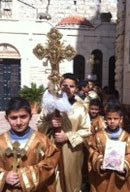
Today was a glorious celebration for the Sunday of Orthodoxy commemorated in my church annually this first Sunday of the Holy Great Lent. After a beautiful Divine Liturgy, Fr. Daoud P. Khoury and the entire congregation of St. George Greek Orthodox Church with the children holding icons made a wonderful procession outside going around the church three times to remember the triumph in the ninth century in able to use icons in the church.
Church history is difficult to explain to children but as bad as my Arabic might be, I simply tried to gather all of them to participate in the procession as living icons in marching the same way that St. Theodora and her son the Great Emperor Michael made a procession in Constantinople with all of the clergy and people making a public statement to restore the holy icons and allow them to adorn churches and homes. Emperor Michael was totally opposite his father, the Byzantine Emperor Theophilus (reign 829-842) who supported the iconoclasts that wanted the icons removed from churches. And sometimes they used very violent forms of persecution to punish the faithful who wanted to keep icons.
Emperor Michael knew that his mother, the Empress Theodora secretly owned many icons. When his father died, Empress Theodora together with Patriarch Methodius made it possible for people to venerate icons out of love as images of the archetypes. The icons are not worshiped as if they are gods. The General Synod held in 843 A.D. finally brought an end to the one hundred years of persecution and fighting about icons. Empress Theodora is credited for asking for this historic meeting to take place. Oral history says she prayed and fasted to seek forgiveness for her husband.
| |
|
|
Oral History Weekly Magazine Aims and Regulations
Oral History Weekly Magazine wishes to create a suitable place for thoughts and idea development; Its main field would be “Oral History” and subjects as telling & writing memoirs, writing diaries, travelogues, chronologies, and all other subfields of history which are presented in the form of news, articles, reports, notes, interviews and memoirs can be included. There is no limitation on the length of would-be-sent materials.
Mentioning the name, academic background and email is necessary. Articles with complete references and bibliography are more credited and an abstract would quite helpful.
Weekly is not about to publish any material consisting insults and libels about other people or anything that brings anxiety to public opinion. Weekly can edit and translate the received materials.
The published articles and materials are only the writer’s ideas and Oral History Weekly Magazine has no responsibility about their content.
|
|
|

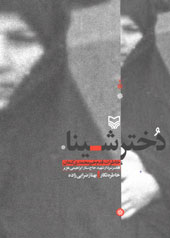
Daughter of Sheena-26
Memories of Qadamkheyr Mohammadi Kanaan
Wife of Sardar Shaheed Haj Sattar Ebrahimi Hajir
Memory writer: Behnaz Zarrabizadeh
Tehran, Sooreh Mehr Publications Company, 2011 (Persian Version)
Translated by Zahra Hosseinian
In Hamadan, earlier, we had no family or friends and acquaintances with whom we associated. My only amusement was that to take Khadija’s hand, hug Masumah, and go to the alley up for buying. Sometimes, when I would see a neighbor in the street or in the alley, I would jump with joy. I would stop and busy myself with talking them.
One afternoon, I had bought bread and was coming back to home. Women neighbors were standing in front of a house together and were busy talking. I looked very blue. After greeting I offered them to come to my house. “I spread a rug in the courtyard.” I said. “Also, I brew a tea and we’ll drink it together.” They accepted.
At the same time, a man with a broom under his arm and some books in his hand came running toward us. “You're from Haji Abad village?” he asked us. We look at each other and answered: “No.”
The man asked: “So, where are you come from?”
Samad had wanted me to be careful in associating with people and give no personal information to anyone. For this reason, I kept my wits about it and said nothing.
The man continuously asked: “Where is your home? What’s your husband job? Which village do you come from?” This state made me to insert the key into the lock and opened our house door. One of the women said: “Sir, you have a lot of questions, so why ask them us. Let me call my husband. He certainly can better guide you.”
Without saying goodbye or another question, the man went running as he heard these words. When he gained distance, the woman neighbor said: “Mrs. Ibrahimi! You saw how I spoiled his good mood. I lied to him. Nobody is in our home by chance.”
One of the women said: “I think he was looking for your husband. On behalf of hypocrites he had come and wanted to identify you to take revenge hypocrites whom your husband had arrested them.” Hearing these things, I got a fright. I was very worried about Samad. I would fear something happen for him again.
The man badly frightened all. So the women neighbors didn’t come to our home and went. I |


|
|