| |

|
Compilation in Oral History of Islamic Revolution

For documenting their history, all the revolutions need to use various research and information tools in order to create strong intellectual bases for various social strata especially the second and third post-revolution generations. Collection, organization and information about Islamic revolution has been a principle to which have been paid attention since the recent decades, and some centers have resorted to compile the history of the revolution and publish books through conducting interviews. A glance at the formation of the revolution’s historiography shows that its emergence and expansion is the result of the society’s historical needs of every decade according to desires, wishes and necessities. This has caused the collection and compilation of the history of the Islamic revolution to be always carried out as an efficient and up-to-date tool in line with the collection, organization and process of the information data related to Islamic revolution at different levels of the users with various goals.

| |

|
|
Revolution Supreme Leader’s memory of first visit with Imam after fifteen years
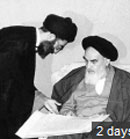
Portal of KHAMENEI.IR published a memory of the early days of Imam Khomeini’s returning to Iran in 1979 and a story about his familiarity with the Holy Quran. The title of this section is "Revolution of Quran" and a part of audio file of Supreme Leader’s memory is released in this program for the first time in thirty-three years. According to Jamaran, the memory of Islamic Revolution Leader is as follows: “I saw Imam Khomeini a single glance, well, when he had arrived in Iran in 1979. The day Imam entered to Iran, we visited him and later, we saw him when he came to Refah School at night. As all had surrounded and kissing him, I didn’t go near lest to inconvenience him. I said to myself, at least I do not bother Imam, so I did not come close, [I said to myself] I’ll visit him later. It was tomorrow night, apparently, that they called us, other brothers and I who were the members of Revolutionary Council, to go to Alavi School.
| |
|
|
A review on the oral history of “the Center for the Propagation of Islamic Truth”:
After Ŝahrivar 1320 (Sep. 1941), Iran was turned to a rivalry field in the course of ideological thoughts and beliefs through creating a liberty political space. Through conflicting the tradition and the modernity, there was emerged a newborn event in which was constancy by following the Shia. Although, it was gotten its construction by tradition; on other hand, it was shaped by a modern framework to reply the daily issues. In spite of linkage to tradition and modernity via Center, it caused to controversy subjects because of the lack of being conditioned to both.
In actuality, these contests were so clearly visible in Mashhad. In this regard, there was founded the Center for the Propagation of Islamic Truth (Islamic Truth Exploration Center; Kanoon-e Nashr-e Haghayegh-e Eslami) in which religious eminent and outstanding persons and scholars who were effective people for the future of the country entered to this rivalry field.
| |
|
|
Reporter who lived three months in Neauphle-le-Château
Rasoul Sadr Ameli shared his memories of accompanying Imam in Neauphle-le-Château and said: I had no choice but to sell some of Imam’s photos to foreign reporters to cover costs of my trip.
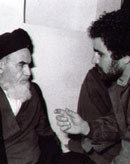
According to Jamaran News, Rasoul Sadr Ameli, prominent filmmaker, in the inauguration ceremony of “Reclusion of the Sun” exhibition on February 2, 2015 in Husseiniyeh Jamaran referred to the controversial answer of Imam to the reporter who asked him: “What do you feel now?” and said: Imam didn’t mean that he felt nothing.
He stated that he has a memory of Imam that he has never shared before and said: I was in the airplane with Imam. When we entered Iranian airspace, Mehdi Araghi and Mohsen Rafighdoust prevented reporters from approaching the airplane.
| |
|
|
Women Missing in Oral History of Revolution
The role women played in the victory of the 1979 Islamic Revolution is largely overlooked by oral history researchers of the contemporary era. In 2006 “Imam Khomeini Works Preservation and Publication Institute” has undertaken an initiative to collect the stories of women who played a part in the revolution.
Historian Faezeh Tavakoli has presented a report over the project and its achievements since it was started in 2006. The following outlines Tavakoli's report:
| |
|
|
Oral History Weekly Magazine Aims and Regulations
Oral History Weekly Magazine wishes to create a suitable place for thoughts and idea development; Its main field would be “Oral History” and subjects as telling & writing memoirs, writing diaries, travelogues, chronologies, and all other subfields of history which are presented in the form of news, articles, reports, notes, interviews and memoirs can be included. There is no limitation on the length of would-be-sent materials.
Mentioning the name, academic background and email is necessary. Articles with complete references and bibliography are more credited and an abstract would quite helpful.
Weekly is not about to publish any material consisting insults and libels about other people or anything that brings anxiety to public opinion. Weekly can edit and translate the received materials.
The published articles and materials are only the writer’s ideas and Oral History Weekly Magazine has no responsibility about their content.
|
|
|

While congratulating on the 36th anniversary of the victory of the Islamic revolution and in view of the correspondence of February 11 with the releasing date of the next of issue of Oral History Weekly, hereby inform you that the next issue will be released on February 18, 2015.
●Interview, oral history workshop held in Mazandaran
●“Interview in Oral History” workshop held
●“I wrote to become permanent” republished for fifth time
●“Noureddin, Son of Iran” turned into computer game
●Encyclopedia about history of Pahlavi published

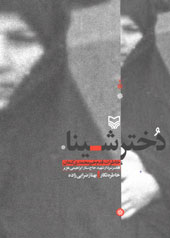
Daughter of Sheena-23
Memories of Qadamkheyr Mohammadi Kanaan
Wife of Sardar Shaheed Haj Sattar Ebrahimi Hajir
Memory writer: Behnaz Zarrabizadeh
Tehran, Sooreh Mehr Publications Company, 2011 (Persian Version)
Translated by Zahra Hosseinian
Hamedan was very different from Qayesh. Everything and everywhere was strange for me. Distance from my Haj Agha made me restless at the first days; so that out of sight of Samad, I would sit and cry my eyes out sometimes. Moving there had just one good point. I would see Samad every day. He would come home for lunching on first week. We would lunch together. He would play with babies a little, then would drink a tea and go to his work until night. His work was hard. It was the beginning of the Islamic Revolution and the peak sabotage of terrorists and hypocrites. Samad would fight with small group’s activities. It was dangerous work.
Our moving to Hamadan also had another advantage. Now friends and families would know they have a place to stay. Hopefully they would set off to Hamedan if they would want to buy something or visit a doctor. So, most days I had guest. |


|
|