| |

|
Oral history, Local History, Anthropological Research

If the folklorist moves outside genre collecting and the oral historian moves beyond interviews with the political and business elite, the two can meet in recording folk prejudices, rumors, biases, awes, hatreds,loyalties, phobias, stereotypes, obsessions and fantasies, argued American folklorist and Professor of Modern Languages and folklore at Western Kentucky University Larry Danielson. What remains to be properly addressed is what oral history, anthropology and local history have in common and how they are different? Can they resort to common resources for historical research? Can the data from oral history and anthropology be considered in local history? Is oral history doomed to preserve and nurture recognition of specific historical events, or it can be used for the review and transferring content as well? This is a fact that oral history and interdisciplinary studies are largely overlooked in Iran;the lack of sufficient oral history theoreticians, indolence of universities and academic bodies in laying out the boundaries of oral history research properly, and over-concentration of oral history activities and projects on topics related only to the Sacred Defense and the Islamic Revolution have restricted the capacity of oral history practice to expand into other fields of study in communications and have prevented convergence of the discipline with other areas like local history, anthropology and sociology.

| |

|
|
Leader Best Critic of his Biography, Author
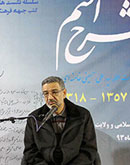
The author and compiler of the "Explication of the Name" on the life and revolutionary activities of the Supreme Leader of the Islamic Revolution Ayatollah Ali Khamenei said the leader is the best critic of his biography.
Addressing a gathering of students at Isfahan University, Hedayatollah Behboudi said writing about the Supreme Leader from any angle is difficult because of the complexity of his personality.
The work entails the leader's biography from his birth until the victory of the Islamic Revolution in 1979 and was debuted in 20012. The book's second edition took some time for publication because the supreme leader corrected the order of a number of the events chronicles in the book. The work's reprint was released in July 2014.
Behboudi added that reading of the book gives readers a basic understanding about the leader's life which was never considered before.
| |
|
|
The 6th Oral History Workshop Held in Hamadan
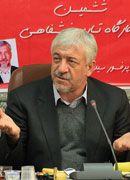
The 6th oral history workshop was hold in 20.Azar.1393 (11.Dec.2014) in Hamadan Bonyad Shahid gathering hall (gathering hall of Hamadan Sacrificing and Martyrs’ affairs Foundation) by presentation of Morteza Nurayee, PhD and Professor in the field of history in Isfahan University, in continuation with the last oral-history workshops.
It should be mentioned that the workshops have been hold since the early of 1393 (March 2014) by the Head of Hamadan National Library and Archives of IR beside other well-known organizations and institutions, such as Hozeh Honari (Art Center) along with Sacrificing and Martyrs’ Affairs Foundation in Hamadan province, to train young and amateur researchers together with professional ones.
Mr. Nurayee had begun his speech through illustrating in relation to the writing a research subject. “Contrary to the most persons’ believes; the writing should be done in the beginning of the research plan not after the ending of that. Although, the main and significance step toward writing is at the time of executing and extracting the plan” he said.
| |
|
|
OHA 2015 Annual Meeting Call for Papers
The Oral History Association invites proposals for papers and presentations for its 2015 annual meeting to be held October 14-18, 2015 at the Marriott Tampa Waterside in Tampa, Florida.
As always, the Program Committee of the OHA welcomes proposals for presentations on a variety of topics. In keeping with this year’s theme, “Stories of Social Change and Social Justice,” the 2015 conference will focus special attention on the power of oral history to uncover links between political and cultural change and to inspire civic engagement.
With its roots in social history, oral history long has offered a means to record stories of social change movements nationally and internationally. Oral history has been particularly useful in amplifying the voices of the people who have protested, inspired or responded to economic crises, political resistance, and waves of migration.
| |
|
|
Cultural Studies Association (CSA) Ethnographic Working Group 2014 CFP
The Cultural Studies Association (CSA) Ethnography Working Group invites proposals to the CSA’s thirteenth annual meeting in Riverside, CA. The Ethnography Working Group investigates how the ethnographic method can continue to shed light onto the field of Cultural Studies, as well discussing the practice of ethnographic research. We invite parties to submit proposals for papers or panels that employ the ethnographic method within the field of cultural studies, discussion panels debating best practices or contemporary issues, or workshops and skill-shares (praxis workshops). While we encourage proposals that match the theme, feel free to submit proposals that do not.
| |
|
|
Oral History Weekly Magazine Aims and Regulations
Oral History Weekly Magazine wishes to create a suitable place for thoughts and idea development; Its main field would be “Oral History” and subjects as telling & writing memoirs, writing diaries, travelogues, chronologies, and all other subfields of history which are presented in the form of news, articles, reports, notes, interviews and memoirs can be included. There is no limitation on the length of would-be-sent materials.
Mentioning the name, academic background and email is necessary. Articles with complete references and bibliography are more credited and an abstract would quite helpful.
Weekly is not about to publish any material consisting insults and libels about other people or anything that brings anxiety to public opinion. Weekly can edit and translate the received materials.
The published articles and materials are only the writer’s ideas and Oral History Weekly Magazine has no responsibility about their content.
|
|
|

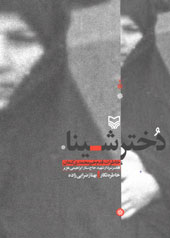
Daughter of Sheena-17
Memories of Qadamkheyr Mohammadi Kanaan
Wife of Sardar Shaheed Haj Sattar Ebrahimi Hajir
Memory writer: Behnaz Zarrabizadeh
Tehran, Sooreh Mehr Publications Company, 2011 (Persian Version)
Translated by Zahra Hosseinian
I passed a sleepless that night. Samad and Haj Agha came back home tomorrow morning. “Since we were united all together, they freed Soltan Hussein.” they were happy and said, “otherwise, there’s no knowing that what the hell gave him.”
Near noon, Samad got ready. He wanted to go to Tehran. I was upset. "Don’t go.” I said, “Our baby might be born today or tomorrow. Then where should we find you?”
As always with a smile he replied: "Don’t worry. I’ll be back on time.”
I frowned. He took his coat off and sat down. "I won’t go, if you're upset. But as a matter of fact, I have no money. After all, wasn’t I supposed to buy some baby clothes and bric-a-brac the next time I go to Tehran?!”
I prepared some food for him. I recommended him to buy what clothes, after he ate his food. I saw him off by the door. In the time of saying goodbye, I said: “Do not forget blanket; a woolen blanket which has just been in fashion. It should be very gorgeous. Please buy a pink one.”
When he was turning at the corner of alley, I cried: “Don’t go to the demo anymore. It’s risky. We're looking forward.”
I returned home. Suddenly, it was like all the house was fallen debris on my head. It was so gloomy and dark. I couldn’t take it. I threw my Chador over my head and went to my Haj Agha’s house.
Two days elapsed of Samad’s leave. I felt that my overall condition isn’t like every day, when I woke up for morning prayers. I felt some back pain and stomachache. "I must endure it.” I said to myself, “the baby isn’t born so soon.”
I did my house works in whatever way. I cooked lunch. There were some dirty clothes, I went to courtyard and into the snow and cold of Qayesh’s winter and washed them.
It had been noon. I came to the end of my endurance. I went to Khadija’s home with deplorable state. She sent one of her children to call midwife and herself came with me to my house.
Sharp pain made me cry loud. Khadija continuously fed me hot water and sugar-candy and saffron infusion.
A little awhile, Shirin jan and my sisters also came to my home. It was afternoon. Near Adhan , my baby was born. I will never forget that night. I rose on my elbows with deplorable state, as I heard a voice. I wished the door was opened and Samad came in. Although the cry of baby didn’t let me to sleep well, but I dreamed Samad as I fell asleep for a moment and I jumped out of my bed in panic.
A week was elapsed from the birth of baby. I heard the sound of the door, while I was laying baby in the cradle. Shirin jan was in the room and looking after me and baby. She went out of the room before Samad came in. |


|
|