| |

|
Cultural Shortcomings Locked in Stalemate

Indeed, economic concerns lower the "threshold of pain” in a society to a great extent. Economic distress is much more likely to cause social turmoil than other issues. One is much more likely to express dissatisfaction by a delayed wage or monthly handout than is so by an unreleased book, unconstructed museum or insufficient educational services. Generally, the first cries of pain are let out from economically injured throats; but this is not all.
Taking economic shortcomings as apparent social pains, there is this other kind of pain that leaves much deeper injuries that remain dormant for so long: cultural shortcomings. One may not hear cultural cries from time to time, but, for sure, they will not smell a pleasant odor; everything smells stale then.

| |

|
|
New Sacred Defense Titles with English Renditions Unveiled
A number of novel works on biographies of the Sacred Defense comrades and achievements of some of Iran’s divisions during the imposed war have been unveiled in Tehran.
IBNA: ‘The 27ers’ by Golali Babaei in English and Persian, the biographies of 34 martyrs of the 27 Mohammad Rasulallah Operation by Hassan Shokri in English, Persian and Arabic, and ‘The 9th Division by Golali Babaei in assessment of the military achievements of Habib-ibn Mazaher Division were unveiled during a ceremony put together on Thursday, February 28 2014.
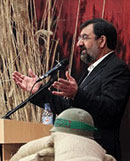
The ceremony was held in the presence of top brass military figures like Mohsen Rezaei, commander of the Islamic Revolution Guards Corps during the war, and a number of senior IRGC officials and commanders at the conference hall of the Interior Ministry.
| |
|
|
In Search of Shahs’ Memories in Historical Tablets
Memories of Iran’s political figures in various eras should be retrieved from inscriptions on the stone tablets remaining from the Achaemenians and Sasanids.
IBNA: The memoirs of political figures in the history of Iran should be considered in the eras of the ancient Iran, Islamic Iran and the contemporary Iran.
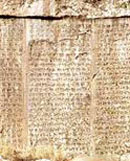
The Bistun Inscription, authored by Darius the Great sometime between his coronation as king of the Persian Empire in the summer of 522 BC and his death in autumn of 486 BC, is regarded as one of the first and most significant inscriptions of shahs in the history of Iran. it is regarded as the first example of memoirs by political figures in the history of Iran. Darius the Great introduces himself, his kingdom and his lands in the inscription.
| |
|
|
Bistun Inscription; First Memoir of Iran’s Kings
Iranian professor of ancient languages and culture said that Bistun Inscription narrates the story of Darius coronation and his kingdom. The Inscription is noteworthy and it is indeed considered as the first memoirs of ancient Iran’s kings.
IBNA: Iranian professor of ancient languages and culture Mahmoud Jafari said: “Before Darius the Great’s Bistun Inscription, several other famous inscriptions were left from the ancient era. Writing inscriptions was one of the methods of reporting the events and the biographies of the ancient era’s kings and dignitaries. Before Iran, the method was also prevalent in Mesopotamia.”
| |
|
|
A Closer Look at Community Partnerships-1
This article charts the early planning stages of a community oral history and civil rights project designed for radio. Along with documenting the intricacies of a community partnership, it explores how the digital age complicates informed consent and challenges our ability to uphold access and use restrictions promised to narrators. History runs deep in the small, storied town of Yellow Springs, Ohio. Arguably a champion of early racial and cultural diversity since its establishment, the village was a cultural nook in the conservative Ohio valley in post–World War II times. High-ranking blacks stationed at nearby Wright Patterson Air Force Base joined the community, many purchasing property during a time when access to home loans was very difficult. Blacks were leaders of the police force, the village council, and the public schools, prior to the social activism that marked the late 1960s.
| |
|
|
Oral History Weekly Magazine Aims and Regulations
Oral History Weekly Magazine wishes to create a suitable place for thoughts and idea development; Its main field would be “Oral History” and subjects as telling & writing memoirs, writing diaries, travelogues, chronologies, and all other subfields of history which are presented in the form of news, articles, reports, notes, interviews and memoirs can be included. There is no limitation on the length of would-be-sent materials.
Mentioning the name, academic background and email is necessary. Articles with complete references and bibliography are more credited and an abstract would quite helpful.
Weekly is not about to publish any material consisting insults and libels about other people or anything that brings anxiety to public opinion. Weekly can edit and translate the received materials.
The published articles and materials are only the writer’s ideas and Oral History Weekly Magazine has no responsibility about their content.
|
|
|

● 800 hours of holy defense oral history recorded
● Air Force oral history used in "A File for MiG-25"
● IRGC Navy oral history ready for presentation
● Writers to receive manual of style of oral history works
● "Oral History of Life and Struggles of Martyr Sadeq Amani" released
● Oral history workshops held in Kerman and southern Khorasan
● Documents, audio and visual materials of martyrs archived
● Coup, memories reviewed

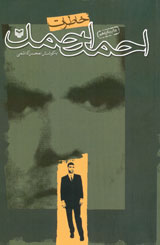
Ahmad Ahmad Memoirs (71)
Edited by Mohsen Kazemi
Soureh Mehr Publishing Company
(Original Text in Persian, 2000)
Translated by Mohammad Karimi
Evin Prison
The day after Eid-ul-Fitr I was told to ready to go to prison. First I called Mrs. Moslehi and thank her for her helps during those days particularly for the help she did to keep me there in the hospital in Ramadan; she thanked me I prayed for her a lot.
Before leaving, Faramarzi –SAVAK torturer- came and told the agents not to close my eye and take via the newly constructed freeways and bridges to see how progressed had become the country. He said that I had been in hospital and was not aware of anything. |


|
|