| |
|
President Hassan Rouhani Honors Journalists at Tehran Press Festival

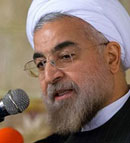
A number of journalists and veterans were honored by President Hassan Rouhani during the closing ceremony of the 20th edition of the Tehran Press Festival on Saturday.
IBNA: According to Tehran Times, veteran journalists and editors Farajollah Saba, Ahmad Samiei Gilani and Parviz Khorsand received lifetime achievement awards and 35 reporters, journalists and photojournalists were awarded, Persian media reported on Saturday.
Minister of Culture and Islamic Guidance Ali Jannati, the Deputy Culture Minister for Press Affairs Hossein Entezami, and a number of art and cultural figures and veteran journalists attended the closing ceremony, which took place at Vahdat Hall.

| |

|
|
Persian Readers to Enjoy Memoirs of Pilot of First Flight to Iran
The Iranian translator Seyyed Saeid Firuzabadi is currently working on the memoirs of the Swiss pilot Walter Mittelholzer who made the first flight to Iran in 1925.
IBNA: According to Tehran Times, 'Flying to Persia' will be probably be published by Farhang-e Moaser in May 2014.
In this book, Mittelholzer chronicles his adventures during the 104-day voyage to Iran.
Mittelholzer took off from Zürich on December 18, 1924, to fly to Persia. His aircraft was a Junkers A 20 floatplane and named Switzerland.
| |
|
|
Japanese, Iranian Writers Meet at Tehran Peace Museum
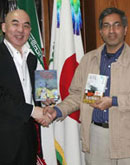
Naoki Hyakuta, the Japanese author of “The Man Who Was Called a Pirate”, and Habib Ahmadzadeh, the Iranian author of “Chess with the Doomsday Machine”, met at The Tehran Peace Museum on Saturday to discuss works which promote nationalism in the countries of the two writers.
IBNA: According to Tehran Times, “The Man Who Was Called a Pirate” is a historical novel based on the Nissho Maru Incident, in which the Japanese oil company Idemitsu won a court case against the Anglo-Iranian Oil Company in 1953 when Iran was involved in a dispute with Great Britain after nationalizing its oil industry.
| |
|
|
Reprinted: ‘Daily Notes' of Najaf Daryabandari
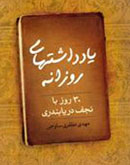
The second reprint of ‘Daily Notes, Thirty Days with Najaf Daryabandari' compiled by Mehdi Mozaffari Savoji has been released by Negah Publications.
IBNA: The book covers numerous sessions with Daryabandari by Savoji which was debuted last month and has been reprinted shortly after its release.
During the sessions and the dialogues, Daryabandari has provided concise but detailed responses to the questions asked by Savoji about numerous social, political and cultural issues.
Also the book entails memories of Daryabandari, one of the most renowned and respected Iranian translators who has won the Thornton Wilder award from Colombia University in Canada.
| |
|
|
Days of Revolution
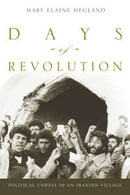
Outside of Shiraz in the Fars Province of southwestern Iran lies "Aliabad." Mary Hegland arrived in this then-small agricultural village of several thousand people in the summer of 1978, unaware of the momentous changes that would sweep this town and this country in the months ahead. She became the only American researcher to witness the Islamic Revolution firsthand over her eighteen-month stay. Days of Revolution offers an insider's view of how regular people were drawn into, experienced, and influenced the 1979 Revolution and its aftermath.
| |
|
|
Q&A with oral historian Sara Wood
The stories and history surrounding Southern food are just as colorful and diverse as the food itself. The Southern Foodways Alliance collects stories from across the region and celebrates the contributions of countless classes, races and ethnicities on Southern cuisine.
Based in Wilmington, N.C., Sara Wood works as an oral historian with the SFA. The Daily Tar Heel sat down with Wood to find out more about her research and what she has learned from working in the South.
| |
|
|
Oral History Weekly Magazine Aims and Regulations
Oral History Weekly Magazine wishes to create a suitable place for thoughts and idea development; Its main field would be “Oral History” and subjects as telling & writing memoirs, writing diaries, travelogues, chronologies, and all other subfields of history which are presented in the form of news, articles, reports, notes, interviews and memoirs can be included. There is no limitation on the length of would-be-sent materials.
Mentioning the name, academic background and email is necessary. Articles with complete references and bibliography are more credited and an abstract would quite helpful.
Weekly is not about to publish any material consisting insults and libels about other people or anything that brings anxiety to public opinion. Weekly can edit and translate the received materials.
The published articles and materials are only the writer’s ideas and Oral History Weekly Magazine has no responsibility about their content.
|
|
|

● One year and 13 oral history workshops
● Collection gives identity to people’s oral history
● Oral history of revolution in Karaj to amount to more than 3000 pages
●“Oral Treasury of Taibad” released
● Book tells memories of meeting with political and cultural figures
● Memoirs of Emma Gerstein released in Iran

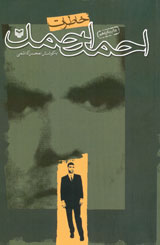
Ahmad Ahmad Memoirs (69)
Edited by Mohsen Kazemi
Soureh Mehr Publishing Company
(Original Text in Persian, 2000)
Translated by Mohammad Karimi
Foul Smell and Resistance
About a fortnight or more I was abed in The Police Hospital and still tolerating pain. They had not done any particular treatment for me except some pain relief injections. The bullets were still in my body. I was burning in pain. My injuries smelled disgustingly foul. One day it was reported to Dr. Javad Hey’at [1] –head of surgery section- that the foul smell had filled that section. He came to check the matter and found it was from the room that I was kept in. When he was entering the room, the agents impeded and told him: “You are not allowed to enter.” However, he came in by force.
Dr. Hey’at came beside my bed. He put away the sheet. He found out the foul smell was from my back injuries. He ordered to change the sheets and sterilize the injuries and room. The sheets had stuck to the injuries. When the nurse would pull the sheets the foul smell of pus would fill the room. I would bite my lips of pain. Hey’at who watched this terrible scene angrily shouted at nurses and asked: “What the hell is this condition?” They said: “They (SAVAKIs) do not let us to change the sheet and the bandage on his injuries. |


|
|