| |
|
Hiroshima Travelogue - Final Episode

Before leaving Tokyo for Tehran, we went to the Iranian embassy and awaited Dr. Nazar Ahari, Iran's ambassador to Japan, in the public meeting room. After the conventional formalities, each of us voiced their concerns regarding enhancement of cultural ties between Iran and Japan. Mr. Ambassador listened carefully and, whether sincerely or respectfully, subscribed to the aired views. In the end, everybody thanked the embassy staff for their hospitality and received gifts from the ambassador.
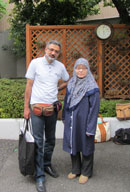
We stopped by at the embassy yard to take some good-bye pictures. I took my last picture with Mrs. Koniko Yamamora (Babaei), mother of a martyr.
In the final lines of my travelogue, I'd like to touch on members of the Iranian delegation in their 10th cultural Hiroshima visit:

| |

|
|
Review: Soviet Families' Inner Lives-1
How did Stalin’s terror shape “the inner world of ordinary Soviet citizens” (xxix)? To answer this question, the British historian Orlando Figes organized a team of researchers who interviewed Russians about life since the Revolution. They also collected their personal documents and created several archives and a website (http://www.orlandofiges.com), which serve as extensions of Figes’s book. The “moral sphere of the family” (xxx) is the focus of Figes’s 700-page-narrative. In this sweeping exploration, he masterfully handles a massive number of sources as he constructs a complex history of myriad psychic, emotional, intellectual, social, and cultural changes over the course of nearly a century. The thrust of this compelling and often tragic story of families’ everyday lives in Stalinist Russia derives from hundreds of testimonies that have survived through letters, photographs, diaries, memoirs, oral histories, and many other personal or socalled ego-documents. The result is a history of Soviet society’s mentalité in the longue durée.
| |
|
|
Bosnian memories preserved in St. Louis
ST. LOUIS (AP) — Selma Avdagic was only an infant when her Bosnian family fled from Sarajevo to St. Louis two decades ago as war ravaged the former Yugoslavia.
The college student knows her parents' immigration story well. How her mother, a doctor back home, worked a succession of low-wage jobs in the St. Louis suburbs until she could obtain a U.S. medical license. How her father, who remained behind for another year, was nearly killed by a Serbian soldier.
Avdagic thought little of her own story, figuring few people would be interested in the perspective of an American college student with only the faintest of eastern European accents. But then she stumbled upon the Bosnia Memory Project, an effort by two scholars at Fontbonne University, just outside St. Louis, to collect oral histories about the Bosnian war
| |
|
|
The importance of historical accuracy in the present day
When thinking about a certain country, the images that appear come from a history that has been laid out in front of us from a variety of sources. The question, though, is who exactly is writing that history, and how is it being presented to the general population?
History is presented to the public in a variety of different manners. Academic monographs, popular film, commercial textbooks and public museums are only a few of the outlets that are utilized to present the history of one’s country. All of these methods have their own governing rules, missions and guidelines that must be followed in the process. With this context, the groundwork for comprehending the process of writing the history for America can be better understood.
| |
|
|
ORAL HISTORY: A Collaborative Method of (Auto)Biography Interview (Part V)
As you have already seen, qualitative research in general, and oral history in particular, demand a high degree of ethics in practice. The archiving of oral history transcripts and/or projects is an important part of the oral history process. The American Historical Association says that arranging to deposit oral history interviews in an archival repository is a part of ethical research. The archiving of oral history materials, which makes them available for any host of future uses, may influence the research process in many ways. If a participant is well informed about the research and its outcomes, as they should be through informed consent, then the knowledge the interview will be archived may influence their storytelling. This is particularly salient when unedited interviews will be archived as narrators understand their initial telling of their story will be documented and made available forever.
| |
|
|
Oral History Weekly Magazine Aims and Regulations
Oral History Weekly Magazine wishes to create a suitable place for thoughts and idea development; Its main field would be “Oral History” and subjects as telling & writing memoirs, writing diaries, travelogues, chronologies, and all other subfields of history which are presented in the form of news, articles, reports, notes, interviews and memoirs can be included. There is no limitation on the length of would-be-sent materials.
Mentioning the name, academic background and email is necessary. Articles with complete references and bibliography are more credited and an abstract would quite helpful.
Weekly is not about to publish any material consisting insults and libels about other people or anything that brings anxiety to public opinion. Weekly can edit and translate the received materials.
The published articles and materials are only the writer’s ideas and Oral History Weekly Magazine has no responsibility about their content.
|
|
|

● Oral History of Golestan Palace to be completed within 3 years
● Biography of Ahmad Mahmoud has oral history
● “Oral History of Iran’s Central Bank” unveiled
● Oral history and memoirs of war registered
● 10,000 hours of interview conducted with Khorasanis
●“Second Revolution in Two Movements” continues to be written
● 13 years for collection and publication of memoirs of teens
● “I AM Ezzat from Sanglaj” with 100 memories
● Memories of the 2nd wife of Reza Khan released

Ahmad Ahmad Memoirs (63)
Edited by Mohsen Kazemi
Soureh Mehr Publishing Company
(Original Text in Persian, 2000)
Translated by Mohammad Karimi
Thunder
Contacts with Andarzgou
After separation from MKO and moving my furniture to Mo’ezzossoltan Street, one day I was walking aimlessly in the street. I decided to go and visit Haj Sadegh Eslami. After greetings, I reported all my visits and whatever that had happened to me during that last few days. I expressed my sorrow about the separation MKO imposed on my wife and me. He said: “The comrades in in Coalition Councils advised me to take care of you. So, call Haj Mohsen Rafiqdoost (1) tomorrow morning at 9 o’clock and tell him that I have ordered you to go there and get the luggage there. Then he would tell you what to do. Go and be relaxed.” |


|
|