| |
|
Call to Boycott the Oral History Conference at the Hebrew University of Jerusalem: Open Letter

Few weeks ago we heard Hebrew University of Jerusalem is going to hold an international conference on oral history. But soon it was banned by oral history activists around the world in an attempt to object Israeli racist policies against Palestinian people. Here we have the open letter of these activists which is signed by more than 280 oral historians. A look at this open letter shows how intellectuals around the world are aware of what is happening in Palestine and also informs us about very exact legal and historical points about Palestinian rights and Israeli racist policies. At the end you can read the call for the so-called conference.

| |

|
|
Hiroshima Travelogue: Episode 8
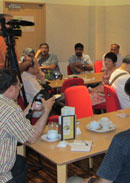
In the evening, we are invited to a restaurant. A relatively small part of the restaurant is already prepared for us. The former president of the Hiroshima Peace Museum and members of the MOCT are with us at the restaurant.
A colorful dinner set is prepared for us in one corner; most of the stuff is new to us in the dinner except for the potatoes, fish and pasta. I take some of each. As the dinner is over, and as this is a routine in such gatherings, each of the guests introduces himself. After the introductions, Ms. Soya, head of the MOCT delegation, delivers a speech and repeats some parts.
| |
|
|
Globalizing Palestine
The Birzeit University Palestinian Archive was conceived some years ago, and resulted in the creation and rapid development of a generalist, open, online archive of the Palestinian people, which stores and presents textual and audio-visual documents coming from all sectors of the society, official and unofficial, from late Ottoman times to the present (with the legally-based exception of materials produced by the Palestinian Authority). It is located in the Ibrahim Abu-Lughod Institute of International Studies, and benefits from its multidisciplinary expertise.
| |
|
|
Events mark acquisition; UF celebrates Stetson Kennedy's work
Events mark acquisition; UF celebrates Stetson Kennedy's work
The University of Florida marked the acquisition of Stetson Kennedy's manuscripts Tuesday with a full day of events, from an open house exhibiting Kennedy's books and writing samples to a panel discussion about his legacy.
"This is a great day in the history of the University of Florida, for the people of our state and the nation," said Paul Ortiz, director of the Samuel Proctor Oral History Program at UF.
Ortiz also thanked first lady Chris Machen, who said that she came to respect and admire Kennedy's work during the six years she served on the Florida Folklife Council.
| |
|
|
Share oral history between generations
Sharing the oral history between generations is an important way to capture and stories that otherwise might be lost for generations. (Shutterstock)
Sharing oral history between generations is an important way to capture stories that otherwise would be lost for generations. Following are a few ideas to consider:
Meet and get to know your relatives
Take the opportunity to meet relatives. Often they provide important insight into the history and makeup of the family. For example:
Break the ice with relatives you hardly know by talking about your shared family history.
| |
|
|
Duncan's totem project completion offers signage and oral histories
Signage and oral histories are now part of the world's largest collection of outdoor totem poles, City of Duncan staff says.
Completion of the Totem Interpretive Project will be toasted Oct. 23 at 10 a.m. in Charles Hoey Park, beside the train station-museum building.
Signs fronting Totem Town's 37 poles were developed based on oral histories recorded from carvers and their families.
Those stories, collected by Jane Mertz, accessed previously unknown stories about the artists and their kin — and acknowledges the artists' voices in the stories of the poles they made.
Carvers' cultural knowledge is now housed in the Cowichan Valley Museum and Archives for use by visitors and scholars.
| |
|
|
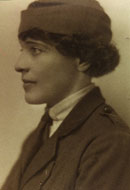
Living History: Utah’s Maud Fitch had the right stuff in WWI
On April 6, 1917, the United States joined the Allied forces to defeat Germany and the Central Powers in what was then called the Great War (1914-18). More than 200 bilingual female telephone operators, called "Hello Girls," were recruited to serve abroad.
An initial corps of 400 nurses was sent to France to work in base hospitals. And nearing the war’s end, Maud Fitch, a 35-year-old society gal from Eureka, traveled to Manhattan to join the Woman’s Motor Unit of Le Bien-etre du Blesse, qualify as an ambulance driver, purchase her own truck and sail to France to do her bit.
| |
|
|
Oral History Weekly Magazine Aims and Regulations
Oral History Weekly Magazine wishes to create a suitable place for thoughts and idea development; Its main field would be “Oral History” and subjects as telling & writing memoirs, writing diaries, travelogues, chronologies, and all other subfields of history which are presented in the form of news, articles, reports, notes, interviews and memoirs can be included. There is no limitation on the length of would-be-sent materials.
Mentioning the name, academic background and email is necessary. Articles with complete references and bibliography are more credited and an abstract would quite helpful.
Weekly is not about to publish any material consisting insults and libels about other people or anything that brings anxiety to public opinion. Weekly can edit and translate the received materials.
The published articles and materials are only the writer’s ideas and Oral History Weekly Magazine has no responsibility about their content.
|
|
|

The Holy Defense Garden Museum and Promotion of Resistance Culture has so far organized 689 meetings of registration of holy defense oral history attended by the commanders, senior officers and combatants of the holy defense period.

Ahmad Ahmad Memoirs (56)
Edited by Mohsen Kazemi
Soureh Mehr Publishing Company
(Original Text in Persian, 2000)
Translated by Mohammad Karimi
Behind the Curtain Visit with Taqi Shahram
I couldn’t understand why Fatimah would not show any reaction and this was bothering me. I could guess some changes had happened in her ideas. I thought her religious believes would not let her to take position against me. Lack of reaction by her made me thinking about her attempts and words during the last few months and then I frightened.
Few days later Iraj came and said: “Shapour, someone comes here today to discuss with you and hear your objections and explain the developments for you.” Iraj mounted a rope in the middle of the room and put a veil on it and divided the room to two parts. That afternoon he came. Iraj and he sat on one side and Iraj and I sat on the other side. It was so interesting that Shapourzadeh sat in the middle in a way that she could see both sides. It was a question for me that why my wife had the right to see him but I had not and it was sad sign for me. It would show that Shapourzadeh knew him before and possibly they might have had some coordination in thoughts and ideas. By hearing the very first words I knew him; he was Mohammad Taqi Shahram. I also could see his huge and bad-shape body shadow clearly because of the light rays on the veil. I found out it was his dirty body who was talking to me on the other side.
During our talks Iraj was playing with my daughter, Maryam, who was only little baby and would run this side and that side and it would show there were some closeness between them. By watching these scenes I understood how deep that tragedy was and I bid farewell to everything. I had visited Taqi Shahram in 1971-1972 in Qezel Qal’eh. He had a huge body and a harsh voice and cold face.
Taqi Shahram said: “… Shapour! I know you well…” It was clear that he knew me from those prison days and the explanations that my wife and Iraj had given him about me. He began with fundamental discussions about progressive ideals and the masses and people’s struggle, proletarian revolution and … continued: “We should devote everything for the struggle even our ideas. |


|
|