| |
|
Hiroshima Travelogue - Episode 3

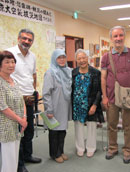
It is pleasantly sultry. In the morning we leave for a museum called the “The Center of the Tokyo Raids and Was Damage”. It's a small 3-story building. A polite old woman welcomes us in. We take the steps to the second floor and take a seat. A film is being displayed about the horrific bombing of Tokyo by US forces. During the wee small hours of March 10 1945, almost 300 B-29 fighters bombarded Shitamachi town in Tokyo. They say over 100,000 died in the US-made hell and some one million were displaced as a result of the bombing. The air strike, according to the museum's guide book, is one of the 100 aerial bombings of Tokyo by US fighters. The places where the bombs fell are marked in a large map of the city. The film is a recreated documentary about a mother trying to salvage her children. Burned, ploughed ground is only thing left of Tokyo as it is shown in the movie.

| |

|
|
‘Da’ to hit American bookshelves
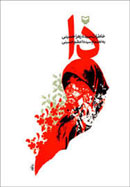
U.S. translator Paul Sprachman has completed the translation of the Iranian bestselling novel ‘Da’ which will be released by Mazda Publishers.
IBNA: ‘Da’ contains recollections by Seyyedeh Zahra Husseini of the time when the Iraqi army captured Khorramshahr in the early days of the 1980-1988 Iran-Iraq war. It is a true-to-life story of a teenager who experienced the early days of the war in Khorramshahr.
Seyyedeh Azam Husseini wrote ‘Da’ according to narrations by Seyyedeh Zahra Husseini. The book was published in 2008 and soon became an Iranian bestseller.
The book’s translator said that he started to convert the book in 2009 which is ready now on the eve of the Sacred Defense Week in Iran.
| |
|
|
Russian written scolds erroneous impression of Iran-Iraq war in Russia
Sergey Verevkin says the Iraq-imposed war on Iran has been misinterpreted by Russian writers, which is why he has decided to pen a book about the realities of the war.
IBNA: Visiting the Resistance and Sacred Defense Literature Bureau in Tehran, Verevkin said in an interview with the Arts Bureau that he had interviewed Iran’s ambassador to Russia about the Sacred Defense but the dialogue was never published in Russian media due to negative propaganda prevalent among the media.
“I have decided to write a book about Iran-Iraq war and I have come to Iran to see places like Khouzestan, Sousangerd, Azerbaijan, Kurdistan and other regions and talk to the war-stricken people and take pictures of the places,” he said elaborating on the reasons for his visit of Iran and travelling to various parts of the country.
| |
|
|
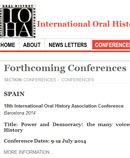
IOHA CONFERENCE/MASTERCLASS
For each international conference the IOHA is able to provide small grants for a limited number of participants. The IOHA Conference/Master Class Scholarship Fund aims to bring together international oral history scholars from inside and outside the academic realm, to continue building a unique global platform for professional exchange and comparative oral history inquiry.
IOHA Conference/Masterclass Grants take the form of financial support for travel costs, master classes fees or conference fees. This time the maximum grant is 6.850-€. (as of March 2014). Most awards range between 250 € to 500 €. The grant is a supplement; applicants are advised to start looking for funds from other sources
as soon as they determine their intention to participate.
| |
|
|
The first OHAI conference, 18th-19th November 2013, Bangalore, India
There has been a widespread recognition of the fact that that the field of oral history has contributed widely to the inclusion of people who have been left out of official histories. Oral history is now seen both as a method and as a field that records memories and experiences of individuals and communities whose voices would remain unheard otherwise. Apart from that, often in the absence of archival documents, oral history functions as an important tool that can be used to record histories of institutions and
organizations – filling up gaps in our knowledge of the past and enabling different, sometimes contentious, but always valuable perspectives that contribute to a complex and textured understanding of the past and its relationship to the present.
| |
|
|
USA: The Apollo Project
Terrell Frazier, Director of Education and Outreach from Columbia University reports on an oral history project of Harlem’s Apollo Theater, which was undertaken as the famed theatre approached its seventy-fifth anniversary in 2009.
‘In 2008 Columbia University’s Center for Oral History (CCOH) joined with the Apollo Theater Foundation Inc (www.apollotheater.org) to document and preserve the vibrant history of Harlem’s Apollo Theater and its surrounding neighbourhood in anticipation of the theater’s seventy-fifth anniversary. The Apollo Theater oral history project began with the reminiscences of prolific songwriter and Motown legend Smokey Robinson. In his interview, Robinson recalls his journey from Chicago to New York City to perform with his band “The Miracles” on the Apollo stage
| |
|
|
Oral History Weekly Magazine Aims and Regulations
Oral History Weekly Magazine wishes to create a suitable place for thoughts and idea development; Its main field would be “Oral History” and subjects as telling & writing memoirs, writing diaries, travelogues, chronologies, and all other subfields of history which are presented in the form of news, articles, reports, notes, interviews and memoirs can be included. There is no limitation on the length of would-be-sent materials.
Mentioning the name, academic background and email is necessary. Articles with complete references and bibliography are more credited and an abstract would quite helpful.
Weekly is not about to publish any material consisting insults and libels about other people or anything that brings anxiety to public opinion. Weekly can edit and translate the received materials.
The published articles and materials are only the writer’s ideas and Oral History Weekly Magazine has no responsibility about their content.
|
|
|

Writer Mohammad Hassan Abu Hamza says he has been given the responsibility of registering of the oral history of Islamic Republic of Iran's Broadcasting (IRIB) and that the research stage of the plan has been started.

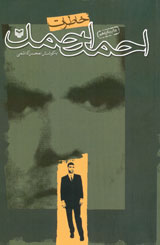
Ahmad Ahmad Memoirs (51)
Edited by Mohsen Kazemi
Soureh Mehr Publishing Company
(Original Text in Persian, 2000)
Translated by Mohammad Karimi
After some time Habib told Parviz: “You are so faithful to your wife and it is dangerous for your way and MKO. If they arrest you in future this dependence would put you in a weakened position and MKO would definitely get harmed. In the following days, Habib continued such discussions with Parviz and then MKO ordered him to become friends with a MKO female member and get about in his residence area in a red BMW. Obeying MKO orders, Parviz accepted to do that and some of his relatives and friends saw him with that girl and reported the matter to his wife. Finally MKO ordered them (The girl and Parviz) to have a trip to Caspian coast in North of Iran. There, they took a photograph from them and put it in Parviz’s pocket. Parviz’s wife saw that pic and considering the previous heard stories, the warm circle of their life collapsed. It was the beginning of his misery. Parviz who could earn good money and owned a color shop in Bouzarjomehri Street (15th of Khordad) gradually lost his house, car, credit and everything. (1)
Day by day more tasked would be ordered to our team. Typing and duplicating MKO announcements and pamphlets was one of them. While doing this organizational task we would read these texts and find new firsthand information. The duplication task was done by a Photo Stencil machine which had been confiscated (!) by MKO members. The services and repairs of these machines were exclusively done few particular companies and they had to deliver all the names and information of the people who would bring their machines to repair to SAVAK. MKO being aware of this problem would choose different tricks to hoax SAVAK. Whenever the duplicating machine needed services, Parviz would make himself neat and clean and go to one of these companies along with a veil-less girl and ask for the repair by presenting untrue information. The way nobody would suspect.
Day by day our tasked would be added. Inevitably I was forced to leave my job in Iron Junks Company in order to have more free time for my organizational tasks. |


|
|