| |
|
Recording unheard voices

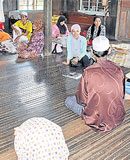
Farina So believes in the power of oral history. Collecting and studying historical information through interviews with Muslim and non-Muslim communities in the three restive southern provinces of Thailand, for instance, can help officials in charge of reconciliation better understand the issues residents are facing. And So ought to know, because the 33-year-old heads the Cham Oral History Project at the Documentation Center of Cambodia (DC-Cam). The term oral history can include written, audio or videotaped interviews, she said, which record memories, stories and reflections that can assist people to get a clearer picture of an otherwise complex situation.

| |

|
|
Principles for Oral History and Best Practices for Oral History
Oral history refers both to a method of recording and preserving oral testimony and to the product of that process. It begins with an audio or video recording of a first person account made by an interviewer with an interviewee (also referred to as narrator), both of whom have the conscious intention of creating a permanent record to contribute to an understanding of the past. A verbal document, the oral history, results from this process and is preserved and made available in different forms to other users, researchers, and the public. A critical approach to the oral testimony and interpretations are necessary in the use of oral history.
The Oral History Association encourages individuals and institutions involved with the creation and preservation of oral histories to uphold certain principles, professional and technical standards, and obligations. These include commitments to the narrators, to standards of scholarship for history and related disciplines, and to the preservation of the interviews and related materials for current and future users.
| |
|
|
The Oral History Review Published- Volume 40
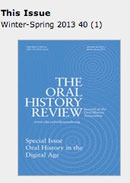
(Issue 1 Winter-Spring 2013) of the Oral History Review is a special issue that builds on and extends the work of the Oral History in the Digital Age (OHDA) Project. That project began with a grant proposal to the Institute of Museum and Library Services (IMLS) in the National Leadership Grants category. The original intent of OHDA was, essentially, to articulate best practices for oral history in the digital age, emphasizing the collecting, curating, and disseminating phases of the oral history trajectory, with a specific focus on technologies, intellectual property, and digital video. The original project proposal was submitted by MATRIX: Center for Humane Arts, Letters & Social Sciences Online at Michigan State University, in partnership with the Oral History Association, the American Folklore Society, the American Folklife Center at the Library of Congress, the Smithsonian Center for Folklife and Cultural Heritage, and, later, the Louie B. Nunn Center for Oral History at the University of Kentucky Libraries.
| |
|
|
"Deindustrialization and Its Aftermath: Class, Culture and Resistance" International Conference
The Deindustrialization and Its Aftermath: Class, Culture and Resistance international conference is being organized jointly by Concordia University’s Centre for Oral History and Digital Storytelling and the Scottish Oral History Centre at Strathclyde University in Glasgow.
May 1-4, 2014 - Montréal, Québec
Deindustrialization may not be a recent phenomenon but the study of it is. The word has its origins in the Second World War when the Nazis stripped occupied areas of their industry. The term was then picked-up by the Allies in the war’s immediate aftermath to describe possible postwar retribution against Germany.
| |
|
|
Oral History Weekly Magazine Aims and Regulations
Oral History Weekly Magazine wishes to create a suitable place for thoughts and idea development; Its main field would be “Oral History” and subjects as telling & writing memoirs, writing diaries, travelogues, chronologies, and all other subfields of history which are presented in the form of news, articles, reports, notes, interviews and memoirs can be included. There is no limitation on the length of would-be-sent materials.
Mentioning the name, academic background and email is necessary. Articles with complete references and bibliography are more credited and an abstract would quite helpful.
Weekly is not about to publish any material consisting insults and libels about other people or anything that brings anxiety to public opinion. Weekly can edit and translate the received materials.
The published articles and materials are only the writer’s ideas and Oral History Weekly Magazine has no responsibility about their content.
|
|
|

"The post-revolution memoirs of Javad Mansouri penned by Mohammad Mohsen Mos'hefi and with the attempt of the office will be published by Sooreh Mehr Publications", said Hojat-al Eslam Saeed Fakhrzadeh who is in charge of the Oral History Department of the Office of Islamic Revolution Literature.

Ahmad Ahmad Memoirs (42)
Edited by Mohsen Kazemi
Soureh Mehr Publishing Company
(Original Text in Persian, 2000)
Translated by Mohammad Karimi
Apple Smell
Job, Marriage
In the early days after my freedom, my relatives and friends came to visit me to get the news. I was happy with that because of my worriedness about SAVAK’s monitoring who come to our house. Some days passed this way. I had to find a job. Because of my political background, it was not easy to find a good job. I talked to many people and it was useless. Finally I visited the late Haj Mohammad Sadegh Eslami and told the matter to him. He employed me in Qa’em Glaze Company (1) where he was the directing manager. SAVAK’s monitoring continued. They would follow me everywhere and all the time. |


|
|