| |
|
Ghanipour festival highlights resistance literature

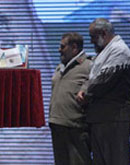
During the closing ceremony of the 12th martyr Habib Ghanipour book of the year festival, an official of Art Bureau said: “The festival’s main purpose is to highlight resistance literature.”
IBNA: The closing ceremony of the 12th martyr Habib Ghanipour book of the year festival was held on Monday with the attendance of the manager of Art Bureau’s literary creations center and the festival’s founder Amir Hussein Fardi, the event’s secretary Mohammad Naseri as well as a group of authors.

| |

|
|
60 new titles unveiled on martyred women
Iran held a congress revering 7,000 Martyred Iranian Women and unveiled 60 titles on martyred women.
IBNA: Arranged on Wednesday, March 6, 2013, the congress was held in the presence of a number of high-ranking officials like Representative of the Supreme Leader in Martyrs’ Foundation Hujatoleslam Mohammad Hassan Rahimian, Chief of Staff of the Islamic Republic of Iran’s Armed Forces Commander Hassan Firuzabadi, Head of the Basij Mostaz’afan Organization Commander Mohammad Reza Naghdi, and a number of the family members of martyred and Basiji women. The event was arranged at Tehran’s Vahdat Hall.
| |
|
|
E-Workshop: Getting Started with Oral History
The Institute for Oral History invites you to take part in our eighth online oral history workshop. Join us on April 10 and 17, 2013, from 10:00 a.m. to 1:00 p.m. Central Daylight Time. A fee of $75.00 covers six hours of instruction, access to useful documents and forms, and continuing consultation for your oral history project.
| |
|
|
Oral History and Life Stories Network, European Social Science History Conference
The Oral History and Life Stories Network has become the major regular international forum for European oral history and life story researchers and is currently one of the largest, friendliest, and most popular networks of the European Social Science Conference.
We invite proposals for the Vienna ESSHC-conference on 23-26 April 2014 both for individual papers and for sessions. Sessions can have various formats: panels, round table discussions, presentations in other media followed by discussion.
We invite contributions discussing conceptual and methodological issues related to the representation of crises and ruptures (private, public, personal and/or political) in oral history with specific reference to memory and narrative.
| |
|
|
Dreams, Phantasms and Memories
There are a number of reasons why it is worthwhile to study dreams. This topic is currently an especially relevant and important one for two primary reasons. Firstly, the current zeitgeist is one of rationality and pragmatism, almost exclusively oriented towards measurable profit, tangible effect and spectacular success. As a result, phenomena such as dreams, fancies, secret fantasies, and remnants of memories are often neglected. Secondly, in the light of postmodern suspicions which question any permanent foundations of existence, truth, memory and identity, and in a situation where our whole reality reveals a distinctly phantasmatic character, a temptation arises to treat the realm of dream and imagination as especially distinguished – as the most important way of “being-in-the-world”, or perhaps even the only one which we can access.
| |
|
|
Africa: The Fading Use Of Indigenous Languages
It is a disturbing fact that African countries have embraced foreign languages at the expense of indigenous languages. As such, traditions and beliefs that have been passed on from generation to generation are gradually going extinct. Proverbs and stories that served as moral lessons and generational teachings have been traded for the 'fables of aesop', Mills and bones, etc, and foreign films now serve as the instructor of today's children. Indigenous languages have been labeled 'vernacular' or 'gibberish', and as such, most African children and youths in primary and secondary schools are even punished for speaking their mother tongues.
| |
|
|
Oral History Weekly Magazine Aims and Regulations
Oral History Weekly Magazine wishes to create a suitable place for thoughts and idea development; Its main field would be “Oral History” and subjects as telling & writing memoirs, writing diaries, travelogues, chronologies, and all other subfields of history which are presented in the form of news, articles, reports, notes, interviews and memoirs can be included. There is no limitation on the length of would-be-sent materials.
Mentioning the name, academic background and email is necessary. Articles with complete references and bibliography are more credited and an abstract would quite helpful.
Weekly is not about to publish any material consisting insults and libels about other people or anything that brings anxiety to public opinion. Weekly can edit and translate the received materials.
The published articles and materials are only the writer’s ideas and Oral History Weekly Magazine has no responsibility about their content.
|
|
|

The closing ceremony of the 12th Festival of the Year Book of Martyr Habib Ghanipour was held on 4th of March, 2013. The book "Nureddin, the Son of Iran" authored by Masumeh Sepehri was admired in the section of memory with the subject of holy defense and Islamic revolution, and "The Foot that Left Behind" written by Seyyed Nasser Hosseinipour was chosen as the book of the year.

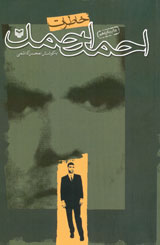
Ahmad Ahmad Memoirs (25)
Edited by Mohsen Kazemi
Soureh Mehr Publishing Company
(Original Text in Persian, 2000)
Translated by Mohammad Karimi
Being Trained in Hezbollah
We needed some training to ready to fight against the regime consciously. So we scheduled program for the needed trainings such as martial arts, shooting and ideological discussions somewhere around brick kilns near Khavaran Road. We (Abu Sharif, Sepasi Ashtiani and I) would go to places far behind the public eyes in order to save any human or animal from the possible hurts of our shooting and also not to make any suspicion.
In another program, Abba Agha Zamani conducted Arabic Language classes first in Haj Amjad Mosque (1) and then in Amir-al-Mu’menin Mosque (2). These classes were free and in a new style and beside the call Agha Zamani would ask the participants to memorize some Koranic verses particularly the ones about Jihad.
Ayatollah Musavi Ardebili – the prayer leader clergy at Amir-al-Mu’menin Mosque- despite knowing Abbass had been a political prisoner, had agreed to hold these classes and provide the expenses for publishing the news about them in the press from the mosques budget. Then the other classes were also introduced and expanded. After some time Jamal Nikou Ghadam (3), Javad Mansouri and Abbas Douzdouzani accepted to conduct these classes. These classes would hold in a 3-story building belonging to the mosque which was located beside it. I would participate in some of these classes and would write down the weaknesses and the positive points and later discuss about them in the meetings of Hezbollah central members. |


|
|