| |
|
Publication of SAVAK docs a brave act

During the Fajr decade celebration held as the National Library of Iran, manager of the Islamic Revolution Bureau said the professional production of written works on Islamic Revolution has not been achieved yet. He then considered the publication of ex-regime and SAVAK documents in the last decades a brave act.

| |

|
|
Memoirs of Rafigh Doust unveiled
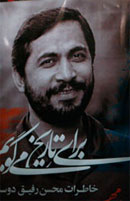
“I’m Talking for the Sake of History” is the title of an oral history book based on memories of Mohsen Rafigh Doust about the Sacred Defense and the Islamic Revolution.
IBNA: Addressing the unveiling ceremony of the book at the Art Bureau of the Islamic Development Organization, Hedayatollah Behboudi, director of the Islamic Revolution Literature bureau, stated that the book entails forthright memories of the events which led to the Islamic Revolution.
| |
|
|
Afshin Peyrovani interested in releasing his memoir
Afshin Peyrovani, a retired Iranian footballer and a football coach, is interested in releasing his memoir.
IBNA: Talking about the publication of sportsperson’s memories, Afshin Peyrovani said: “In Iran, unfortunately, the publication of footballer’s memoir isn’t common; while noted foreign footballers like Zinedine Zidane, David Beckham and Wayne Rooney have released books about their professional life which have been welcomed warmly indeed.”
| |
|
|
Iranian soccer player to write memoir
Persepolis team captain Mehdi Mahdavikia has intended to release his memories as a professional soccer player in Iran and Germany in a new book.
IBNA: Mehdi Mahdavikia has announced that he will end his soccer carrier next year to write a memoir of his 20 years as a soccer player in Iran’s national team, Persepolis and German teams. He has made the announcement despite strong requests from his supporters for his stay in the team for a further year.
| |
|
|
CZECH REPUBLIC: POLITICAL PRISONERS
Michal Louč and Tomáš Bouška report on ‘Political Prisoners’ a Prague-based, cross-disciplinary, unsubsidized research project.
‘The primary purpose of the project is to collect, analyze and disseminate the life stories of political prisoners who survived jailing in Stalinist prisons and working camps in the former Czechoslovakia and other European countries. Most of our narrators were jailed in the 1950s and 1960s but their traumatic experiences continued after they were released from prison and inevitably affected their families. We think their life stories can enrich our view of the Czechoslovak socialist dictatorship with new perspectives.
| |
|
|
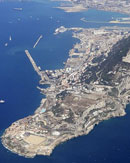
About 400 people will take part in Oral History of Gibraltar in the 20th Century
Dr Andrew Canessa (University of Essex) and Dr Jennifer Ballantine Perera (Gibraltar Garrison Library) are recipients of a major award from the UK Economic and Social Research Council for their project Bordering on Britishness: An Oral History of Gibraltar in the 20th Century. The project will officially start in September 2013 and finish in March 2017.
Bordering on Britishness will focus particularly on experiences of the border with Spain and at its root is the simple question: what does it mean to be Gibraltarian?
| |
|
|
Oral History Weekly Magazine Aims and Regulations
Oral History Weekly Magazine wishes to create a suitable place for thoughts and idea development; Its main field would be “Oral History” and subjects as telling & writing memoirs, writing diaries, travelogues, chronologies, and all other subfields of history which are presented in the form of news, articles, reports, notes, interviews and memoirs can be included. There is no limitation on the length of would-be-sent materials.
Mentioning the name, academic background and email is necessary. Articles with complete references and bibliography are more credited and an abstract would quite helpful.
Weekly is not about to publish any material consisting insults and libels about other people or anything that brings anxiety to public opinion. Weekly can edit and translate the received materials.
The published articles and materials are only the writer’s ideas and Oral History Weekly Magazine has no responsibility about their content.
|
|
|

The Organization of Basij Mostazafin (Mobilization of the Destitute) has introduced Seyyedeh Tahereh Hashemi, Abdolhamid Dyalameh and Soleiman Khater as the prominent martyrs of 1392 solar Hijri.

Ahmad Ahmad Memoirs (21)
Edited by Mohsen Kazemi
Soureh Mehr Publishing Company
(Original Text in Persian, 2000)
Translated by Mohammad Karimi
Prison No. 2, Row No. 4
Our deadline was going to be over and we were ready to go on hunger strike. Major Teymouri came and said: “Don not think that we are frightened of your threat; since there some room is being freed, we are taking you to Prison No. 3. However, 3 people should go to Prison No. 2. Thus, two people and I went to row No. 4 in Prison No. 2 and the rest were taken to Prison No.3.
They had transferred the INP leader and some central committee members to this row. Ayatollah Mohiyeddin Anvari, Sheik Fazlollah Mahalati and Haj Ali Noori were among other prisoners in this row who were completely aware of our resistance in Prison No. 1. When we entered they warmly welcomed us abd we became happy to see INP palls and seeing Mr. Bojnourdi alive.
Row No 4 of Prison No. 2 was a hard place and without facilities to live in. The only financial facility of there was the same 12 Rials for each prisoner to buy food. However, they would give two pieces of bread each day to each prisoner. The living for prisoners was hard there. Because of the limited chances for visiting the families and also their poorness, they were not able to afford any financial help either. |


|
|