| |
|
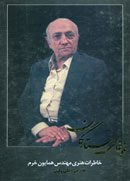
Went and not heard the sad tune of my song’s resonance…

In the evening of January 17, art and music world of Iran mourned in memory of one of the most distinguished professors and composers, Homayoun Khorram. Leading artist’s death gave us an opportunity to introduce his Memoirs to our dear readers. Recording the Memoirs of elite like him is an imperative for the next generation and we hope that all the artists and elite of our country consider it more than previous. Also, we hope that they make their story indelible for the people’s history before they pass away.

| |

|
|
Biography of martyred commander to be released
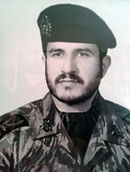
Mohsen Sadeghnia is currently working on a novel based on the life of martyred Sacred Defense commander Mostafa Pajouhandeh.
IBNA: Speaking with IBNA, Sadeghnia stated that he is working on a new book about the martyred commander with support from the University of Army Commanders. The work will be published by Soureh Sabz Publishing Company in Iran.
Pajouhandeh commandeered the 401 Telecommunications Division of the army during the Sacred Defense.
He also served at one of the divisions of the 58 Zolfaghar Corps during the war.
| |
|
|
The Persistence of Silence after Dictatorships-2
Students at El Morell High School similarly undertook an analysis of the interviews, although in their case it was of audiotaped, not videotaped, interviews. A number of interview excerpts have been selected for presentation in this section, and they exhibit characteristics similar to those observed at ORT school, as students sought to understand everyday life under dictatorship. These excerpts concern the intertwining nature of several aspects of everyday life: traditions and customs, religious festivities and the role of the Church, and sexuality.
| |
|
|
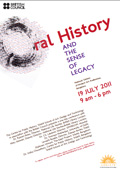
ASIA-INDIA: ORAL HISTORY AND THE SENSE OF LEGACY – A CONFERENCE IN BANGALORE
Indira Chowdhury and Rob Perks report on a conference organized by the Centre for Public History (CPH) at the Srishti School for Art, Design and Technology on the 19 July 2011.
‘The conference was held at the auditorium of the National Gallery of Modern Art, Bangalore, and brought together 160 participants from many parts of India, including Baroda, Lucknow, Kolkata, Chennai, Pondicherry, Mumbai and Hyderabad. Participants included academics, NGOs, college students, corporates and individuals.
| |
|
|
An Oral History of San Francisco’s Bay Bridge
After eleven years of construction, the Bay Bridge’s new eastern span is set to open to traffic this fall.
Meanwhile, the Regional Oral History Office (ROHO), part of University of California-Berkeley’s Bancroft Library, is soliciting stories from people who were there when the original Bay Bridge opened in 1936.
Sam Redman, a ROHO historian, recorded a number of interviews with folks who remember that time. He shared excerpts with KALW’s Steven Short.
“The clips that I’m sharing today are from people who happened to be in the Bay Area at the time,” said Redman, “people who were working on the bridge—Rosie the Riveters or tow truck drivers and engineers and other people that worked on the Bay Bridge.”
| |
|
|
Good Will Hunting: An Oral History
Fifteen years after the release of the movie that made them stars, Matt Damon and Ben Affleck—along with the rest of the cast and crew—reflect in their own words on how a long-shot film by two unknowns became one of Hollywood's biggest success stories.
It’s hard to remember life without Matt and Ben.
But there was a time—before Jason Bourne, before Bennifer, and, yes, before Gigli—when they were just two struggling actors from Cambridge. Then came their script about a bunch of kids from Southie scraping their way through life. The hook: One of them, Will Hunting, is a genius, a guy who wows MIT, humiliates Harvard grad students, and turns down job offers from the National Security Agency.
| |
|
|
Words of love and nostalgia: portrait of a Libyan poet
The revamped Libyan Center for Archives and Historical Studies in downtown Tripoli hosted a reading, “Echoes on the beaches of longing”, from one of the Libya’s elder poets this week.
Veteran poet Abderraouf Abdelmajid Bin Al-Amin came to share some of his more recent work in Arabic, drawn from his repertoire of thousands of verses, all a product of his lifelong obsession with words and their origins.
Attendance was low, but the warm welcome Bin Al-Amin received from the audience show he is a well-respected figure among the elder generation of Libyan intellectuals.
| |
|
|
Oral History Weekly Magazine Aims and Regulations
Oral History Weekly Magazine wishes to create a suitable place for thoughts and idea development; Its main field would be “Oral History” and subjects as telling & writing memoirs, writing diaries, travelogues, chronologies, and all other subfields of history which are presented in the form of news, articles, reports, notes, interviews and memoirs can be included. There is no limitation on the length of would-be-sent materials.
Mentioning the name, academic background and email is necessary. Articles with complete references and bibliography are more credited and an abstract would quite helpful.
Weekly is not about to publish any material consisting insults and libels about other people or anything that brings anxiety to public opinion. Weekly can edit and translate the received materials.
The published articles and materials are only the writer’s ideas and Oral History Weekly Magazine has no responsibility about their content.
|
|
|

"The Artistic Bureau of Western Azerbaijan Province will publish the memoirs 14 Iranian abducted pilgrims in Syria who live in the province in a book", says the Head of the Artistic Bureau of Western Azerbaijan Province Alireza Nowrouzi.

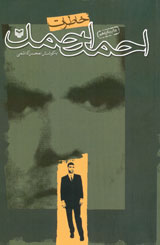
Ahmad Ahmad Memoirs (19)
Edited by Mohsen Kazemi
Soureh Mehr Publishing Company
(Original Text in Persian, 2000)
Translated by Mohammad Karimi
INP Members Trial
In late January, after a hundred days of silent in the press, the regime broadcasted the news about INP members arrest along with great propaganda. My picture was printed on the first page of Ettela’at and Keyhan newspapers (Documents no.1 & 2)
By the propaganda in the press, our pals found out the trials were so near. So, they gathered together and consulted each other about their defense in the court. It became almost clear for each of us how begin, rise and finish our defense. All of us agreed that each person should only defend himself and do not accept the deeds by others. So, the defense statements were supposed to be in written form. (1)
We all wrote our defense statements; each one was sharper than the other one. Since we were sure that we would not be executed, did not consider anything in our defense statements when explaining our ideas. It was believed that if we compromise and accept defeat, our defeat was the defeat of Muslims and betray to Islam. So, the pals considered it a must for themselves to defense seriously from their ideals to exemplify themselves for the other ones who may join the fight against the regime.
At the court it was clarified that the regime and its agents had thought we would not have anything to say; so they conducted the trail with the presence of a group of reporters. After some minutes they found what a big mistake they have done and impeded the reporters to enter the court and only few censored new items were published in the press.
On February 6th 1966, the first session of the trial for 55 members of INP was held in the Officers Club Amphitheatre at Jamshidiyeh Garrison. Brigadier General Taj-ud-dini was the judge and Colonel Atefi was the prosecuting attorney. They entered us to the room in a line. After some introductory affairs they read our accusations. Most of them were conducting attempts against the country’s security. The judge indicted death penalty for the eight members of central committee and for the rest three to ten years of imprisonment. We asked the central cadre to defend legally. Then the accused individuals read their defense statement. |


|
|