Lindsey Barnes and Kim Guise
Abstract: Many interpretative institutions today focus increasingly on narratives, storytelling, and the personal experiences of historical and everyday figures. Providing access to oral histories through a vocabulary focused on describing these stories and experiences is a unique and effective way to share these narratives. This article is a case study of the development of a controlled vocabulary for the oral history collections at The National WWII Museum.
Keywords: controlled vocabulary, The National WWII Museum, World War II
Storytelling has played a central role at The National WWII Museum since its opening as the D-Day Museum in New Orleans in 2000. The museum’s mission is to tell the story of the American experience in the war that changed the world—why it was fought, how it was won, and what it means today—so that all generations will understand the price of freedom and be inspired by what they learn. In 2003, Congress designated the museum as The National WWII Museum. In honoring the legacy of museum founder Stephen Ambrose, who was dedicated to giving voice to the citizen soldier and bringing to light the everyday experiences of men and women, the institution draws heavily on personal accounts, autobiographical materials, and oral histories to accomplish its mission.
The museum has expanded from one building to several and will quadruple in size by the summer of 2016. The museum hosts a growing collection of artifacts, images, documents, and more than seven thousand oral histories. In addition to gallery exhibits, we present traveling exhibitions, host conferences, lead educational tours, and produce documentaries and publications, both scholarly and popular. We are dedicated not only to preserving the artifacts, archives, and oral histories entrusted to us by donors but also to finding new ways to bring this material to life. The museum’s goal is to engage the public on a variety of levels and to create avenues to reach students, researchers, family members, general World War II enthusiasts, and casual visitors—attracting new audiences while engaging old friends.
Of the museum’s seven thousand oral histories, approximately one-third are video, one-third are cassette tape, and one-third are paper transcripts. The museum’s oral histories represent a wide array of World War II experiences with a heavy emphasis on combat stories collected for use in future exhibitions. Excerpts from interviews are used in many museum exhibitions and programs, but the majority of the interviews have not been seen or heard by the public.
The National WWII Museum embarked on an ambitious project in 2009, funded by the Institute of Museum and Library Services (IMLS), to explore innovative ways to navigate, describe, and present oral histories. Our partners on this National Leadership Grant, “Bringing Oral Histories to Life: Unlocking the Power of the Spoken Word,” were The Randforce Associates and National History Day (NHD). The project’s goal was to provide deep and meaningful access to our oral history collection for researchers and students of all ages, beginning with online access to 150 of the museum’s video oral histories.
Despite being a museum with a worldwide scope, we found that a general vocabulary to describe the oral histories in this project did not exist. The vocabularies in common use were not capable of the level of description our institution desired, since we wanted the public and our own staff to be able to search collections by navigating through personal stories. Instead of accessing interviews by searching through transcripts of oral histories, we hoped to provide access via small segments of the entire videos, each indexed using a vocabulary created specifically for this collection. The three overarching goals of the grant were to: (1) create a framework to allow museums and libraries to develop a meaningful vocabulary for oral history collections that enables detailed querying and exploring; (2) develop a model for users to access oral history collections in a flexible and interactive Web 2.0–based environment; (3) improve museum and library engagement with constituents.
Creating the vocabulary was only one aspect of the project. Below are the steps the museum completed to ensure the success of the entire grant:
1. Prioritized 150 oral histories for publication online by developing a matrix to account for diversity and range of stories.
2. Selected software in which to segment, annotate, and index. We chose an open-source solution, Annotator’s Workbench, originally created for use in ethnomusicology.
3. Created a collection-specific experiential vocabulary to aptly describe World War II narratives.
4. Developed standards for segmentation and annotation, as well as a handbook with guidelines for theory and workflow.
5. Segmented, annotated, and indexed 150 oral histories (about 300 hours of video). The museum chose to segment, annotate versus transcribe, and index all video segments.
6. Held focus groups with NHD teachers and students to assess the vocabulary and website.
7. Designed the website’s interface, developed the back-end database, developed video presentations, and created content delivery guidelines.
8. Produced thousands of teacher sourcebooks with our partner, NHD, that provide K–12 lesson plans based on the oral histories and website.
9. Addressed problems that arose while meeting the benchmarks above.
The project website (http://ww2online.org) provides users with the ability to tag, comment, and create their own collections. We hope that users will develop a greater intellectual and emotional connection to the museum’s oral histories through the opportunity to interact with selected video segments. User-applied comments and tags will further classify the videos in a personal way, adding a level of vernacular description to create a flexible and interactive Web 2.0–based environment.
A World War II Vocabulary Solution
As large, centrally themed collections grow within an institution, standard controlled vocabularies, such as the Library of Congress Subject Headings (LCSH) or the Thesaurus of Graphic Materials (TGM), can miss the more specific access points an institution wishes to provide. These and other standard vocabularies are imperative to provide access to large collections and across multiple institutions. Yet these terms often do not drill down to the specificity required to describe recurring events or experiences key to one’s institution. Supplementing standard vocabularies with local terms is now customary at most institutions, but the museum strove to move beyond standard access tools and create a vocabulary specific to the stories of people who experienced World War II. Our grant consultants, The Randforce Associates, helped us to create this new vocabulary, and our grant advisory board helped us to define its goals.
The challenge the museum faced stemmed from providing access into experiences. Creating a vocabulary to describe experience-based oral histories presented a different set of challenges than a vocabulary created to describe items or artifacts. Accurate description through the application of standard vocabulary terms was lacking, because often an interviewee is not discussing an item as if it were being identified in a photograph. The vocabulary needed to be more attuned to the particularities of narrative rather than static subjects. This meant including action words and verbs, such as experiencing, interacting, and overseeing, in the vocabulary terms. The experience, rather than the subject, becomes the search term. These terms provide the researcher with a better sense of what they can access within the museum’s collections of stories.
The Process of Creating a Vocabulary and Recommendations
Although the museum created a vocabulary for access to segmented oral histories, the process described below can apply to any institution interested in creating and applying a local vocabulary to any type of video. These recommendations can also be applied with the same efficiency to nonsegmented oral history collections or to videos that are not oral histories, such as ethnomusicology field recordings. It is our intent that this process helps all institutions interested in indexing video, regardless of the subject matter.
When creating a unique vocabulary, institutions should be fully aware of their audience. During the first steps of vocabulary creation, the team should remember its user base and how those users wish to access the collection. Our users include museum staff, K–12 students, museum members, World War II researchers, and artifact donors’ families. Audiences will most likely range from novices to experts, and therefore the vocabulary terms must be understandable across many levels of knowledge and searching expertise.
The chart (fig. 1) illustrates the process the museum took to create a controlled vocabulary specific to our oral history collection. The vocabulary team was led by the museum archivist, who worked closely with a curator and an oral historian and in cooperation with the entire oral history department. The museum’s oral historians conducted the majority of the interviews and were most familiar with the collection; therefore, their participation was key to understanding the breadth and depth of material.
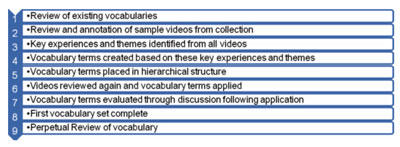
Fig. 1. Steps in creating a controlled vocabulary
Lindsey Barnes is the Senior Archivist and Digital Projects Manager at The National WWII Museum. She earned her master’s in library and information science from Louisiana State University. E-mail: Lindsey.Barnes@nationalww2museum.org.
Kim Guise is a Curator and Content Specialist at The National WWII Museum. She earned her master’s in library and information science from Louisiana State University. E-mail: Kimberly.Guise@nationalww2museum.org.
End of Part I, next week Part II would be presented.